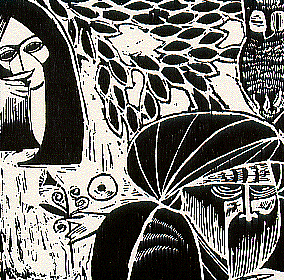
The Blind Owl
| After reading The Blind Owl, consider reading: |
|
"The Message of The Blind Owl" A Personal Note Analysis |
In life there are certain sores that, like a canker, gnaw at the soul
in solitude and diminish it.
Since generally it is the custom to relegate these incredible sufferings
to the realm of rare and singular accidents and happenings, it is not possible
to reveal them to anyone. If one does talk or write about them, people pretend
to accept them with sarcastic remarks and dubious smiles, while adhering
either to prevalent beliefs or to their own ideas about them. The reason
is that as yet man has not found a remedy for these sores; the only remedy
now is forgetfulness induced by wine or, artificial sleep induced by opium
and other narcotics. It is a pity, however, that the effect of these drugs
is transitory and that after a while, instead of soothing, they add to the
pain.
Will it come to pass one day that someone will penetrate the secrets of
these supernatural happenings and recognize this reflection of the shadow
of the soul which manifests itself in a coma-like limbo between sleep and
wakefulness?
I shall only describe one such incident which happened to me and which has
shocked me so much that I shall never forget it; its ominous scar will poison
my life throughout-from the beginning to the end of eternity where no man's
understanding can fathom. Did I say poisoned? Well, I meant to say that
I am scathed by it and will remain so for the rest of my mortal life.
I shall try to put down whatever I recall, whatever has remained in my memory
of the relations that connect the events. Perhaps I can make a universal
judgment about it. No. I want merely to become sure, or else to believe
it myself, because it is immaterial to me whether other people believe me
or not. Simply, I am afraid that I may die tomorrow but still not know myself,
because in the course of life experiences I have realized that a frightful
chasm lies between others and me. I also have realized that I should keep
silent as much as possible and that I should keep my thoughts to myself.
If I have decided that I should write, It is only because I should introduce
myself to my shadow--a shadow which rests in a stooped position on the wall,
and which appears to be voraciously swallowing all that I write down. It
is for him that I want to do an experiment to see if we can know each other
better, because since the time I severed my relations with the others, I
have wanted to know myself better.
Absurd thoughts! It may be so, but they torture me more than any reality.
Are not these people who resemble me, and who seemingly have the same needs,
whims and desires as I do--are they not here to deceive me? Are they not
shadows brought into existence merely to mock and beguile me? Isn't that
which I feel, see and measure imaginary throughout and quite different from
reality?
I write only for my shadow which is cast on the wall in front of the light.
I must introduce myself to it.
. . . . . . . . . . . . . . . . . . . . . . . . . . . . . .
In this base world, full of poverty and misery, for the first time
I thought a ray of sunshine had shone on my life. But alas, it was not a
sunbeam, rather it was only a transient beam, a shooting star, which appeared
to me in the likeness of a woman or an angel. And in the light of that moment,
lasting only about a second, I witnessed all my life's misfortunes, and
I discovered their magnitude and grandeur. Then this beam of light disappeared
again into the dark abyss into which it was destined to disappear. No. I
could not keep this transient beam for myself.
It was three months, no, it was two months and four days since I had lost
her, but the memory of her enchanting eyes, no, the attractive malice of
her eyes, remained in my life forever. How can I forget one who is so pertinent
to my life?
No, I will not call her by name, because she, with that ethereal body, slim
and misty, with those two large, wonder stricken, sparkling eyes behind
which my life was gradually and painfully burning and melting away, she
no longer belongs to this base, fierce world. No, I should not disgrace
her name with earthly things.
After seeing her I withdrew from the circle of people. I withdrew completely
from the circle of the fools and the fortunate; and, for forgetfulness,
I took refuge in wine and opium. I passed, and still pass, my life daily
within the four walls of my room. My whole life has passed within the confines
of four walls.
My daily occupation was the painting of pencase covers; my entire time was
dedicated to the painting of pencase covers and to the consumption of alcohol
and opium. I had chosen the ridiculous profession of pencase-cover painting
to kill the time.
By a lucky chance my house is located outside the city, in a quiet and restful
spot, away from the hustle and bustle of people's lives. Its boundaries
are well defined and around it there are some ruins. From beyond the ditch,
however, some low mud-brick houses are visible and the city begins there.
I do not know which madman or which ill-disposed architect built this house
in forgotten times, but when I close my eyes, not only all its nooks and
crannies materialize before my eyes but I feel its pressure on my shoulders.
It is a house that could have been painted only on ancient pencases.
I must write about all these events to assure myself that they are not figments
of my imagination. I must explain them to my shadow which is cast on the
wall. To begin with, before this incident there had remained for me only
one source of cheerfulness or of content. I used to paint on pencase covers
within the confines of the four walls of my room, and I used to pass the
time with this ridiculous amusement; but after I saw those two eyes, and
after I saw her, every work, every movement lost its inherent value and
meaning entirely. What is strange, however, and what is incredible is that,
for some reason, the subjects of all my painted scenes have been of the
same type and shape. I always used to draw a cypress tree under which an
old man, wrapped in a cloak, hunching his shoulders in the manner of the
Indian yogis, sat in a squatting position. He wore a shalma around his head,
and he put the index finger of his left hand on his lips as a sign of astonishment.
Opposite him a girl, wearing a long, black dress, was bending to offer him
a lily. She was bending because a brook intervened between them. Had I seen
this image before, or was it inspired in a dream? I do not know. I only
know that whatever I painted revolved around this scene and this same subject;
my hand drew this scene involuntarily. And still more incredible than this
is the fact that there were customers for this picture. I even used to send
some of these pencase covers to India in care of my uncle, who used to sell
them and return the money.
I do not recall it correctly, because this picture used to appear to me
to be distant as well as close by at the same time. Now I recall an incident.
I said that I must write down my recollections; but the writing of these
notes occurred much later. It has no relevance to the subject at hand. Although
it was to devote myself to writing that I abandoned pencase-cover painting.
Two months ago, no two months and four days ago, was the thirteenth day
of Farvardin. Everybody had rushed to the countryside. In order to paint
undisturbed, I had shut the window of my room. Around sunset, when I was
busy painting, the door suddenly opened and my uncle entered--that is to
say, he said he was my uncle. I had never seen him before because from his
early youth he had been on a distant journey. Perhaps he was a ship captain.
I thought he had some mercantile business with me, because apparently he
was a merchant as well. In any case, my uncle was a stooped old man who
wore an Indian shalma around his head and a yellow torn cloak on his shoulders.
He had covered his head and face with a scarf. His collar was open and his
hairy chest could be seen. One could count the hairs of his thin beard as
it protruded through his scarf. With his red, fistular eyelids and leprous
lip, he bore a very distant and ridiculous resemblance to me, as if my reflection
had fallen on a magic mirror. I had always imagined my father as looking
something like that. Upon entering, he retired to the corner of the room
and sat there in a squatting position. Thinking that I should prepare something
and offer it to him, I lit a light and entered the closet of my room. I
searched everywhere for something that would be suitable for an old man
to eat. This I did though I knew there was nothing in the house. There was
neither any opium nor any wine left for me. Suddenly the built-in niche
below the ceiling caught my eye. As if inspired, I recalled an ancient wine
flask that I had inherited. I think they had made the wine on the occasion
of my birth. The wine flask was In the niche. I had never thought of this
wine before. In fact I had forgotten that such a thing existed in the house.
To reach the niche, I put a nearby stool under my feet. But as soon as I
tried to pick up the wine flask, I was distracted by the following scene
through the air inlet in the niche: In the field behind my room a bent,
stooped old man was squatting under a cypress tree, and a young girl, no,
a heavenly angel was standing in front of him, bending to give him a black
lily with her right hand. The old man was chewing on the index finger of
his left hand.
Although the girl was located exactly opposite me, it seemed that she did
not pay attention to what was happening around her. She was looking without
seeing anything, and an unconscious, involuntary smile had dried to the
corner of her lips; it seemed as though she was thinking of an absent person.
It was from the stool that I saw her dreadful charming eyes, eyes which
were enchanting and reproachful at the same time. It was to the shining
and dreadful balls of those worried, threatening and inviting eyes that
my single beam of life was attracted, and it was to the depth of those same
eyes that my life was drawn and in them annihilated. This attractive mirror
drew my whole being to itself in a way unthinkable to any human being. Her
curved Turkmen eyes with their intoxicating supernatural beam frightened
as well as attracted. She seemed to have witnessed, with those eyes, supernatural
happenings beyond those any mortal could witness. Her cheeks were high,
her forehead wide, her eyebrows thin and connected and her lips meaty and
half open. Her lips seemed to have just finished a long, warm kiss with
which they were not yet satisfied. A tress of her disheveled, uncontrolled
black hair which framed her silvery face was stuck on her temple. The tenderness
of her limbs and the heedlessness of her ethereal movements bespoke her
transient nature. Only a dancing girl at an Indian temple could have her
harmonious gait.
Her placid form and her sorrowful happiness distinguished her from normal
human beings. Her beauty was not normal at all. She appeared to me like
an image in an opium hallucination. She induced the heated love of the mandrake
in me. She had a slim, tall body with a line symmetrically dividing her
shoulders, arms, breasts, buttocks and shins--it was as though she was separated
from her mate.
She wore a wrinkled, black dress which, fitting her well, stuck to her body.
When I saw her, she was about to jump over the brook which separated her
from the old man. She failed. The old man laughed hysterically. He had a
dry and repulsive laughter, a hybrid mocking laughter, which made one's
hair stand on end. His facial expression did not change. It was the resonance
of a laughter emerging from the depth of a hollow.
With the wine flask in my hand, I jumped off the stool out of fright. For
some reason I was shaking: a shiver in which fright and enjoyment were intermingled.
I felt as if I had jumped up from a pleasantly nightmarish dream. I rested
the wine flask on the ground and held my head between my hands. How many
minutes--hours? I don't know. When I came to, I took the wine flask and
reentered the room. My uncle had gone and the door of my room, like the
open mouth of a corpse, was left ajar. The ring of the old man's laughter
still echoed in my ears.
Even though it was getting dark, and the lamp was smoking, the effect of
the pleasant and frightful shiver that I had felt was not wearing off. From
this moment my life's direction changed. One glance was enough to bring
about the change, because that heavenly angel, that ethereal girl, touched
me more deeply than any human being would be able to comprehend.
I was not in full control of myself, and it seemed that I knew her name
from before. The evil in her eyes, her color, her scent and her movements
were all familiar to me. It was as though my souls, in the life before this,
in the world of imagination, had bordered on her soul and that both souls,
of the same essence and substance, were destined for union. I must have
lived this life very close to her. I had no desire to touch her; the invisible
beams that emanated from our bodies and mingled were sufficient for me.
Isn't this terrifying experience which seemed so familiar to met quite the
same as the feelings of two lovers who feel that they have known each other
before and that a mysterious relationship has previously existed between
them? Was it possible that someone else could affect me? The dry, repulsive
and ominous laughter of the old man, however, tore our bonds asunder.
I thought about this throughout the night. Several times I wanted to go
to the hole in the wall and look, but I was afraid of the old man's laughter.
The next day I was still thinking of the same thing. Was it possible for
we to give up seeing her entirely? The day after that, eventually, with
such fear and trepidation I decided to put the wine flask back in its place.
But when I pushed aside the curtain which covered the entrance to the closet,
and looked in front of me, I saw a dark, black wall, as dark as the darkness
which shrouds my whole life. I could not see any opening, crevice or hole
to the outside. The square hole in the wall was completely closed and it
had become part of the wall, as if it had never existed. I pulled the stool
to me, but no matter how hard I struck my fists against the wall and listened,
or how hard I looked at the wall in the light of the lamp, there was no
trace of a hole in the wall. My blows had little effect on the thick, massive
wall, now like a wall of lead.
Could I give all this up permanently? Yes, but everything was out of my
control. Like a soul under torture, no matter how much I waited, guarded,
or searched for her, it was all to no avail. Like the murderer who returns
to the scene of his crime, or like a chicken with its head cut off, I walked
all around outside our house, not for one day, but for two months and four
days. I walked around our house so much that I could recognize every rock
and pebble around there. I did not, however, find even a trace of the cypress
tree, the stream of water, or of the people I had seen there. For nights
on end I knelt on the ground in the moonlight, I wept and sought redress
from the trees, from the stones and from the moon which she may have looked
at, but I did not see any sign of her. On the contrary, I realized that
all these activities were useless, because she could not be related to the
substance of this world. For instance, the water with which she washed her
hair must have come from a unique and unknown spring, or from a magical
cave. Her dress was not made of the warp and woof of ordinary wool and cotton,
or sewn by hands made of natural elements, like ordinary human hands. She
was a distinguished creature. I realized that the lilies also were not ordinary
lilies. I became certain that if she were to wash her face in ordinary water,
her face would wither and if she were to pluck ordinary lilies with her
long and delicate fingers, like flower petals, her fingers would wither
as well.
I learned all these things. I found this girl, not this angel, to be a source
of astonishment and indescribable inspiration for me. Her substance was
delicate and intangible. It was she who created the sense of worship in
me. I was certain that the gaze of a stranger, or of an ordinary person,
would make her look shabby and withered.
Since the time when I lost her, since the time when a heavy wall, a solid,
moist dam as heavy as lead, was created between her and me, I have felt
that my life has become useless and confounded. Although her kind look,
and the deep pleasure that I drew from seeing her, were universal--she would
have no answers for me because she did not see me--nevertheless, I needed
those eyes, and only one glance from her was sufficient to solve all philosophical
difficulties and theological enigmas for me. After one glance from her,
there would remain no mystery or secret for me.
From this time on, I increased my drinking, I smoked more opium. But alas,
despite these remedies for hopelessness, which were meant to paralyze and
numb my thoughts, making me forget the thought of her, her figure and her
face materialized in front of me more strongly daily, hourly, by the minute.
How could I forget? When my eyes were open, or when I closed them, in sleep
and wakefulness, she was in front of me. Through the hole in the closet
of my room--as through a hole in the night that enshrouds people's thought
and logic--through the square hole which opened to the outside, she was
constantly in front of me.
I was not allowed to rest; how could I rest? I formed the habit of taking
promenades quite late--at sunset. For some reason I wanted, I felt I had
to find the stream of water, the cypress tree and the lily plant. In the
same way that I had become addicted to opium, I became accustomed to these
promenades; it was as though some force compelled me to them. All along
the way, all the time, I was thinking of her, recalling my initial glimpse
of her. I wanted to find the place where I saw her on the thirteenth day
of Farvardin. Were I to find that place, and if I could sit under that cypress
tree, surely some tranquility would appear in my life. But, alas, there
was nothing there but refuse, hot sand, the ribcage of a horse, and a dog
sniffing the top of the trash. Had I really met her? Never. I only saw her
stealthily, while hidden, through a hole, through an ill-fated hole in the
closet of my room. I was like a hungry dog who sniffs the garbage, who searches,
but who, as soon as people appear with more trash, runs away and hides himself
out of fear. Later he returns to seek his favorite pieces in the new trash.
I was in a similar situation, but for me the hole had been blocked up. To
me she was a fresh and tender bouquet of flowers thrown on top of a trash
pile.
The last evening that, like other evenings, I went on a walk, it was dark
and it felt like rain, A thick mist covered everything. In the rainy weather
which decreases the sharpness of colors, and diminishes the rudeness of
the lines of objects, I felt free and relaxed, as though the raindrops were
washing my black thoughts away. During this night, that which should not
have happened came to pass. During these lonesome hours, during those minutes
the duration of which I cannot recall exactly, I walked about involuntarily.
In spite of the fog, her vague and shocking face--like the picture on pencase
covers emerging from behind the clouds and smoke--her motionless, expressionless
face continued to materialize before my eyes much more powerfully than ever
before.
It was quite late at night when I returned. A dense fog was hanging in the
air, and I could not see the way clearly. But out of habit, and through
a special sense which was awakened in me, I arrived at my doorstep, where
I perceived that a black-clad figure, the figure of a woman, was sitting
on the platform of my house.
I struck a match to find the keyhole, but for some reason my eyes involuntarily
caught sight of the black-clad figure, and I recognized the two oblique
eyes--two large, black eyes amid a silvery thin face--the same eyes which
stared at a man's face without actually seeing. And I would have recognized
her, even if I had not seen her before. No. I was not deceived. This black-clad
figure was she. I stood there. I was petrified and felt like someone who
is dreaming, and who knows that he is asleep, but who cannot wake up when
he wants to. The match burnt itself, and then my fingers. Suddenly I returned
to reality, turned the key, opened the door, and drew myself aside. Like
someone familiar with the way, she got off the platform and crossed the
dark corridor. She opened the door of my room and entered. I, following
her, entered my room. Hurriedly I lit the lamp and saw that she had retired
to my bed and was now lying on it. Her face was in the shade. I did not
know whether she could see me or hear me. Her outward appearance showed
no trace of fear or of desire to resist me. It seemed as though she had
come here involuntarily.
Was she sick? Had she lost her way? She had come here unconsciously, quite
in the same way that a sleep-walker would. No living creature can imagine
the mental state I experienced at this moment. I felt a pleasant, yet indescribable,
pain. No. I was not deceived. That lady was this same girl who had entered
my room without being astonished, without uttering a word. I had always
imagined our first meeting to be like this. This state was like a deep sleep,
endless sleep for me; one has to be in a very deep sleep to have such a
dream. The silence was like an eternal life for me, because one cannot speak
at the beginning, or at the end of eternity.
To me she was a woman, and she had something supernatural about her. Her
face reminded me of the confounding oblivion of other people's faces so
strongly that upon seeing her my whole body began to shake, and my knees
gave way. At this moment, I saw the whole painful story of my life behind
her large eyes, her extremely large eyes, wet and glistening eyes, like
black diamond balls thrown into tears. In her eyes, in her black eyes, I
found the eternal night, the dense darkness I had been searching for, and
I plunged into its awesome, enchanting darkness. I felt as though some force
was being extracted from my being; the ground was shaking underneath my
feet. Had I fallen to the ground at that moment, I would have drawn an indescribable
pleasure from that fall.
My heart stopped. Fearing that my breath might make her disappear, as if
she were a piece of cloud or a puff of smoke, I restrained myself from breathing.
Her silence was like a miracle. It was as though a glass wall intervened
between us. This Moment, this hour, this eternity was choking me. Her weary
eyes, as if witnessing something extraordinary which others cannot see--as
if seeing death--were gradually closing. Eventually, her eyelids closed.
The intensity of the moment shook me as if I were a drowning man coming
to the surface for air. I wiped the perspiration from my forehead with the
edge of my sleeve.
Her face had the same calm and motionless expression but it looked smaller
and thinner. As she reclined she was chewing on the index finger of her
left hand. Her face was the color of silver, and through her thin, black
garment which fit her tightly one could see the outline of her legs, arms,
the two breasts, and all the rest of her body.
Since her eyes were closed, I bent in order to see her better. But no matter
how closely I observed her, it seemed that she was quite distant from me.
Suddenly I felt that I had no information whatsoever about the secrets of
her heart, and that there existed no relationship between the two of us.
I wanted to say something, but I was afraid that her ears, accustomed to
some distant, heavenly and soft music, might become hateful because of my
voice.
It occurred to me that she might be hungry or thirsty. I entered the closet
of my room in order to find something for her, although I knew that there
was nothing to be found in the house. But then, as If inspired, I recalled
that above, in the niche, I had a flask of old wine which I had inherited
from my father. I used the stool and brought the flask down. Tiptoeing carefully,
I went to the side of the bed. She was sleeping like a tired, exhausted
child. She was in a deep sleep and her long eyelashes, like velvet, were
closed. I took the cap off the flask and through her locked teeth, gently
poured a cup of wine down her throat.
For the first time in my life a feeling of sudden tranquillity had appeared,
because those eyes were closed. It seemed that the canker that tortured
me, and the nightmare that pressed my insides with its iron claws, had somewhat
subsided. I brought my own chair, placed it beside the bed and stared at
her face. What a childish face, and what a strange disposition! Was it possible
that this woman, this girl, or this angel of torture (because otherwise,
I didn't know what to call her), was it possible that she could have a double
life? To be so quiet, and to be so unceremonious?
Now I could feel the warmth of her body, and I could smell the damp scent
that rose from the heavy, black locks. My hand was not under my control,
but yet I raised it and caressed a lock of her hair with it, the lock that
was always stuck to her temple. Then I sank my fingers in her locks. Her
hair was cold and damp, cold, absolutely cold. It was as though she had
died several days ago. And I was not mistaken she was dead. I passed my
hand in front of her chest and placed it on her breast and her heart. There
was no sign of a heartbeat. Then I brought the mirror and held that in front
of her nose. There was not even a trace of life in her...
Intending to make her warm with the heat of my own body, to give her my
warmth and receive the coldness of death from her, hoping that in this way
I could possibly blow my own soul into her body, I took off my clothes,
climbed onto the bed and lay down beside her. We became stuck like the male
and female mandrake. To be exact, her body was like the body of the female
mandrake severed from its mate, and it had the same burning love of the
mandrake. Her mouth, acrid and bitterish tasted like the bitter end of a
cucumber. Her whole body had become cold, as cold as hailstones. I felt
my blood freezing in my veins, and the cold penetrating to the depths of
my heart. All my efforts being useless, I climbed off the bed and put my
clothes back on. Not it was not a lie. She had come here to my room, to
my bed and surrendered her body to me. She gave me her body, and she gave
me her soul--both!
While she was still alive, while her eyes were brimful with life, only the
memory of her eyes tortured me, but now, devoid of feeling and motionless
and cold, with eyes already closed, she came and surrendered herself to
me. With closed eyes!
This was the same creature that had poisoned my entire life; or maybe my
life was originally susceptible to being poisoned, and I could not have
had any life beside a poisoned life. Now here in my room she gave me her
body and her shadow. Her brittle, transient soul, which had no relation
to the world of earthly beings, slowly came out of her black, wrinkled dress--the
body that tortured her--and went away to the world of wandering shadows.
Perhaps it took my shadow with it as well. Her body, however, devoid of
any feeling or motion, was lying there. Her soft, lax muscles, her veins,
tendons and bones were waiting to rot. A delicious feast was prepared for
the worms and rats who dwell under the ground. In this adversity-stricken,
miserable room itself a grave, amidst the darkness of the eternal night
which was surrounding me, and which was sinking into the walls. I had to
pass an endless, long, dark and cold night beside a corpse--beside her corpse.
It occurred to me that from the beginning to the end of eternity, since
the beginning of my creation, a dead body, a cold, feelingless, motionless
corpse had shared my dark room with me.
At this moment my thoughts froze. A unique, singular life was created in
me, because my life was bound to all the existences that surrounded me,
all the shadows that trembled around me. I felt an inseparable, deep relation
with the world, with the movement of all creatures and with nature. All
the elements of myself and of nature were related by the invisible streams
of some mind-disturbing, agitating current. No thought or image was unnatural
for me. I could understand the secrets of the ancient paintings, the mysteries
of difficult, philosophical treatises, and the eternal foolishness of forms
and norms, because at this moment I was participating in the revolution
of the earth and the planets, in the growth of the plants, and in the activities
of the animal world. The past and the future, far and near, shared my sentient
life and were at one with me.
At such times everyone takes refuge in a strong habit, or in a scruple that
he has developed in his life: the drunkard becomes drunk, the writer writes,
the stone-cutter cuts stones, each giving vent to his anxiety and anger
by escaping into the strong stimulant of his own life. And it is in moments
like these that a real artist can create a masterpiece. But I, I who was
devoid of talent and who was poor, a painter of pencase covers, what could
I do? With these dry, glistening and lifeless pictures, all of which were
the same, as models, what could I paint that would become a masterpiece?
But in my whole being I felt an excessive upsurge of talent and warmth;
it was a special agitation and stimulus. I wanted to draw those eyes, which
were now closed forever, on a piece of paper and keep them for myself. This
sensation forced me to realize my wish, that is, I did not do this voluntarily--one
does not when one is imprisoned with a corpse. The thought of being imprisoned
with a corpse filled me with a special joy.
Eventually, I extinguished the lamp which was giving off smoke, brought
two candlesticks and lit them over her head. Against the flickering light
of the candle, her face assumed more repose, and in the interplay of the
light and darkness in the room, it acquired a mysterious, ethereal air.
I took some paper along with my working tools and went to the side of her
bed--this was her bed now. I wanted to copy this form, which was condemned
to a slow and very gradual disintegration, this form which seemed to be
devoid of motion and expression, without being disturbed. I wanted to record
its fundamental lines on paper. I wanted to choose from this face those
lines which would affect me. No matter how sketchy and simple a painting
may be, it must have an impact, and it must have soul. But I, who was accustomed
to printed paintings on pencase covers, now had to begin to think: I had
to materialize in front of me my own fancy, that is, that aspect of her
face which had influence upon me. I wanted to look at her face once, close
my eyes, and then draw on the paper those lines of her face that I would
choose. In this way, perhaps, using my own intellect, I could find a respite
for my tortured soul. In short, I took refuge in the world of lines and
shapes.
This subject was quite relevant to my lifeless method of painting--painting
with a corpse as a model. I was a painter of corpses. But her eyes, her
closed eyes--did I need to see them again? Was their imprint on my thought
and mind tangible enough?
I do not recall exactly how many times I copied her face, but none of my
reproductions was satisfactory. I tore them up as I finished painting them.
I neither felt tired because of doing this, nor did I feel the passage of
time.
It was about daybreak. A dull light had entered my room through the windowpanes.
I was busy working on a picture which, in my own opinion, was better than
the rest. But the eyes? The eyes, which had assumed a reproachful expression
as if I had committed unforgivable sins--I could not put those eyes down
on paper. Then suddenly, all the life and the memory of those eyes disappeared
from my mind. My efforts were useless. No matter how intensely I looked
at her face, I still could not recall its expression. At this same time,
I suddenly saw that her cheeks were reddening; they were a liver-red color
like the color of the meat in front of a butcher shop. She came to life.
Her exceedingly wide and astonished eyes, eyes in which all the brightness
of life was gathered and glimmering in a sickly light, her sick, reproachful
eyes very slowly opened and looked at my face. This was the first time that
she was aware of my presence. She looked at me and then, once again, her
eyes gradually closed. This event did not take more than perhaps a moment,
but it was enough time for me to capture the expression of her eyes and
put it on paper. I drew this expression with the sharp point of the brush,
and this time I did not tear up the picture.
Then I got up from where I was painting, walked slowly to her and stood
near her. I thought she was alive, that she had come back to life, and that
my love had invested my spirit with her body; but as I drew near, I sensed
the smell of a dead body--the smell of a decomposed, dead body. Small worms
were wiggling on her body, and two flies, the color of golden bees, were
circling her in the light of the candle. If she were completely dead, then
how did her eyes open? I don't know if I had seen this in a dream, or if
this was happening in real life.
I do not wish anyone to ask why, but my main concern was her face, no, it
was her eyes, and now these eyes were in my possession. I had the essence
of her eyes on paper. Her body, a body that was condemned to destruction,
to nourishing the worms and rats that dwell under the ground, was no longer
of any use to me. From now on she was under my control; I was no longer
her vassal. Every minute that I so desired, I could look at her eyes. I
took the painting with the utmost care, and put it into my own tin can,
where I keep my profits, then I hid the tin can in the closet of my room,
The night was moving on, tiptoeing stealthily. It seemed that it had sufficiently
recovered from its weariness. Soft, distant sounds, like the sound of a
fowl or a passing bird's dream or perhaps the whisper of the growth of the
plants, could be sensed. The pale stars were disappearing behind the mass
of clouds. I felt the gentle breath of the morning on my face, at the same
time I heard the crow of a rooster from afar.
What could I do with her body? It had already started to disintegrate First
it occurred to me to bury her in my room; then I thought of taking her out
and throwing her in a certain well around which black lilies have grown.
But all these plots, to prevent other people from seeing, entailed much
thought, labor and dexterity. Furthermore, since I did not wish any stranger
to look at her, I had to do all this alone and with my own hands. I was
not thinking of myself, because, after her, what else was there in living?
But as far as she was concerned, no ordinary human being, no one except
myself, should ever glance at her body. She came to my room, and she surrendered
her cold body and her shadow to me, in order to prevent others from seeing
her; in order not to become defiled by the looks of strangers. At last a
thought crossed my mind: if I were to chop her body up and put it in a suitcase--my
very own old suitcase--then I could take the suitcase out with me to a distant
place, far away from people's eyes, and bury it there.
This time I no longer hesitated. I fetched a bone-handled knife which I
had in the closet of my room and, very carefully, I first tore the thin
black dress which, like a spider's web, had imprisoned her within itself;
or should I say, I tore the only thing that covered her body. It seemed
to me that she had grown taller. Then I severed her head. Drops of cold,
coagulated blood poured out of her throat. I cut off her arms and legs,
then I arranged her whole body, torso and limbs, in the suitcase. As for
her dress, I covered her body with the same black dress. Finally, I locked
the suitcase and put the key in my pocket. When the job was complete, I
felt relieved. I picked up the suitcase and weighed it: it was heavy. Never
before had I felt so fatigued. Definitely no. I would never be able to carry
that suitcase out by myself.
It was cloudy once again, and a light rain was falling. I left the room
to look for someone who would help me carry the suitcase away. Not a soul
was to be seen anywhere near. When I paid more attention, a little farther
away from where I was, through the fog, I saw an old man who had hunched
his shoulders and who was sitting under a cypress tree. His face, over which
he had wrapped a wide scarf, could not be seen. Slowly I approached him,
but before I could utter a word, a hybrid, dry and repulsive laughter which
made my hair stand on end issued from the old man; then he said, "If
you are looking for a porter, I can help you. Were you looking for a porter?
I also own a carriage that I use as a hearse. Everyday I carry corpses to
Shah Abdul Azim and bury them there. I also make coffins. I have coffins
for every person's perfect measurements, not a hair off. I am ready myself--right
now!..."
He laughed so hysterically that his shoulders shook. With my hand, I pointed
in the direction of my house. Without giving me an opportunity to utter
a word, he said, "It's not necessary. I know where you live. Right
now. Shall we go?"
He got up from where he was sitting, and I started to walk towards my house.
I entered my room and, with great difficulty, brought the "dead"
suitcase to the front of the door. There, I saw a ramshackle old hearse
to which a pair of thin, black, skeleton-like horses were hitched. The old
man, shoulders hunched, was sitting up there on the driver's seat. He had
a long whip in his hand, and he did not turn to look at me. With difficulty
I placed the suitcase in the carriage, in the middle of which there was
a special place for putting coffins. Then I climbed into the carriage and
laid myself down in the middle of the place intended for coffins. I placed
my head on the edge of this place so that I could see the surrounding scenery.
Finally I slid the suitcase towards me, rested it on my chest, and held
it tightly with both hands.
The whip whistled through the air, and the horses, whose labored breath
issued through their nostrils like columns of smoke in rainy weathers began
to move with long but gentle leaps. Their slim forelegs, like the hand of
a thief severed of its fingers by law and plunged into hot oil, struck the
ground gently and noiselessly. In the damp air, the sound of the bells on
their necks had a special ring. An indescribable relief, the cause of which
I did not know, had filled me from head to toe so thoroughly that I could
barely feel the movement of the hearse. The only thing that I felt was the
weight of the suitcase on my chest.
Her dead body, her corpse. It seemed as though this weight had always been
pressing on my chest. A thick fog covered the scenery on the sides of the
road. The hearse was passing mountains plains and rivers with a special
speed and comfort. Around me now a new and unique scene, one that I had
seen neither in a dream nor in wakefulness, came to view. On both sides
of the road there were mountains with serrated, jagged tops and strange,
suppressed, cursed trees. From among the trees grey, triangular, cubic and
prismatic houses with dark, low windows lacking any panes, were visible.
These windows resembled the giddy eyes of one who is experiencing a delirious
fever. I don't know what these walls had in them which enabled them to transfer
their coldness and chill into a man's heart. Since no living being could
ever dwell in those houses, they could only have been built to accommodate
the shadows of ethereal beings.
Apparently either the carriage driver was taking me along a special road
or he was taking a by-road. In some places the road was surrounded only
by hacked tree trunks and crooked, bent trees. Behind the trees there were
high and low geometrical houses--some conic, others in the shape of truncated
cones. All the houses had narrow, crooked windows--from within which black
lilies grew, clinging to the doors and walls. Then, suddenly, the whole
scene disappeared under a thick fog. Pregnant, heavy clouds were hugging
and pressing the mountain peaks, and drops of rain, like wandering particles
of dust, were floating in the atmosphere. After traveling for quite some
time, the hearse stopped near a high, arid mountain. I slid the suitcase
away from my chest and got up.
Behind the mountain there was a secluded, quiet and pleasant spot, a place
that even though I had not seen or recognized it, seemed to be quite familiar--it
was not beyond my imagination. The surface of the ground was covered with
scentless black lily plants as if until now no mortal had set foot on that
ground. I put the suitcase down. The old carriage driver, turning his face
away from me, said, 'This place is near Shah Abdul Azim. There is no place
better for you than here. Not even a bird can be found here. Isn't that
right!..."
I put my hand into my pocket to pay the carriage driver, but all the money
I had in my pocket was two qerans and one 'abbasi. The carriage drivers,
uttering a disgusting laugh, said, 'Forget it. Pay me later. I know where
you live. Anything else I can do for you? Let me tell you--as far as digging
graves is concerned, I am quite experienced, you understand? Don't be shy!
Let's go right over there near the river, by that cypress tree. I shall
dig a ditch the size of the suitcase for you, and then I will leave.'
The old man, with an agility the like of which I could not imagine, jumped
down from his seat. I picked up the suitcase and together we walked to a
tree trunk, on the edge of the dry riverbed. Then he said, 'Is this place
good?'
Without waiting for an answer, he began digging the ground with his pick
and shovel. I put the suitcase on the ground and watched him with astonishment.
The old man was going about his job with the agility and dexterity of an
expert. While digging, he found something resembling a glazed jar. He wrapped
the jar In a dirty handkerchief then he got up and said, 'And here is the
ditch. It is exactly the size of the suitcase, not a hair off!'
I put my hand in my pocket to pay him. All I had was two qerans and one
'abbasi. The old man uttered a ghastly laugh and said, 'Don't bother. Forget
it. I know where you live. Besides--for my wages I found a jar. It is a
Raq jar from the ancient city of Ray.'
Then he laughed so hard that the hunched shoulders of his doubled-up body
shook. He put the jar, wrapped up in a dirty handkerchief, under his arm,
walked towards the hearse, and with a special agility climbed up onto the
seat. The whip sounded through the air, the panting horses began to walk.
In the damp air, the sound of their bells had a special ring. The carriage
gradually disappeared into a dense fog.
Once alone, I felt relieved, as though a heavy burden had been removed from
my chest. A pleasant tranquility enveloped me from head to toe. I looked
around. I was in a small area, confined by pitch black hills and mountains.
On one mountain range there were some ruins and ancient buildings made of
thick bricks. A dry riverbed could also be seen in that vicinity. It was
a cozy, secluded and quiet place. I was extremely happy, and I thought that
when those large eyes woke from their earthly slumber, they would find this
place suitable to their structure and mood. Besides, this girl had to be
away from other people's dead, in the same way that she lived her life away
from other people.
I picked up the suitcase carefully and put it in the middle of the ditch.
The ditch was exactly the size of the suitcase, not a hair off. Then, for
the last time, I wanted to look into it--into the suitcase--one more time.
I looked around. Not a soul could be seen. I took the key out of my pocket
and opened the suitcase. But when eventually I pushed the edge of her black
dress aside, there, amid the coagulated blood and wiggling worms, I saw
two large black eyes, two expressionless eyes, fixed on me. My life had
sank to the depths of those eyes. Hastily, I closed the suitcase and covered
it with dirt; then I walked on the dirt until it was well packed. Next,
I fetched some of those scentless black lilies and placed them on her grave.
Then I fetched some rocks and sand and strewed them on the grave to obliterate
all traces completely so that no one could distinguish it. I accomplished
this task so well that even I could not distinguish her grave from the rest
of the ground.
When my work was finished, I looked at myself. To my clothes, which were
soiled and torn, a black piece of coagulated blood was stuck. Two flies,
the color of golden bees, were flying around me, and small worms, wiggling
among themselves, were stuck to me. Then I tried to clean the bloodstain
off the tail of my garment. The more I wetted my sleeve with saliva and
rubbed it onto the stain, the more the bloodstain expanded assuming a darker
color. Soon the stain covered my whole body, and I felt the chill of the
coagulating blood on me.
It was near sunset. A light rain was falling. Involuntarily, I began to
walk, following the tracks of the hearse; but as soon as it grew dark I
lost trace of the carriage tracks. Aimlessly, thoughtlessly and involuntarily
I walked slowly in a thick, tangible darkness towards an unknown destination.
I had lost her, I had seen those large eyes amid the coagulated blood, and,
I was walking in a dark night, in the deep darkness that had shrouded my
entire life, because the two eyes that had served as my life's beacon were
extinguished forever. It was thus immaterial whether I would arrive at a
place or an abode; perhaps I would never arrive at any destination.
An absolute hush covered everything. I felt that everyone had abandoned
me. I took refuge in the lifeless universe. Among the cycle of nature, the
deep darkness which had descended on my soul, and me, a relationship was
established. This silence was a language incomprehensible to mortals. The
intensity of the intoxication made me dizzy; I felt like vomiting. My feet
began to give out and I felt extremely weary. I walked into the graveyard
which was on the side of the road and sat on a tombstone there. I took my
head in my hands, puzzled about my own situation. Suddenly the echo of a
dry, repulsive laughter jolted me back into reality. When I turned in the
direction of the sound and looked, I saw a figure whose head and face were
wrapped in a scarf. The figure, who was sitting beside me, was carrying
an object wrapped in a handkerchief under his arm. He turned his face toward
me and said, 'I bet you were going to town, and you lost your way, huh?
Perhaps you are asking yourself what I am doing in the graveyard this late
at night! But rest assured, my calling is dealing with the dead. I am a
gravedigger by profession, huh? I know every inch of this place. For instance,
right today I went to dig a grave, and I uncovered this jar. Do you realize
that this is a Raq jar, that it is from the ancient city of Ray, huh? Let's
assume it's a useless jar. I give it to you to keep as a souvenir from me,
o.k.?
I put my hand in my pockets took out two qerans and one 'abbasi to offer
him. The old man, with a repulsive, dry laugh, said, 'No, forget it! I know
you. I know where you live. Look, I have a hearse right around the corner.
Let me take you home, Huh? It's only a couple of steps away.'
He placed the jar in my lap and rose. He laughed so violently that his shoulders
shook. I picked up the jar and began to follow that old man's doubled-up
figure. At the turn in the road, a ramshackle hearse with two meager black
horses was standing. With amazing agility, the old man climbed up the hearse
and sat down on the seat. As for me, I entered the carriage and lay down
in the special place made for coffins. I placed my head on the high edge
so that I could see the scenery. I put the jar on my chest and held it tightly.
The whip whistled through the air, and the horses, panting, began to move
with long and gentle leaps. Their hooves touched the ground softly and noiselessly.
In the damp air, the sound of the bells on their necks had a special ring.
From behind the clouds, the stars, like the balls of some glistening eyes
emerging from amid clotted blood, watched over the earth. A pleasant relief
filled me; only the jar, like the weight of a corpse, pressed on my chest.
In the darkness, fearing that they might slide and fall, the intertwined
trees with their twisted branches seemed to be holding each other by the
hand. Along the side of the road, there were some strange houses with distorted
geometrical shapes and a few black windows. An evil, dull radiance like
the light from a glowworm, emanated from the walls of these houses. In an
awe-inspiring scene, the trees were passing by in groups and clumps, escaping
one after the other. It seemed, however, that the lily stalks became tangled
in their legs and feet and made them fall to the ground. The smell of dead
bodies, the smell of decomposed flesh, had filled my soul as if that smell
had always been penetrating my body and as if I had passed all my life lying
in a black coffin, being carried about amid mist and hovering shadows by
a stooped, old man whose face I could not see,
The hearse came to a halt. I picked up the jar and jumped down. I was in
front of my house. I hurried into my room, put the jar on the table, picked
up the tin can, the same can which served as my piggy bank and which I had
hidden in the closet of my room. I came to the door to give the tin can
to the old carriage driver instead of a reward. But he had disappeared.
There was no sign of either him or his carriage. Disappointed, I returned
to my room, lit the lamp, took the jar out of the handkerchief and, using
my sleeve, cleaned the dust off of it. The jar had an ancient, transparent
purple glaze which had been transformed into the color of a crushed bee;
on one side of its body, in the form of a diamond, there was a border of
black lilies, and in the middle of it her face was in the middle of the
diamond frame. It was the face of a woman whose eyes were black and large,
eyes larger than normal; her eyes reproached me as if I had committed some
unforgivable crime of which I was not aware. She had spell-binding eyes
which were simultaneously worried, perplexed, threatening and hope-inspiring.
Her eyes were timid, yet attractive; an intoxicating, supernatural light
shone from their depths. She had prominent cheeks, a wide forehead, slender
and connected eyebrows, full, half-open lips, and disheveled hair, a strand
of which was stuck to her temple.
I took the picture that I had painted of her the previous night out of the
tin can and compared the two; my picture was not even slightly different
from the picture on the jar --they were pictures of each other, you could
say. They were identical and they were both painted by an unfortunate painter
of pencase covers. Perhaps, at the time of the painting, the spirit of the
painter of the jar had entered my body and taken possession of my hand.
The paintings were not distinguishable; however, my picture was on a piece
of paper, while the painting on the jar had a transparent ancient glaze
which imparted a mysterious air, an unusual, strange soul, to that picture.
In the depths of her eyes, the flames of an evil soul were glowing. No,
it was incredible. She had the same large, thoughtless eyes, the same secretive
disposition; she, however, was free! No one could comprehend my feelings
at this moment. I wanted to run away from myself. Could such a thing really
happen? Once more all of my life's misfortunes materialized in front of
my eyes. Weren't the eyes of one person enough in my life? Now two people
were looking at me. Two people were looking at me through her eyes. No,
this was absolutely unbearable. The eyes which were buried near the mountain,
by the trunk of the cypress tree on the edge of the dry riverbed the eyes
which were underneath black lilies, amid thick blood, in the middle of the
feast of the beasts and insects; the eyes which before long, plant roots
would penetrate and suck; these same eyes, brimful of vigorous life, were
looking at me!
I had never imagined myself to be so unfortunate and damned. Nevertheless,
at the same time, because of a latent guilt, I felt an unjustifiable, strange
sense of pleasure, for I realized that I had an ancient fellow-sufferer.
Wasn't this painter of ancient times, who hundreds or perhaps thousands
of years ago had painted this picture on this jar, wasn't he a fellow-sufferer
of mine? Had he not passed these same stages that I am passing? Until this
moment I had thought myself to be the most wretched of all creatures, but
now I realized that at some time on those mountains, in those ruined houses
and habitations built of heavy brick, among those people whose bones have
rotted and whose limbs have turned into particles of living black lily plants--I
realized that among them there had lived an afflicted painter, a damned
painter; perhaps among them an unfortunate painter of pencase covers had
lived--one exactly like me. I realized this. Only I could understand that
he, too, had been burning and dissolving amidst two large, black eyes, exactly
like me. This realization comforted me.
Finally, I put my painting beside the painting on the jar. Then I went out
of the room and prepared my own special pot of fire. When the charcoal turned
red, I brought the pot of fire inside and placed it in front of the paintings.
I gave several pulls to the opium pipe, and in a state of ecstasy I stared
at the pictures; I was trying to concentrate, and only the ethereal smoke
of opium could concentrate my thoughts and create a relief from them.
I smoked all my remaining opium so that this strange narcotic agent would
dispel all the difficulties and would push aside the veils which covered
my sight; could it dispel all these dense, distant, grey recollections?
The state I was expecting appeared; it was beyond my expectations. Gradually
my thoughts grew exact, large and enchanting, and I entered a state of half-sleep,
half-coma.
Soon, I felt that the pressure and the weight on my chest were removed,
as if the law of gravity no longer existed for me. I was flying freely in
pursuit of my thoughts, which were now large, delicate and precise. A profound,
indescribable pleasure filled my being from head to toe, and I was relieved
from the burden of my binding body. I was in a world that was quiet but
full of enchanting and delectable shapes and colors. Then the train of my
thoughts was interrupted and the remainder was dissolved in these colors
and shapes. I was drowning in waves,, waves which were caressing and ethereal.
I could hear my heart beat, and I could feel the blood moving in my veins.
This was a very meaningful and intoxicating moment for me.
From the bottom of my heart I wanted and wished to give myself up to the
inactivity of oblivion. If such an oblivion were available; if it could
be enduring; if when my eyes closed, beyond sleep, they would enter utter
nothingness so that I could not feel my existence; if it were possible for
my existence to become dissolved in a black stain, in a musical note, or
in a colorful beam of light; if these colors and shapes would become larger
and expand until they disappeared--then my wishes would be fulfilled.
Gradually, a state of sluggishness and numbness overtook me; it was like
a pleasant fatigue or like delicate waves flowing from my body. I felt that
my life was passing in reverse. Gradually, the stages and events of the
past, and my own obliterated, forgotten childhood reminiscences, advanced
before my eyes. I was not only observing, I was participating in these events;
I could feel them. I was rapidly growing smaller and younger; then suddenly
my thoughts grew dark and vague. It seemed as though all my existence hung
at the end of a thin hook; I was suspended at the bottom of a deep, dark
well. Then I was unhooked. I was sliding and falling down without encountering
any obstacles. It was a never ending abyss in an eternal night. After that,
some vague and obliterated veils took shape in front of my eyes, and I experienced
a moment of utter oblivion. When I came to, suddenly, I found myself in
a small room, in a special position, a position which seemed strange, yet
at the same time, natural.
The new world to which I awoke, with its environs and its modes of life
and activity, was thoroughly known and close to me. This world was so familiar
that I could even say I felt more at home in it than I had in my previous
life and its environs. In a way this was an echo, or a reflection, of my
previous life. Although a different world, it was so near and relevant to
me that I thought I had returned to my original environment. I was reborn
in an ancient world which was both closer and more natural to me.
Dawn was breaking. A tallow burner was burning on the mantle in my room,
and a quilt was spread in the corner. I was not asleep, however. I felt
that my body was hot and that blood stains were stuck to my cloak and scarf.
My hands, too, were stained with blood. But in spite of restlessness and
excitement, a feeling stronger than the desire to obliterate the traces
of blood, even stronger than the thought of being picked up by the magistrate,
was generated in me. Besides, I had been waiting to be picked up by the
magistrate for a long time now. I decided, however, to finish the poisonous
wine from the cup in the niche with one gulp. The need to write had now
become a compulsion. I wanted to drag out the fiend which tortured my soul.
I wanted to record all that I had wanted to say but had refrained from saying.
At last, after a moment of hesitation, I pulled the tallow burner closer
and began to write as follows:
. . . . . . . . . . . . . . . . . . . . . . . . . . . . . .
I always thought forbearance from speech was the best of things. I thought
that one should, like a bittern, spread his wings on the shore of the sea
and, sit alone there. But now I am no longer in control, because that which
should not have happened has come to pass. Who knows? Perhaps immediately,
or perhaps an hour from now, a group of drunken night watchmen will come
to apprehend me. I have no desire whatsoever to save my carcass. Even if
I obliterate the blood stains, there is little room left for denial. Before
they lay their hands on me, however, I will drink a cup of the wine in that
wine flask; a cup of my own inherited wine which I placed in the niche.
Now I want to press my entire life, as if it were a bunch of grapes, in
my hands; and I want to pour its essence, no, its wine, drop by drop, like
water containing the holy dust of Mecca, into the dry throat of my shadow.
All I want to do before I go is to record on paper all the sufferings which
have, like consumption or leprosy, eaten away at me in the corner of this
room. In this way, I think, I will be able to arrange and organize my thoughts
better. Do I intend to write a will? Never. I do not own any property that
the government can confiscate, nor do I profess a faith which Satan can
take away. Besides, what on earth is there that could have the least value
for me? That which is usually referred to as "life" I have already
lost; I allowed this, and I wanted it to be lost. And after my departure,
what the hell, I don't give a damn if anyone does or does not read my tattered
notes! I am writing only because this drive to write has become a necessity
for me. I am in need--I am in need more than ever before to relate my thoughts
to my imaginary creature, to my shadow: that same ominous shadow which is
bending on the wall in front of the tallow burner and which seems to be
reading, carefully swallowing whatever I write. This shadow definitely has
a better sense of perception than I. Only with my shadow can I hold a meaningful
conversation. He is the one who makes me talk. Only he can know me. I am
certain that he understands... I want to pour, drop by drop, the essence,
no, the bitter wine of my life into my shadow's dry throat and say to him,
"This is my life!"
Whoever looked at me yesterday saw a distressed, ailing youth; but if he
looked at me today, he would see a stooped old man with white hair, sore
eyes and a leprous lip. I am afraid to look out of the window of my room
or to look at myself in the mirror, because everywhere I see a multiplicity
of my own reflections. To be able to describe my life for my stooped shadow,
I must narrate a story. Oh, there are so many stories about childhood days,
loves, acts of copulation, weddings and deaths and not a grain of truth
in any of them. I am tired of telling stories and of fanciful phraseology.
I shall try to press this cluster, but whether there will be the slightest
bit of truth in it, I do not know. I do not know where I am; I do not know
whether the patch of sky above my head, or the few spans of ground on which
I sit, belongs to Nishapur, to Balkh or to Benares. Anyway, I trust nothing.
In the past, I have seen so many contradictory things and have heard so
many inconsistent speeches; my sight--this thin yet hard substance behind
which the soul abides--has rubbed itself over so many surfaces that now
I do not believe anything. I doubt the weight and the permanence of objects
as well as the visible and manifest facts that relate to this very moment.
For example, if I were to touch the stone mortar in the corner of our yard
and ask it, "Are you stationary and firm?" and it were to respond
in the affirmative, I am not sure whether I should believe it or not.
Am I a distinct, singular being? I don't know. However, when I looked into
the mirror just now, I did not recognize myself. No, that "I"
of previous times is dead; it has disintegrated. Between us, however, there
exists no physical obstruction or obstacle. I know I should narrate my story,
but I don't know where to begin. All of life is made up of stories and tales.
I must press the cluster of grapes and pour its essence, spoon by spoon,
down the dry throat of this old shadow.
It is difficult to know where to begin, because all my restless thoughts
at this moment belong to this moment. They know no hour, minute or history.
For me, something that happened yesterday might be more ancient, or less
effectual, than an event which took place a thousand years ago.
Perhaps the reason for the appearance of all these reminiscences is the
fact that all my relations with the world of the living are now severed--past,
future, hour, day, month and year are all the same to me. These stages would
be meaningful for the ordinary people, for the rabble--yes, that is exactly
the word I was looking for--rabble with two b's. These stages apply to the
rabble whose lives have recognized seasons and limits, such as the divisions
of the year, and who live in the temperate zone of life. My life, on the
other hand, my entire life, has had one season and one state. Even though
a constant flame burns in the center of my body and melts me away like a
candle, my life seems to have passed in a cold zone and in an eternal darkness.
My life is gradually melting away in the middle of the four walls that create
my room, amid the strong fortification that is built around my life and
thoughts. No, I am mistaken. My life is like a fresh stump of wood lying
at the side of a tripod: it is scorched and charred by the fire of burning
wood, but it neither burns thoroughly nor stays fresh and green--the smoke
and the fumes suffocate it.
Like all other rooms, my room, made of sun-dried and baked bricks, is built
on the ruins of thousands of ancient houses. It has a whitewashed interior
with a strip of inscription. It is exactly like a grave. The smallest details
of my room, like the spider in the corner, for instance, are sufficient
to occupy my thoughts for many long hours. Since the time that I have become
bedridden, they do not pay very much attention to me. The horse-shoe nail
which is hammered into the wall is the supporting nail of my cradle and
possibly the cradles of many other children. A short distance below this
nail, a piece of the plaster has fallen off the wall. From this exposed
crevice the smell of objects and creatures who previously occupied this
room can be scented to such an extent that no current or breeze has been
able to dispel the stink of these stagnant, lazy and dense odors: the smell
of bodily sweat, the smell of past sicknesses, the smell of bad breath,
the smell of rancid oil, of rotting mats, of burnt omlettes, the smell of
mallow, the room-smell of a boy just beyond puberty, smells that have come
in from the outside as well as dead smell or dying smells--all these smells
are fresh and have retained their distinctive qualities. There are, however,
many other smells which, although their sources are now unknown, have left
their imprint on this room.
My room has one dark closet and two windows to the outside--to the world
of the rabble. One of the windows opens onto our own courtyard, the other
onto the street. Through this window and that street I am connected with
the city of Ray, the city which they call the bride of the world and which
has thousands of streets, alleys, unpretentious houses, madrasahs and caravanearies.
This biggest city of the world breathes and lives behind my room. Here,
in the corner of my room when I close my eyes, the scrambled shadows of
the city, those which have affected me, including its mansions, mosques
and gardens, all materialize before my eyes.
These two windows connect me with the outside world, the world of the rabble;
but in my room there is a mirror on the wall in which I look at my own face.
Considering how limited my life is, a mirror is much more important to me
than the world of the rabble, a world with which I have no business.
Of all the scenery of the city, in front of my window there is a butcher
shop which uses two sheep a day. Each time I look out of the window I see
the butcher. Early every morning, two black, gaunt packhorses--consumptive
horses who cough heavily and whose skeleton-like forelegs end in hoofs as
though, following some severe natural order, their forelegs had been cut
off and the stumps plunged into boiling oil--these horses, with carcasses
hanging on each side, are brought to the front of the shop. The butcher
strikes his hennaed beard with his greasy hand, then, with a buyer's eye,
he appraises the carcasses, chooses two of them, weighs their fat tails
in his hand and takes them and hangs them on the hooks in his shop. Breathing
heavily, the packhorses move on. The butcher rubs and caresses the bloodstained,
slit-throated bodies whose eyes are transfixed and whose bloodstained eyelids
seem to emerge from the middle of their black skulls. He takes a bone-handled
knife, carefully cuts their bodies up into pieces and sells the lean meat
to his customers with a smile. And with what pleasure he performs all this!
I am certain that he draws special pleasure and intoxication from this.
The burly yellow dog who has dominated our locale, and who constantly begs
the butcher with submissive and innocent-looking eyes, that dog also knows
all this. He, too, knows that the butcher enjoys his profession
A little distance farther away, under an archway, there sits a strange old
man who has spread a display cloth in front of him. On display he has placed
a sickle, two horseshoes, several types of colored beads, a long-bladed
knife, a mousetrap, a rusted pair of pliers, a dropper for adding water
to inkpots, a gap-toothed comb, a trowel and a glazed jar covered by a dirty
handkerchief. I have watched this old man for hours, days and months. He
always wears a dirty scarf and a cloak made in Shushtar; his collar is open
and through it the white hair of his cheat protrudes. With a talisman attached
to his arm, and fistular eyelids afflicted by some stubborn, shameless disease
that eats at them, he sits in that same position day after day. But on Thursdays,
in spite of his yellow or missing teeth, he recites the Qur'an. This seems
to be how he makes his living, for I have never seen anyone buy anything
from him. It seems that this man's face has been a part of every nightmare
I have ever had. What stubborn, foolish thoughts, like weeds, emanate from
behind his narrow forehead or from his close-cropped head, on which there
is a protuberance and around which he wraps a yellowish turban? There seems
to be a special relationship between the old man's life and the assortment
of wares displayed in front of him. Several times I decided to go and talk
with him or to buy something from his display, but I did not dare.
According to my nanny, this man, in his youth, had been a potter. Now that
he earns his living as a retailer, however, he has kept only this one jar
for himself.
These were my links to the outside world. Now the world inside: the only
people left for me were a nanny and a whore of a wife. But nanny is her
nurse as well. She is the mother of the two of us. For not only were my
wife and I close relatives, but granny breastfed us together. In principle,
her mother was my mother as well, because I never saw my own parents. It
was her mother, that tall lady with grey hair, who brought me up. I loved
her mother like my own, and it was because of this love that I married her
daughter.
I have heard several different stories about my parents. Only one of them,
however, the one that nanny told me, do I imagine to be true. Nanny told
me that my father and uncle were twins; both of them had the same face,
the same physiognomy and the same disposition; even the quality of their
voices was similar, so much so that they could not easily be distinguished
from each other. Furthermore, such an intrinsic bond and sense of mutual
sympathy existed between them that if one became ill, the other became ill
as well. They were, as they say, the spitting image of one another. Anyway,
they both chose to be merchants and, at the age of twenty, they went to
India. They took Ray goods such as different types of material, shot silk,
printed cloth, cotton cloth, jobbas, shawls, needles, ceramic bowls, fuller's
earth and pencase covers to India and sold them there. Apparently my father
stayed in the city of Benares, and he sent my uncle to the other cities
of India for commercial enterprises: after some time my father fell in love
with a virgin, a Bugam Dasi girl, a dancer at the temple of the Linga. This
girl's profession required that she perform religious ritual dances in front
of the large Linga as well as take care of the temple. She was a warm-hearted
girl with olive-colored skin, lemon-shaped breasts, large, slanted eyes,
and narrow connected eyebrows between which she wore a red beauty-mark.
Now I can imagine Bugam Dasi, that is to say my mother, dancing with measured
and harmonious movements to the tune of sitars, drums, lutes, cymbals and
horns. She is wearing a gold-embroidered, colorful silk sari; her dress
is open at the neck; her heavy, black tresses, over which she wears a brocaded
headband and which are as dark as the eternal night, are knotted at the
back of her head; she wears bracelets on her wrists and ankle, and a golden
ring for which her nostril is pierced. Her eyes are large, black, languid
and slanted; her teeth are brilliant. She is dancing to a soft and monotonous
melody played by naked men wearing only shalmas; she is dancing to a meaningful
melody in which all the mystery, magic, superstitions, lusts and sufferings
of the people of India are summarized and secured. Depending on appropriate
movements and lustful gestures-holy movements, Bugam Dasi opens up like
flower petals, shimmies her shoulders and arms, bends, and once again returns
to normal. What effect must these movements of special import, eloquent
without the use of words, have had upon my father? The acrid, pepperish
smell of her sweat, mingled with the scent of champac and sandalwood oil,
especially increased the lustful consequence of this scene. I mean that
scent which smells of the sap of the trees of distant lands, which revives
all those suppressed, distant sensations: the smell of a medicine chest,
of Indian drugs kept in nurseries, of unidentified oils from a land full
of meaning, tradition and ancient rituals--perhaps a smell like the smell
of my homemade concoctions. All of these must have revived my father's latent
and suppressed memories. Now, my father became so ensnared in the love of
Bugam Dasi that he embraced the dancing girl's religion and joined the cult
of the Linga. As soon as the girl became pregnant, however, they expelled
her from the service of the temple.
I have just been born when my uncle returns from his travels. His taste
and his sense of love apparently being the same as my father's, he too falls
deeply in love with my mother and seduces her--his external and intrinsic
resemblance to my father facilitates his task. When the affair is exposed,
my mother threatens to abandon both, unless my father and uncle undergo
the trial by a Nag-serpent; she will belong to the survivor of the trial.
The trial requires that my father and uncle be isolated in a dark room,
like a dungeon, in which a Nag-serpent has been released. It is assumed
that whoever is stung by the serpent will scream; then the snake charmer
will open the door of the room and save the other. Bugam Dasi will belong
to the survivor.
Before being confined to the dungeon, my father asks Bugam Dasi to perform
the sacred ritual of the temple and dance one more time before him. She
agrees to his request and, in the light of the flame, dances to the tune
of the snake charmer's flute. With the meaningful, harmonious and wanton
movements of a Nag-serpent, she twists and turns. Then my father and my
uncle are confined in a special room with a Nag-serpent, but instead of
the expected shriek of anguish, a moan amid a hair-raising peal of laughter,
the laughter of a madman, is heard. When the door is opened, my uncle walks
out of the room. To everyone's astonishment his face is aged and anguished.
He has heard the snake's hiss and the sound of its coils sliding upon one
another; he had seen the snake's round, evil eyes, its poisonous fangs;
and he has seen its body: a small head and a long neck, terminating in a
spoon-shaped pustule. Aged and deranged from dread and fright, my uncle
walks out of the room with his hair turned white.
According to the condition and the promise, Bugam Dasi is given to my uncle.
There remains the frightful fact, however, that this man could be either
my father or my uncle. The survivor is deranged; he has lost his memory
completely, and he does not recognize the child. Based on this lack of recognition,
nevertheless, everyone imagines him to be my uncle. Isn't the totality of
this story related to my life? Or, hasn't the resonance of that hideous
laughter, or the terror of that trial influenced me? Doesn't all this affect
me?
Henceforth, I am nothing more than an extra mouth to feed. At last my uncle,
or father, accompanied by Bugam Dasi, returns to the city of Ray pursuing
his own mercantile affairs. He brings me along and entrusts me to the care
of my aunt.
Nanny claimed that my mother, when saying goodbye, entrusted my aunt with
a purple wine flask for me; in this wine poison from the fangs of Nag, the
Indian serpent, is dissolved, she said. What better keepsake than purple
wine, the elixir which bestows eternal tranquillity, can a Bugam Dasi leave
behind for her child? Perhaps she, too, squeezed her life like a cluster
of grapes and bestowed its wine upon me--some of the same poison that killed
my father, Now I recognize the value of her gift to me!
Is my mother alive? Perhaps at this very moment she is dancing; twisting
and turning her body like a serpent in the light of a torch in the meydan
of some remote Indian town; she twists and turns as though a Nag-serpent
has bitten her. She is surrounded by women, children and curious naked men,
while my father or uncle, white haired and stooped, sits in the corner of
the meydan and watches her. Looking at her he recalls the dungeon, the hissing
and the sound of the angry snake's body as it slides, holding its head high
up; the snake's eyes glitter, its neck assumes the shape of a hood, with
a gray line resembling a pair of spectacles at the back of the neck.
In any case, I was a nursing child when I was put in the arms of nanny who
nursed my cousin, this same whore who is now my wife. I grew up under the
supervision of my aunt, the tall lady with grey hair on her temple. I grew
up in this house with her daughter, the whore.
Ever since I have known myself I have looked upon my aunt as though she
were my mother, and I have loved her. I loved her so much that later on
I married her daughter, that is, my own foster-sister, because she resembled
her. Maybe I should say I had to marry her. This girl gave herself to me
only once. I shall never forget that; it happened at the bedside of her
dead mother. It was quite late at night when I, in my pajama, entered the
dead woman's room to pay my respects for the last time. Everyone else in
the house was asleep. In the room I saw two camphor candles burning at her
bedside. To prevent Satan from entering her body, a Qur'an was placed on
her abdomen. When I pushed the cloth that covered her face aside, I saw
my aunt with her usual dignity and attraction. It seemed that her face had
abandoned all earthly concerns; it had assumed an expression that inspired
reverence in me. At the same time death appeared to be a normal and natural
event. A sarcastic smile had dried on the corner of her lips. I kissed her
hand and began to leave the room when upon turning my head, to my astonishment,
I saw this same whore, who is now my wife, enter the room. She pressed herself
as hard as she could against me, pulled me to herself and kissed me passionately
right in front of the dead mother, her dead mother. I was so ashamed of
this that I wanted to sink into the floor. I didn't know what to do. The
dead body with its protruding teeth seemed to be mocking us. It seemed to
me that its quiet smile changed. Involuntarily, I embraced the whore and
kissed her. At this moment the drapes of the adjacent room were drawn and
my aunt's husband, the whore's father, entered. His shoulders were hunched
and he wore a scarf.
He burst into hideous laughter that made my hair stand on end; his shoulders
shook violently. He did not look at us; I wished I could sink into the ground.
Had I been able to, I would have slapped the dead body for looking at us
like that. What a disgrace! I ran from the room. I ran out for the sake
of this same whore. Perhaps she had created this scene so that I would have
to marry her.
In spite of our being foster brother and sister, and in order to uphold
the family reputation, I had to marry her; it was rumored that she was not
a virgin, a fact that I did not, and never could, know. On our wedding night
when we were left alone, no matter how much I implored and begged her, she
did not give in to me and did not take off her clothes. All she said was
"wrong time of the month." She did not admit me in any way, but
put out the light and retired to the other end of the room and slept there.
She shook like a willow tree, or as if she were thrown into a dungeon with
a dragon. No one believes this, and it is incredible; she did not allow
me even to kiss her on the cheek. The next and the following nights, like
the first night, I slept on the floor, on the same spot as the first night;
I did not dare do otherwise. In short, I slept on the other side of the
room from her for many nights. Who believes this? For two months, no, for
two months and four days, I slept away from her and did not dare approach
her.
She had already fixed a virginity token by sprinkling a pigeon's blood on
a kerchief. I don't know. Or maybe it was the handkerchief that she had
used on the night of her first lovemaking; she had kept it all along and
was now showing it to ridicule me. Those who were congratulating me exchanged
winks. I am certain in their hearts they were saying, "Last night he
must have discovered", but I pretended that I didn't hear any of that.
They laughed at me; they laughed at my stupidity. I decided that one day
I would write all this down.
After I discovered that she had all sorts of lovers, and thinking that she
did not like me because a mullah, reciting a couple of Arabic verses, had
taken away her freedom and put her under my authority, I decided to possess
her by force. I carried out my decision. But after much struggle she left
and I had to be satisfied with rolling all night in her bed which had her
warmth and scent. And that is the only time that I have ever had a satisfying
sleep. After that night she slept in another room.
In the evenings, when I came home, she would still be out. I never knew
whether she was in or out; I didn't want to know, because I was condemned
to loneliness and to death. This is incredible, but I tried at all costs
to establish contact with her lovers. When I discovered that she had taken
a fancy to someone, I would, with much humility and disgrace, watch, follow,
cajole and flatter him, until eventually, I would make his acquaintance
and bring him to her. Do you know who her lovers were? A tripe-peddler,
a jurist, a liver-peddler, the chief magistrate, a judge, a trader and a
philosopher. Although their names and titles were different, they all had
learned their professions from the man who sells boiled sheep's head. She
preferred all these men to me. Fearing that I might lose my wife, I belittled
myself to an unbelievable degree; I even went as far as aping the manners,
ethics and attractive behaviors of her lovers, but I ended up a sorry pimp
mocked by fools. How could I learn the ways of the rabble anyway? But now
I know that she loved them because they were shameless, smelly fools. Her
love was inseparable from dirt and death. Was I really willing to sleep
with her; was it her apparent beauty that attracted me; was it her hatred
towards me; was it her coquettish gestures; was it my life-long love for
her mother, or was it a combination of all these things that attracted me
to her? No--I don't know. I know one thing, though. This woman, this whore,
this witch had poured some poison into my soul, into my existence, a poison
that not only made me want her but made all the atoms of my body need the
atoms of her body, they shrieked for her atoms. I had a great desire to
be on a lost island where there were no people. I wished that an earthquake,
a storm or a tornado would strike all the rabble who breathed outside my
door, who raced around having fun, so that only she and I would remain.
Even then wouldn't she prefer an animal, an Indian serpent, or a dragon
to me? I wished that we might spend one night together and die in each other's
arms. This seemed to be the sublime culmination of my existence--of my life.
As though the sufferings that consumed me were not sufficient, at last I
became disabled; like a moving corpse, I gave up all activity and was confined
to the house. My aged nanny, the companion of my gradual death, took sides
with the whore and reproached me. I used to hear, "How does this poor
woman put up with this lunatic husband?" all around me and behind my
back. And they were right, because the degree of my helplessness was incredible.
I wasted away daily; when I looked at myself in the mirror my cheeks were
red, the color of meat at the butcher shop. My body was feverish and my
eyes had assumed a languid and sorrowful expression. This newly acquired
state intoxicated me, and in my eyes I could see the messenger of death;
it was evident that I was dying.
At last they sent for the physician; the healer of the rabble. He was the
family doctor who, in his own words, had "brought us up." He wore
a yellowish turban and a long beard. He took pride in administering a drug
for strengthening my grandfather's virility, in pouring rocket seed and
rock candy down my throat and in making my aunt take cassia extracts. Anyhow,
sitting at the side of my bed, taking my pulse, and looking at my tongue,
he prescribed ass's milk and barley juice and advised that I fumigate twice
a day with mastic and arsenic. He also wrote several lengthy prescriptions
containing weird and strange extracts and oils like hyssop, oil of bay,
extract of licorice, camphor, maiden's hair, chamomile oil, goose oil, linseed,
fir-tree seed and other such trash.
I grew worse. Only my nanny, who was her nanny, too, grey-haired and old,
sat in the corner of the room at the side of my bed, pressed cold cloths
on my forehead, brought me herbal extracts and talked to me about the facts
and events of my childhood and of the whore's as well. For instance, she
told me that my wife's habit of chewing on the nails of her left hand until
they are sore goes back as far as the cradle. Sometimes she told me stories,
too. Since these stories were related to my childhood, I recall that they
minimized my age, making me feel like a child again. She talked about when
I was very small and my wife and I slept in the same cradle, a large, double-sized
cradle. Now some of the incredible episodes of these stories are more natural
to me.
I felt the change of events in these stories with an indescribable anxiety
and intoxication, because the illness had created a new world for me, an
unrecognizable, vague world full of pictures, colors and desires unimaginable
to a healthy person. I felt that I had become a child, a feeling that I
am experiencing at this very moment. These feelings belong to the present,
not to the past.
The actions, thoughts, desires and habits of the ancients bequeathed to
later generations through these tales are, apparently, among the necessities
of life. For thousands of years men have said these things, performed these
sexual acts and faced these childish predicaments. Isn't all of life a comical
story, an incredible, foolish tale? Am I not writing my incredible account:
the story of my own past? Tales are means of avoiding the real, unfulfilled,
unattainable desires imagined by various storytellers, each according to
his own mentality and hereditary traits.
I wish I could sleep as in the days when I was an innocent child--I mean
comfortable, tranquil sleep--and I wish that when I woke up the surface
of my cheeks would be red, the color of meat at the butcher's, that my body
would be hot, and that I would be coughing--horrifying, deep coughs--coughs
which could not be traced to any known recesses of my body, like the coughs
of the packhorses that brought the sheep carcasses to the butcher shop early
in the morning.
I recall clearly that it was completely dark; I was in a coma for several
minutes and, before going to sleep, I talked to myself. At this moment I
felt--I was sure--that I had become a child and that I was lying in a cradle.
Then, even though everyone in the house was asleep, I felt that someone
was at my side. It was around daybreak, the time when life seems to transcend
the limits of this world; my heart was beating hard but I was not afraid
at all; my eyes were open but because of the density of the darkness I could
not see anyone. Several minutes passed, then an unpleasant thought occurred
to me. I said to myself, 'Perhaps it is she! At this very moment I felt
the chill of a hand as it touched my feverish forehead.
I shuddered. Two or three times I asked myself, "Wasn't that the hand
of the Angel of Death?"; then I went back to sleep. When I awoke in
the morning, my nanny said that her daughter (I mean my wife, that whore)
had come to my bedside, placed my head on her knee and rocked me like a
child. Perhaps a sense of maternal love had been awakened in her. I wish
I had died at that moment. Or perhaps the child she was carrying had died.
Had her child been born yet? I did not know.
In this room which steadily grew narrower and darker than the inside of
a tomb, I was constantly waiting for my wife, but she did not come. Isn't
my current situation of her making? This is not a joke. For three years,
no, for two years and four months, but what are days and months? Time loses
its significance for one who lives in a grave. This room was the grave of
my life and thought. All the activities, the sounds, the pretentious life
of the others, the life of the rabble who are bodily and mentally molded
alike, was strange and meaningless to me. Since I had been bedridden, I
awakened in a strange and incredible world in which there was no need for
the world of the rabble. I was a world unto myself, a world full of mysteries,
a world every nook and cranny of which I felt compelled to examine.
During the night when I wallowed at the edge of the two worlds, moments
before I sank into a deep and empty sleep, I dreamed. In the twinkling of
an eye, I was living a life different from my own; I breathed in a different
atmosphere, distant from myself, as though I intended to escape from myself
and change my destiny. When I closed my eyes, my real world, whose imaginary
pictures had a life of their own, returned to me. These pictures appeared
and disappeared at random, as though my will had no influence on them. But
I cannot be too sure about that either; the scenes which materialized before
me were not normal dreams, because I was not asleep yet. In silence and
with composure, I could separate these pictures from each other and make
comparisons between them. As a result it was becoming apparent that until
then I had not known myself, and that the world did not have the force and
the meaning that I thought it did; such force and power was now over-ruled
by the darkness of the night. If only I had been taught to look at the night
and enjoy and love it!
I am not sure whether at this time my arm was under my control; I thought
that if I were to leave my hand to itself, following some unknown and unidentifiable
stimulus, without my influencing it in any way, it would begin to move by
itself. If I was not constantly and consciously controlling it, my body,
too, was capable of doing unexpected things. For a long time now I had the
feeling that I was undergoing a process of living degeneration. Not only
my body, but my soul, too, contradicted my heart; they were constantly in
disagreement. I was constantly undergoing some sort of strange dissolution
and disintegration. Sometimes I thought of things that I myself could not
believe; at other times I experienced a feeling of pity. In every case my
intellectual faculty reproached me. Often when holding a conversation, or
when working, I would lose sight of the main subject and take up other subjects
that were not relevant to the conversation; my attention was elsewhere and
I was thinking of something else while, at the same time, blaming myself
for being inattentive. I was a mass undergoing a process of degeneration
and disintegration. Apparently, I have been and shall continue to be like
this: a strange, incompatible mixture...
The unbearable fact was that I felt myself quite detached from the people
whom I saw and lived with; only a superficial resemblance, a vague and remote,
yet close, resemblance united me with them. Indeed, it was the mutual necessities
of life, like resemblance, that diminished my astonishment. The resemblance
which tortured me most was that between the love of the rabble for this
whore, my wife, and my love for her. She, however, was more inclined towards
them, reassuring me that some flaw existed in her or in my character.
I refer to her as the whore because no other designation suits her as accurately
as this word does. I don't want to use "my wife," because the
wife-husband relationship did not exist between us; thus, if I were to use
such a term, I would be deceiving myself. From the beginning of eternity
I have referred to her as the whore. This title, in addition, held a special
attraction for me. I married her because she approached me first, not because
she loved me in any way, but because this, too, was part of her cunning
and duplicity. How could a sensual woman, who needs one man for lust, another
for love and still another for torture, fall in love with only one man?
I am not sure whether all her men could be subsumed under one or another
of these categories, but I am sure that she had chosen me for torture. Indeed,
she could not have made a better choice, for in spite of all problems, I
still married her because she resembled her mother and because I do not
wish to hide my true feelings under the fanciful blanket of love, fondness,
and theosophy. I felt that an emanation or an aureole, like those one paints
around the head of a saint, was seated in the middle of my body; and that
this sickly and unpleasant aureole desired the aureole in the middle of
her body and strove with all its might to attract it,
When I felt better, I decided to leave. Like a damned, leprous dog, or like
birds who hide themselves away to die, I decided to disappear and lose myself.
I got up early in the morning, picked up the two cookies in the niche and,
making sure that nobody saw me, I ran away from the house; I escaped from
the affliction that had enmeshed me. Without any predetermined destination,
I passed through many streets and distraughtly walked by the rabble who,
with greedy faces, were in pursuit of money and last. In fact, I did not
need to see them to know them; one was enough to represent the rest. They
were all like one big mouth leading to a wad of guts, terminating in a sexual
organ.
Suddenly I felt more agile and lighter; my leg muscles were operating with
a special momentum and rapidity that was beyond my imagination. I felt that
I had been cut free from the fetters of life. I raised my shoulders, a natural
movement dating back to my childhood days when I did the same thing upon
being freed from a task or a responsibility.
The rising sun was burning hot. I reached some quiet and empty streets.
On my way there were some grey houses designed in strange, singular, geometric
shapes: cubic, prismatic and conic houses with low, dark windows; the windows
did not have any shutters and the houses seemed to be temporary and abandoned.
No living being, apparently, could live in those houses.
Like a golden knife, the sun sheared the edges of the shades and took them
away. The streets, confined between old, whitewashed walls, were adding
to their own length. Everything was quiet and speechless, as though the
elements of nature were obeying the sacred law of the quietude of the burning
atmosphere, the law of silence. Every place harbored so much mystery that
my lungs did not dare inhale the air.
Suddenly I realized that I had left the city gate behind. With a thousand
sucking mouths, the heat of the sun was drawing sweat from my body. Under
the blazing sun, the desert bushes had assumed the color of turmeric. From
the depths of the sky, like a feverish eye, the sun bestowed its burning
heat on the silent, lifeless scene. The soil and the plants of this area,
however, had a special aroma, an aroma so strong that upon inhaling it I
was reminded of my childhood. I clearly recalled not only the activities
and the words but the whole time as if it had happened only yesterday. As
though reborn in a lost world, I felt an agreeable giddiness. This feeling,
which had the intoxicating quality of an ancient, sweet wine, penetrated
my veins and sinews, reaching my very existence. I could identify with all
the thorns, rocks, tree trunks and the tiny shrubs of wild thyme. I recognized
the almost human-like scent of the vegetation. I began to think of my past--of
my own far and distant days--but all those recollections, as if through
some magic, sought distance from me; they were living together and had an
independent life of their own. I was no more than a detached, helpless witness
with the feeling that there existed a deep whirlpool between me and those
recollections. Compared to those days, today my heart was empty, the shrubs
had lost their magical fragrance, the distance between the cypress trees
had increased and the hills were dryer. I was no longer the creature that
I used to be, and if I could materialize that creature and speak to him,
he would not hear me, nor would he understand my words. He would have the
face of an acquaintance but he would not be mine or part of me.
The world appeared like an empty and depressing mansion. A special agitation
filled my chest as though I were compelled to investigate all the rooms
in this mansion with bare feet. I passed through interconnected rooms, but
at the end of each, I was confronted by the whore. One by one the doors,
of their own accord, closed behind me. And the trembling shadows of the
walls with their obliterated corners, like some female and male black slaves,
stood guard around me.
When I reached the Suren river, a dry and barren mountain confronted me.
The dry and hard figure of the mountain reminded me of my nanny, although
I could not establish a point of comparison between the two. I passed by
the side of the mountain and reached a small, pleasant spot surrounded by
mountains. The ground was covered with black, lily plants, and above the
mountain there was a high fort made of hefty mud bricks.
Feeling fatigued, I retired to the bank of the Suren river and there I sat
on the sand beneath an ancient cypress tree. This enclosure was a quiet
and secluded spot, one in which no one had walked before. Suddenly I noticed
that a small girl emerged from behind the trees and walked in the direction
of the fort. She wore a black dress of very thin and light warp and woof,
apparently of silk. Biting the index finger of her left hand she moved freely,
as if sauntering in a carefree mood. It seemed to me that I had seen her
before, and that I knew her; but because of the distance between us, and
because she was directly under the intense light of the sun, I could not
recognize her and she suddenly disappeared.
I was petrified; unable to move even slightly. This time, however, I had
seen her with my own bodily eyes as she passed in front of me and disappeared.
No matter how hard I tried I could not recall whether she was real or imaginary,
or whether I had seen her in a dream or in wakefulness. I felt a special
tremor in the column of my spine and it seemed to me that all the shadows
in the fort on the mountain had come to life and that that girl was one
of the ancient citizens of the city of Ray.
Suddenly, the scene became familiar, I recalled that as a child, on a thirteenth
day of Farvardin my mother-in-law, the whore and myself had come here. I
don't recall exactly for how long the whore and I ran after each other that
day and played behind these cypress trees; but I recall that later on a
group of other children joined us. At one time when I searched for this
same whore, I found her by the side of the same Suren river. She slipped
and fell into the river. She was pulled out and taken behind the cypress
tree to change her clothes. I followed. They held a prayer veil in front
of her so that she could not be seen, but stealthily I saw her whole body
from behind the tree. She smiled as she chewed on the index finger of her
left hand. They then clad her in a white cape and spread the black silk
dress, made of very delicate warp and woof, on the ground to dry in the
sun.
At last, I lay down on the fine sand at the foot of the cypress tree. The
sound of the water, like a discontinuous, unintelligible speech murmured
in a dream, reached my ear. Involuntarily, I sank my hands in the warm,
damp sand; I pressed the warm and moist sand in my fist: it felt like the
firm flesh of the body of a girl who was just pulled out of the water and
whose clothes were changed.
I don't know how much time passed in between, but when I left that place,
I began to walk involuntarily. Everywhere was quiet and still. I walked
without seeing my surroundings; a force beyond my control made me go. Although
all my attention was concentrated on my feet, I was not walking; rather,
like the girl in black, I was sliding on my feet. When I came to, I found
myself in the city in front of my father-in-law's house. His small son,
my brother-in-law, was sitting on the platform. Was he the spitting image
of his sister? He had slanting eyes, prominent cheeks, a wheat- colored
complexion, a lustful nose and a thin, strong face. As he was sitting there
he had put the index finger of his left hand in his mouth. Involuntarily,
I approached him, took the cookies out of my pocket and gave them to him,
saying, "Shajun sent these for you"--he used to call my wife Shahjan
instead of calling his own mother by that name. He cast a curious glance,
with his slanted Turkmen eyes, at the cookies that he held doubtfully in
his hand. I sat on the platform, put him on my lap and hugged him tightly.
His body was warm, the calves of his legs were like those of my wife and
he had the same unceremonious disposition. His lips, however, resembled
his father's but, that which in the father evoked a sense of disgust in
me was attractive and charming in the son. It seemed that his half-open
lips had just finished a long, warm kiss. I kissed him on his open lips
which resembled my wife's; his lips tasted like the end of a cucumber--bitterish
and acrid. Probably that whore's lips, too, have the same taste.
At this very moment I saw his father, the stooped old man who wore a scarf,
leave the house. He went on his way without looking in my direction. He
laughed convulsively, a dreadful laughter that made his shoulders shake
and caused one's hair to stand on end. I was so ashamed of what I was doing
that I wished I could sink into the ground. It would soon be time for the
sun to set. I got off the platform as though trying to run away from myself
and involuntarily headed for home. I did not see anything or anyone; it
was as if I were traveling in some unknown and unidentifiable town. I was
surrounded by scattered, geometrically designed houses with only a few black,
deserted windows. It seemed that no living creature could inhabit those
white-walled houses from which a faint light emanated. The incredible thing
is that whenever I stood between the moon and one of these walls, I cast
a very large and dense shadow, but the whole time my shadow was headless.
My shadow did not have a head. I had heard that those whose shadow is headless
die before the year's end.
Frightened, I entered my house and took refuge in my room. I had a bloody
nose and after losing much blood, I fell unconscious on my bed. My nanny
began tending me.
Before going to bed, I looked at myself in the mirror; my face was distressed,
vague and lifeless, so vague that I did not know myself. I climbed into
bed, pulled the quilt over my head, rolled over and faced the wall. Then
I curled up, closed my eyes and continued my ruminations about those delicate
images which form my dark, depressing, dreadful, yet intoxicating destiny.
I entered the realm where life becomes death and death becomes life, where
distorted images take shape, and where past, slain, obliterated and suppressed
desires, shrieking for vengeance, are revived. At moments like this, I withdrew
from the world of matter, ready to be annihilated in an eternal flux. Several
times I murmured to myself, "death, death ... where are you?"
This calmed me down and my eyes gradually closed.
Upon closing my eyes, I found myself in the Muhammadiyeh Square. There a
high gallows was set up and the odds-and-ends man who sits in front of my
room had been strung up. At the foot of the gallows several drunken watchmen
were drinking wine. I saw my mother-in-law, her face glowing with anger--like
my wife's face when she becomes angry: her lips pale and her eyes become
round--plowing among the crowd trying to attract the attention of the hangman
who wore a red garment. She was shouting, "String this one up, too!..."
Terrified by this nightmare, I jumped up from sleep; I was extremely feverish.
my body was drenched with sweat and a consuming heat glowed on my cheeks.
To save myself from the clutches of this nightmare, I got off the bed, drank
some water and sprinkled some more on my face and head and returned to bed.
I could not make myself go back to sleep.
In the shadowy light of the room, I was staring at the water jar in the
niche. It seemed to me that as long as the water jar was in the niche I
would not go to sleep. I was overwhelmed by a groundless fear that the jar
was going to fall down. To prevent this, I got off the bed to secure the
jar but, in response to some unknown stimulus, my hand purposefully struck
the jar; it fell down and broke into pieces. Anyway, when I pressed my eyelids
together to make myself go back to sleep, it struck me that my nanny was
up and was looking at me. I clenched my fists under the quilt, but nothing
out of the ordinary happened. In a coma-like state I heard the front door
open, then I heard the sound of nanny's slippers as she went out and bought
bread and cheese.
Now I heard the cry of a vendor from afar, shouting, "Mulberries are
good for bile!" Yes, as usual, tiresome life had started all over again.
The amount of light was increasing. When I opened my eyes, I saw a trembling
reflection of sunlight thrown onto my ceiling by the water in the pool;
it had entered my room through a hole in the wall.
Now my previous night's dream appeared distant and vague, as though I had
seen it as a child many years ago. When nanny brought my breakfast, her
face had assumed an incredible and comical form. It was thin and elongated
as if it had fallen on a magic mirror or was pulled down by some weight.
Nanny knew well that the smoke of the hooka was detrimental to my health;
nevertheless, she smoked in my room. She had to smoke or she wouldn't be
herself. Nanny had spoken so much about her house, her daughter-in-law and
her son that she had made me a partner in her own lustful pleasures. How
foolish! Sometimes, for no reason, I would think about the lives of the
people at my nanny's, but for some reason everything related to the life-style
and the joys of others nauseated me.
What relationship could exist between the lives of the fools and healthy
rabble who were well, who slept well, who performed the sexual act well,
who had never felt the wings of death on their face every moment--what relationship
could exist between them and one like me who has arrived at the end of his
rope and who knows that he will pass away gradually and tragically?
Nanny treated me like a child; she wanted to see every phlegm in the basin,
combing my hair and beard, putting my nightcap straight whenever I entered
the room. I did not feel shy with my nanny in any way. Why should this woman,
who bore no relationship to me at all, involve herself so deeply in my life?
I recall how when, as children, the whore and I used to sleep under a korsi
that was set up on the cistern. Nanny slept with us under the korsi. In
the morning light, when I opened my eyes, the design on the embroidered
curtain hanging in front of the doorway came to life. What a strange, terrifying
curtain it was! Depicted on it was a stooped old man resembling the Indian
yogis. He wore a turban and he sat underneath a cypress tree. In his hand
he held an instrument which looked like a sitar. In front of him stood a
beautiful young girl, like a Bugam Dasi or a dancer at the Indian temples.
Her hands were in chains and it seemed that she was being forced to dance
in front of the old man. I used to think to myself that the outward appearance
of the old man and the white color of his hair and beard must be the result
of his having been thrown into a dungeon in which a Nag-serpent had been
released.
It was one of those gold-embroidered curtains which my father or my uncle
had probably sent us from far-off lands. When I stared at this picture for
a long time, it frightened me. I would then awaken my nanny, who with her
bad breath and coarse, black hair rubbing against my face, would hug me
tightly. This morning when I opened my eyes, she seemed to be exactly the
same as then except for the wrinkles on her face which appeared to be deeper
and harder now.
Often, in order to forget, to run away from myself, I would recall my childhood.
This was to help me feel the same as I did before the sickness, to make
me feel that I was healthy. I still felt that I was a child and that there
was a second being who would pity me, who would pity this child who was
about to die. In my moments of distress and fear, the quiet face of my nurse--her
pallid complexion, her dull, motionless, sunken eyes, her thin nostril wings
and her wide, bony forehead--revived those memories in me. Perhaps some
mysterious rays emanating from her brought me comfort. On her temple, nanny
had a fleshy mole covered with hair. I believe this is the first time I
saw that. Usually I did not look so closely at her face.
Though nanny's outward appearance had changed, her thoughts had not. Her
attachment to life had increased; so had her fear of death. She reminded
me of the flies which take refuge in the room at the beginning of the fall
season. My life, however, was changing daily, even by the minute. It seemed
that the many years necessary to introduce changes in a normal human being's
life were speeded up a thousand times for me. But the pleasures that such
changes brought me, instead of being manifold, were nil, less than nil.
There are those who begin to struggle with death when they are twenty years
of age, while others die in a moment, a very quiet and peaceful death; they
die in the same way that a tallow burner which has run out of fuel is extinguished.
When at noon my nanny brought me my lunch, I upset the soup bowl and shrieked;
I shrieked with all my might. All those living in the house gathered in
front of my door. The whore, too, came, but she did not stay. I looked at
her belly. It was swelled up. No, she was still carrying the child. They
sent for the physician. It pleased me inwardly that I had created some trouble
for this foolish lot.
The physician, who wore a long beard, arrived and had me smoke opium. What
a valuable drug opium was for my suffering-ridden life! As I smoked, my
thoughts grew large, subtle, magical; they soared. At such times I traveled
in a world beyond the ordinary. My thoughts and my imagination, free from
the attraction and the weight of earthly things, rose toward an empyrean
tranquility and stillness. It was as though I sat on the wings of a golden
bat and roamed in a radiant, empty world unimpeded. This experience was
so profound and so delightful that it surpassed even the intoxication induced
by death.
When I left the pot of fire where I was smoking opium, I walked to the window
which opens onto our courtyard. My nanny was sitting in the sunlight cleaning
vegetables. I heard her say to her daughter-in-law, "We all have lost
our hearts. I wish God would kill him and put him out of his misery!"
I knew then that the physician had told them that my disease was incurable.
As for me, I was not surprised at all. How foolish people are! She said
all this, then an hour later she brought my herbal extracts. Her eyes were
swollen and blood shot because of excessive weeping; nevertheless, she forced
herself to smile in front of me. They were play-acting for me, but they
were quite clumsy at it. Did they think that I did not know about it? Anyway,
why was this woman so very fond of me? Why did she think of herself as the
companion of my sufferings? All that she had done was to thrust her bucket-like,
black, wrinkled nipples into my mouth for pay. I wished her breasts were
struck by leprosy. Now, looking at her breasts, I am nauseated even to think
of having sucked the sap of her life through those breasts and that our
body temperatures met and became one. She treats me now with the boldness
of a widow, because when I was a child she used to rub my body all over;
she still regards me as a child, because at some time in the past she held
me over the latrine. Maybe she even used me as her lesbian partner, or her
adopted sister, as some women choose to call them.
She indeed "took care of me," as she put it, with a great deal
of curiosity and attention. If my wife, that whore, attended me, I would
never allow nanny to touch me, because in my estimation, my wife's dominion
of thought and her sense of beauty were vaster than nanny's, or else lust
has created a sense of shyness and bashfulness in me.
For reasons such as these I felt less shy with my nanny, and that is why
only she took care of me. Perhaps my nanny believed that fate, or her star,
had arranged things in this way. Using my sickness as an excuse, she told
me all the intimate details of her family's life: their joys, their quarrels;
she revealed every corner of her own simple, cunning and beggar-like soul.
She told me that she was not happy with her daughter-in-law, as if that
woman were a second wife, encroaching on her son's love and lust for her.
She said all this in a most indescribable, vengeful tone! Her daughter-in-law
must be a beautiful girl. I have seen her through the window that opens
onto the yard. She has hazel-colored eyes, blond hair and a small, straight
nose.
Sometimes my nanny talked to me about the miracles of the prophets. She
thought that by so doing she would console me, while in reality I was merely
envious of her low level of thinking and of her foolishness. Sometimes she
came to me to gossip. For instance, several days ago she told me that her
daughter (the whore, that is), at an auspicious hour, had been sewing a
resurrection garment for the child, for her own child. Then, as if she knew
well what she was talking about, she comforted me. Sometimes she goes to
the magician, to the fortune-teller, to the cupper and to the augur and
discusses my situation with them. On the last Wednesday of the year she
went eavesdropping; she returned with a bowl full of onions, rice and some
rancid oil. She said that she had begged these for the sake of my health--later
she fed all this to me stealthily. In between I had to take the herbal extracts
that the physician had prescribed; those same unholy concoctions: hyssop,
extract of licorice, camphor, maidenhair, chamomile, oil of bay, linseeds,
fir-tree seeds, starch, London-rocket seeds, and a thousand other kinds
of trash...
Several days ago she brought me a prayer book with a layer of dust on top
of it. But neither the rabbles' prayers nor any of their books, writings
or thoughts was useful for me. What use did I have for their nonsense and
their lies? Wasn't I myself the result of many succeeding generations, and
weren't their hereditary sufferings inherent in me? Wasn't the past in myself?
Never has any of these--the mosque, the call to prayer, the ablutions, the
noisy spitting, the bowing and prostration in front of the Almighty or absolute
Creator with Whom one could converse only in Arabic--none of these has ever
had any effect upon me.
Even when I was healthy and attended a mosque several times, in spite of
my efforts to harmonize my thoughts and feelings with those of others, I
found my eyes scanning the glazed tiles and the intricate designs on the
walls, designs which relieved me from the obligations of the mosque and
transported me into a realm of delightful dreams. While praying, I closed
my eyes and hid my face in the palms of my hands. In this self-created night,
I uttered my prayers as if they were some irresponsible words spoken in
a dream. My pronunciation of the words of the prayer was devoid of inner
meaning because I preferred to speak to a friend, or an acquaintance rather
than to God or to an all powerful One--God was too much for me!
Inasmuch as I was lying in a warm, damp bed, none of these problems was
of the slightest interest to me. I did not wish to know whether God existed,
or whether as an embodiment of the wishes of the rulers of the earth He
was created to confirm their divinity and to facilitate their robbing of
their subjects. In other words, was God an imaginary picture of the ills
of this world projected onto the heavens? At this stage of my life I wished
to know if I could make it through the night. In comparison with death,
I found creed, faith and belief to be weak and childish, like a kind of
entertainment for the healthy and fortunate. Compared with the frightful
reality of death and my state of degeneration, all my education on the subjects
of spiritual reward and punishment and the Resurrection Day was nothing
but a tasteless, deceitful notion. The prayers I had learned were wholly
ineffectual in warding off the fear of death.
No, the fear of death had dominated me and would not leave me alone. Those
who have not experienced suffering do not understand the meaning of these
words. The urge to live had been intensified so much that the smallest moment
of pleasure compensated for long hours of palpitation and anguish. I recognized
the existence of suffering, but, having no tangible manifestation, I could
not describe it. Among the rabble I had become an unknown and unrecognizable
breed, so much so that they had forgotten that I had ever existed in their
world. The dreadful thing is that I did not feel either completely alive
or totally dead; I was a moving body who, thrown out of the world of the
living, had no recourse other than the oblivion and tranquillity of the
dead.
. . . . . . . . . . . . . . . . . . . . . . . . . . . . .
.
Early in the evening I left the pot of fire where I smoke my opium and looked
out of the window. I saw a black tree and the shuttered entrance door to
the butcher shop. Many dark shadows blended into each other, lending everything
an aura of emptiness and transience. The pitch dark sky above looked like
an ancient black tent pierced by innumerable shining stars. And at this
moment I heard the call to prayer; an untimely call to prayer--perhaps a
woman, maybe that whore, was on the bricks giving birth to a child. Interspersed
with the call was the barking of a dog. I thought to myself, "If there
is any truth in the saying that everyone is assigned a star in the sky,
my star must be remote, dull and insignificant; perhaps I never had a star!"
At this time I heard the voices of a group of drunken watchmen who passed
in the street and played practical jokes on one another. Then, altogether,
they sang in chorus:
Let us go and drink mey--
The wine of the kingdom of Ray;
If not today, then what day?
Frightened, I pulled myself aside. Their singing echoed in a peculiar
way in the air until gradually it grew distant and faint. No. they were
not looking for me; they did not know... Once more darkness and silence
returned, covering everything. I did not light the tallow burner in my room
because I felt like sitting in that dense liquid which permeates everything--in
darkness. I was accustomed to darkness. There, in darkness, my lost thoughts,
my forgotten fears and my terrifying and incredible recollections, hidden
in the unknown recesses of my brain, all came alive, moved about and mocked
me. These threatening, formless figures and thoughts lurked everywhere;
in the corner of the room, behind the curtain and at the side of the door.
Right there, beside the curtain, there was a frightening figure. It was
not moving, it was not gloomy and it was not cheerful. Every time I turned
my head in its direction, it stared right at me. The face was familiar,
as if I had seen this very face when I was a child. It was on a thirteenth
day of the month of Farvardin. I was playing hide-and-seek with some children
on the bank of the Suren river. There I had seen this face appear to me
along with other ordinary faces. But this face was the same as the face
of the butcher across from my room. This man was obviously involved in my
life and I had seen him quite often. Possibly this shadow was my twin, a
creature bound to the limited boundaries of my life...
As soon as I got up to light the tallow burner, the figure disappeared automatically.
I walked to the mirror and concentrated on my own face but the picture in
the mirror seemed to be that of a stranger. It was incredible and terrifying;
my reflection was stronger than myself and I had become like the reflection
in the mirror. It seemed that I could not remain in the same room with this
reflection. I was afraid that if I ran, my reflection would chase me, like
two cats facing each other to fight. Instead, I covered my eyes with the
palm of my hand to create an eternal night for myself. Often these moments
of fright were accompanied by a special intoxication; I felt giddy, my knees
gave way and I felt nauseated. Then suddenly I realized that I was standing
on my feet. Standing like that was like a miracle for me. How could I be
standing on my feet? I felt that if I moved one of my legs I would lose
my equilibrium; I was feeling quite dizzy. The earth and the creatures thereon
were away from me. Vaguely I hoped for an earthquake or a tornado, so that
I could be reborn in a quiet, bright world.
When I wanted to enter the bed, several times I said to myself, "death...
death..."; my lips were closed but still I was afraid of my own voice.
I seemed to have lost the courage that I once had; I was like the flies
that invade the house at the onset of fall: lean, lifeless flies afraid
of the buzz of their own wings. They cling to the wall and remain motionless
until they realize that they are alive; then they ricochet wildly against
the doors and windows until their dead bodies fall to the floor.
As soon as my eyes closed, a vague world materialized before me, a world
wholly of my own making, compatible with my thoughts and observations. Anyway,
it was a world of wakefulness, as though no obstacles or impasses barred
my thoughts and imagination. This lust-purged feeling, produced in the depth
of my being, a product of my latent needs, created some incredible, but
natural, shapes and events before me. When I woke up, I was still doubtful
of my existence and had no sense of place and time. It seems that my dreams
were all of my own making and that I was already familiar with their interpretation.
It was quite late at night when I fell asleep. I found myself walking and
breathing freely in the streets of an unknown city, the houses of which
were built in strange geometrical shapes: prismatic, conic and cubic; they
had dark, low windows with lily plants clinging to the doors and windows.
All the inhabitants of this city, however, had died strangely; they were
all literally petrified in their places and two drops of blood had run from
their mouth to their clothes. I tried to touch one; his head broke off and
fell down.
I came to a butcher shop. There I saw a man who resembled the odds-and-ends
man who sits in front of our house. He wore a scarf and was carrying a long-bladed
knife in his hand; he stared at me with red eyes, the lids of which seemed
to have been cut. When I tried to take the knife away from him, his head
came off and tumbled down. Overcome with fright, I escaped. I ran through
the streets. Everyone that I saw was petrified in the same way. I was afraid
to look behind me. When I reached my father-in-law's house, I saw my brother-in-law,
that whore's little brother; he was sitting on the platform. I took two
cookies out of my pocket to give to him, but when I touched him, his head,
too, came off and fell down. I shrieked and woke up.
It was still dusk. I was suffering from palpitations of the heart. The ceiling
seemed to be pressing on my head. The walls were extremely thick and my
chest seemed about to burst open. My sight was dim. For a while I stared
at the rafters, counting and recounting the beams. When I pressed my eyes
shut, I heard the door open. It was my nanny. She wanted to sweep my room.
She had taken my breakfast upstairs to the upper chamber. I went upstairs
and sat in front of the sash-window on the balcony. From there I could not
see the odds-and-ends man who sits in front of my room, but I could see
the butcher to my left. His activities, however, which had seemed frightening,
grave and measured from my window, seemed comical and poor from up here.
Apparently he was not a real butcher, but was only play-acting. They brought
in the lean black packhorses who coughed heavy, dry coughs and on whose
sides two sheep carcasses were hung. The butcher stroked his mustache with
his greasy hand, appraised the sheep with a buyer's eyes; then with difficulty
he carried two of them to his shop and hung then on the hooks there. He
rubbed his hand over the legs of the sheep as if caressing them. At night,
too, when he plays with his wife's body, who knows that he does not remember
the sheep; he may even think of the profit she might bring if he were to
sell her.
When the cleaning was finished, I returned to my room and made a decision;
a frightening decision. I fetched the bone-handled, long-bladed knife from
the tin can in the closet of my room, cleaned the blade with the tail of
my shirt and put the knife under my pillow. I had made this decision a long
time ago, but something in the activities of the butcher, in his chopping,
weighing and appraising the legs of the sheep revived a sense of imitation
in me. It was necessary for me to experience this pleasure. Looking at the
sky through my window, among the clouds I saw a patch of absolutely deep
blue. It seemed that to reach there I must climb a very high ladder. The
horizon was covered with thick, yellow and deathly clouds which weighed
heavily on the city.
The weather was horrible yet intoxicating. For some reason, I found myself
bending toward the floor. In weather like this I always thought of death
but only now, now that death with its bloodstained face and bony hands had
me by the throat, did I want to carry out my decision. I had decided long
ago to take that whore along with me so that later on, after my death, she
wouldn't say, "May God have mercy on him. He suffered enough!"
At this time they were carrying a coffin in front of my window. The coffin
was covered with black drapes and on top of it two candles were burning.
The sound of la ilaha il-allah, there is no god but God, drew my attention
to the procession. The tradespeople and the passersby halted their activities
and walked seven steps behind the coffin before continuing their business;
even the butcher, for the sake of having performed a ritual good deed, followed
the coffin for seven steps before returning to his shop. The odds-and-ends
man, however, did not move from where he sat at his display. Everyone had
assumed a stern, serious face! Perhaps this procession had reminded them
of the philosophy of death and of the other world. When my nanny brought
herbal extracts to me, she was frowning. She was passing the large beads
of a rosary through her fingers and praying to herself; then she said her
prayer aloud in a contemptible way, reciting, allahomma, sallahomma...
She behaved as though I was in charge of the forgiveness of the sins of
the living! But none of this buffoonery had the slightest effect on me.
On the contrary, I was pleased to see that, even though temporarily and
deceitfully, the rabble were living several seconds in my world. Was not
my room a coffin? Was not my bed colder and darker than a grave? The same
ready-made bed constantly inviting me to sleep! Several times the thought
that I was in a coffin had occurred to me. At night my room seemed to shrink
and press in on me from all sides. Isn't the experience of pressure a feature
of the grave? Is anyone informed about the condition of the senses of the
deceased?
Although at the time of death the blood ceases to circulate, and although
after twenty-four hours some parts of the body begin to decompose and disintegrate,
for quite some time the hair and the nails continue to grow. Do senses and
thoughts also cease when the heart stops, or do they continue a vague life
using what blood remains in the smaller vessels? The feelings surrounding
the thought of death are frightening in themselves; thus, by extension,
the feeling that one it actually dead must be most terrifying and unbearable.
There are some old people who die so quietly that one could say they go
from one sleep to another. They are like tallow burners which quietly burn
themselves out. But what are the feelings of a robust youth who dies suddenly--one
whose bodily powers put up a fight with death--what are his feelings? I
had often thought about death and about the disintegration of my body. I
was accustomed to these thoughts--so much so that they no longer frightened
me. On the contrary, I wished earnestly to die, to cease existing. I was
afraid, however, that the particles of my body might blend with those of
the rabble, an idea which I could not bear. Sometimes I wished that I had
long hands and long sensitive fingers so that I could gather the particles
of my body carefully and prevent them from getting mixed with those of the
rabble.
Sometimes I thought that my observations were very similar to those of people
in their death throes; the zeal for life, as well as anxiety, awe and fear,
had abandoned me. The rejection of all indoctrinations imposed on me produced
a special sense of tranquility. The hope for nonexistence nonexistence after
death was the only thing that consoled me. The thought of a second life
frightened me and made me tired. I was still not used to this world in which
I was living; what good would another world do me? I had a feeling that
this world was not made for me but for a group of pseudo-intellectuals:
a group of shameless, diabolical, rude, beggarish mule-drivers who lack
insight and wisdom. It was made for those who were created to suit it, those
who, like the hungry dog in front of the butcher shop wagging its tail for
a bit of offal, are used to flatter the mighty of the earth and of the sky.
Yes, the thought of a second life frightened me and made me tired. I had
no need to see all these nauseating worlds and those repulsive figures.
Had God acquired his worlds so recently that he wished to intimidate me
by exhibiting them? I cannot tell lies. Were I to have a second life, I
should wish for dull and blunt thoughts and feelings; I would like to breathe
freely and without feeling fatigued; and lastly I would like to continue
my life in the shade of the columns of a Linga temple--a world in which
I could run around freely without the sun hurting my eyes or people's voices
and the bustle of life hurting my ears.
. . . . . . . . . . . . . . . . . . . . . . . . . . . . .
.
I was growing inward incessantly; like an animal that hibernates during
the wintertime, I could hear other peoples' voices with my ears; my own
voice, however, I could hear only in my throat. The loneliness and the solitude
that lurked behind me were like a condensed, thick, eternal night, like
one of those nights with a dense, persistent, sticky darkness which waits
to pounce on unpopulated cities filled with lustful and vengeful dreams.
My whole being could now be summed up in my voice--an insane, absolute record.
The force that, out of loneliness, brings two individuals together to procreate
has its roots in this same insanity which exists in everyone and which is
mingled with a sense of regret, tending gradually toward death...
Only death does not tell lies!
The presence of death annihilates all that is imaginary. We are the offspring
of death and death delivers us from the tantalizing, fraudulent attractions
of life; it is death that beckons us from the depths of life. If at times
we come to a halt, we do so to hear the call of death... throughout our
lives, the finger of death points at us. Has not everyone experienced a
moment of sudden yet absolute concentration of thoughts for which one cannot
find a focus but which distorts the reality of time and space, a concentration
broken only through great effort? And after one is jolted back into reality,
does he not need to become reacquainted with the real world? At this time
it is the call of death to which we respond.
In this damp bed which smelled of sweat, when my eyelids grew heavy and
I was about to surrender to nonexistence and eternal night, all my lost
memories and forgotten fears came to life: fear that the feathers in the
pillow might turn to blades of daggers, that the button on my bed-clothes
might grow as big as a millstone, that the piece of bread which falls to
the floor might shatter like a piece of glass. I was apprehensive that should
I fall asleep, the oil in the tallow burner might spill over and cause the
whole city to go up in flames. I dreaded the devilish thought that the sound
of the dog's paws in front of the butcher shop might echo like the sound
of hoofs on a pavement. My heart was filled with trepidation for fear that
the odds-and-ends man sitting at his display might suddenly begin to laugh,
a laughter that he could no longer control. I was afraid that the worm in
the footpath of our pond might become a serpent, that my quilt might become
a tombstone with hinges that would slide and lock its marble teeth and bury
me alive. I was afraid that I might lose my voice and no matter how much
I screamed, nobody would hear me...
I wished I could recall my childhood; when my wish came true and I felt
as I did in those days, it was as difficult and painful now as it had been
then.
There was much to be afraid of: coughs that resounded like the coughs of
lean black packhorses in front of the butcher shop; spitting your phlegm
with the fear that you may see traces of blood in it--blood, that tepid,
salty liquid, the essence of life which emerges from the depths of the body
and must be vomited--the constant threat of death which irrevocably tramples
over all thought and which leaves no trace of hope. All these were sources
of fear.
Life, coolly and dispassionately, reveals to each person his own reflection,
as if everyone carried several masks with him. Some, the thrifty, constantly
use the same mask. Naturally this mask becomes dirty and wrinkled. Others
save their masks for their children, and there are still others who constantly
change their masks. It is only when they begin to age that they realize
they have run out of masks; their real faces then emerge from behind that
last mask.
There was some kind of lethal influence in the walls of my room which poisoned
my thoughts. I was certain that a condemned criminal, a chained lunatic,
had occupied this room. And the walls of my room alone were not responsible
for creating these thoughts in my mind; the view outside, the butcher, the
odds-and-ends man, my nanny, that whore and all that I saw, including the
bowl from which I ate my soup, and my clothes; all these were responsible
for creating these thoughts in my mind.
Several nights ago in the cloakroom of the bathhouse, when I took my clothes
off, my thoughts were changed. Later on when the bath-attendant poured water
on my head, I felt as though my black thoughts were washed away. In the
bathchamber I looked at my shadow on the steamy wall. I noticed myself to
be delicate and brittle as I was ten years ago when I was a child. And I
recalled that my shadow used to fall on the steamy wall just like that.
I looked closely at my body, at my thigh, my calf and at the middle of my
body. It was a disappointing, lustful sight; the shadow of these, too, was
like it was ten years ago when I was a child. I felt that my entire life
was a meaningless, aimless show, just like the flickering shadows on the
wall of a bathhouse. Perhaps the others who were sturdy, heavy and robust
cast a bigger and denser shadow on the steamy wall of the bathhouse; a shadow
that left a permanent trace of its existence, while my shadow disappeared
instantaneously. In the cloakroom when I was dressing, my appearance and
my thoughts, once again, changed. It was as though I had entered a new world;
as if I were reborn in the very world that I hated. In any event, since
somehow miraculously I did not dissolve like a chunk of salt in the bathing
pond of the bathhouse, I was certain that I had acquired a second life.
. . . . . . . . . . . . . . . . . . . . . . . . . . . . . .
My life appeared to me as unnatural, uncertain and incredible as the design
on the pencase I am using at this moment. It seems that a painter who has
been possessed, perhaps a perfectionist, has painted the cover of this pencase.
Often, when I look at this design, it seems familiar; perhaps it is because
of this design that I write or perhaps this design makes me write. Depicted
on the cover of the pencase is a cypress tree underneath which a stooped
old man, like an Indian yogi, is squatting, wrapped in a cloak and wearing
a turban. He has placed the index finger of his left hand on his lips in
astonishment. Opposite him, a girl wearing a long, black dress and assuming
an unnatural posture--perhaps a Bugam Dasi--is dancing before him. She is
holding a lily. A brook separates the two.
. . . . . . . . . . . . . . . . . . . . . . . . . . . . . .
At the side of the opium brazier, I dispersed all my dark thoughts in the
delicate and heavenly smoke. Now it was my body that thought, it was my
body that dreamed, it was my body that was gliding as if it were freed from
the gravity and pollution of the air; it was soaring in an unknown world
full of unknown colors and shapes. The opium had inspired in me a vegetable
soul, a sluggish vegetable soul, and I was traveling in the world of the
plants. Had I become a plant? As I was wrapped in my cloak, dozing off in
front of the pot of fire, for some reason I thought of the odd-and-ends
man; he, too, sits before his display with hunched shoulders as I sit. This
thought frightened me. I got up, took off the cloak and walked to the mirror.
My glowing cheeks were the color of meat at the butcher shop; my beard,
though disheveled, lent me an expression of attractive spirituality. The
look in my sickly eyes was offended and childish, one of fatigue, as though
all that was terrestrial and human had abandoned me. I liked my face; it
made me lustfully intoxicated. Looking at my reflection in the mirror I
said to myself, "Your suffering is so profound that it is caught at
the bottom of your eyes... even if you cry, it is not certain that you will
be able to shed tears!...'
Then again I said, "You are a fool, why don't you finish yourself?
What are you waiting for?... What more is there for you to desire? Isn't
the wine flask in the closet of your room?...Take a slug and there you go!...
fool!...you are a fool... "Then I realized that I was addressing the
empty air!
The different thoughts that converged in my mind were not related to each
other. I could hear my voice in my throat, but I could not understand the
meaning of my words. In my mind these sounds blended with other sounds and
lost their identity. My fingers seemed to be longer now, like the time when
I was feverish; my eyelids, too, were heavy, and my lips had become thick.
Upon turning away from the mirror I saw my nanny standing in the doorway.
I burst into laughter, but my nanny's motionless face showed no expression;
her lifeless eyes stared at me, but they showed no trace of surprise, anger
or sorrow. Generally one laughs at a foolish act, but my laughter was more
profound than that; I was laughing at the grand folly, and at all that man
has failed to solve and the comprehension of which is beyond his reach;
I laughed at that which is lost in the darkness of the night and at death--a
superhuman force. My nanny picked up the pot of fire and, with measured
steps, walked out of the room. I wiped the sweat off my brow; the palms
of my hands were covered with white flecks. I leaned against the wall and
placed my head upon it. I seemed to feel better. Then I began to whisper
this tune, the origin of which is not known to me:
Let us go and drink mey--
The wine of the Kingdom of Ray;
If not today, then what day?
Occurring to me before a crisis, this tune always made me agitated
and uneasy; like a knot around my heart, it was a depressing sign, the calm
before the storm. At such times the real world abandoned me and I lived
in a luminous world immeasurably distant from the terrestrial one.
At such times. I was afraid of myself; I was afraid of everyone. This fear
was undoubtedly related to my sickness, which had weakened my thoughts as
well as my body. I was afraid even when I looked at the odds-and-ends man
and the butcher through the window of my room. There was something frightening
in their actions and in their appearance, but I could not say exactly what.
My nanny told me something that frightened me. She swore by the holy prophets
that she had seen the odds-and-ends man visit my wife's bed-chamber at night;
she had even heard the whore's own words through the door, saying, 'Take
off your scarf!' And this is even more incredible: the day before yesterday
or the day before that, when I shrieked and my wife appeared behind the
half-open door of my room, with my own eyes I saw the traces of the old
man's dirty, yellow and decayed teeth, teeth from between which Arabic verses
of the Qur'an, flow, on my wife's cheek. To begin with, what prompted this
man to appear in front of our house and remain there since my marriage?
Did he forsake the world for the sake of this whore? I recall that on that
same day I went over to his display and asked him the price of the jar.
Through his scarf, two decayed teeth and leprous lip, and laughing hysterically,
with laughter that made one's hair stand on end, he said to me, "Don't
you look at what you buy? This jar is not worth much, young man. Take it!
I hope it brings you luck!" His voice had a peculiar tone as he said,
'This jar is not worth much. I hope it brings you luck!" I put my hand
in my pocket, took out two derhams and four peshizes and placed them on
the corner of his display. He laughed again; hideous laughter that made
my hair stand on end. I could have sunk into the ground with shame. Covering
my face with my hands, I returned home.
The entire display spread before him had the rusty smell of dirty things
refused by life, as if he intended to blame people for what life has refused,
or perhaps he intended merely to display them. Wasn't he himself old and
dejected? The articles in his display were all lifeless, dirty and worn
out; nevertheless, the display had a persistent life as well as profoundly
meaningful forms! The effect of these articles on me was greater than the
effect of living human beings.
Nanny gave me the news of the old man's visits to my wife's bed-chamber;
she told everyone else as well. Sleeping with a dirty beggar! Nanny also
told me that my wife had become infested with lice and that she went to
the bathhouse. What kind of a shadow did she cast on the steamy wall of
the bathhouse? Perhaps a lustful shadow quite confident of itself. On the
whole, this time I did not disapprove of my wife's taste, because the odds-and-ends
man was not a commonplace, vulgar and colorless man like the stud-males
who attract foolish women with an inordinate desire for coition. The layers
of misfortune encrusted on the old man's head and face, along with the misery
that emanated from him, marked him as a demi-god; and even though the old
man was not aware of this, he was a manifestation and a representative of
creation itself.
In any case I saw the traces of two decayed teeth, from behind which Arabic
verses came forth, on my wife's cheek, on the cheek of this woman who did
not admit me, who humiliated me and whom I loved despite all this--even
though she had not allowed me to kiss her on the cheek even once!
When I heard the plaintive sound of the kettle-drums the sunlight was yellowish
and pale; it was like the sound of entreaty and supplication which revives
all inherited superstitions and the fear of darkness. The moment of crisis,
the foretold moment for which I had been waiting, arrived. My body was burning
from head to toe, and I was suffocating. I went to my bed, lay down and
closed my eyes; the intensity of the fever had distorted my vision in such
a way that everything seemed bigger and had fuzzy margins. Instead of sinking,
the ceiling seemed more elevated. My clothes pressed against my body. Without
any reason, I sat up in my bed and murmured, "This is the limit...
it is unbearable..." Suddenly I became silent. Then mockingly, but
loudly and clearly enunciating, I said to myself, "It is the..."
and added, "I am a fool!" I was not paying any attention to the
meaning of what I said; I was merely amusing myself with the vibrations
of my voice. Maybe I talked to my shadow to dispel loneliness. Then I saw
something incredible: the door opened and that whore entered my room. Obviously,
every now and then, she thought of me. I should be grateful for it because
it showed that she too was aware that I am alive, that I suffer and that
I shall undergo a gradual death. This was good grounds for being thankful;
however, I wished to know if she were aware that I was dying because of
her; if she were, I would die peacefully and happily--I would be the happiest
man on the face of the earth. Upon the whore's entrance, all my evil thoughts
vanished. Some rays emanating from her being or some blessing in her gestures
comforted me. This time she was healthy; she was plump and mature. She wore
a cloak made of Tusi gusset material, her eyebrows were plucked and darkened
with woad, and she wore a mole; to her face she had applied some white facial
powder and rouge and she had added collyrium to her eyelashes. In short,
she entered my room all made up. She seemed content with her life. Involuntarily,
she placed the index finger of her left hand in her mouth. Was she the gentle
lady, the delicate, ethereal girl who wore a wrinkled black dress, who played
hide-and-seek with me on the bank of the Suren river, the childish, transient
and free girl whose provocative, sexy calves were visible through her skirt?
Until now, whenever I looked at her, I was not aware that she was that same
ethereal girl, but now, as if a curtain was removed from before my eyes,
for some reason I was reminded of the meat in front of the butcher shop
and she resembled a lump of lean meat. All the traces of her inherent attractiveness
had totally abandoned her. She was a mature, grave, made-up woman--my wife!
With fear and dread I realized that while my wife had grown up and was an
adult, I had remained a child. To tell the truth I felt ashamed to look
her in the face; I felt ashamed especially of her eyes. She yielded herself
to everyone except me; my only consolation was the vague memory of her childhood
when she had a simple childish face and had been a vague, transitory being,
when there had been no trace of the odds-and-ends-man's teeth on her face--no,
she was not the same person.
"How are you feeling?" She asked sarcastically.
"Are you not free? Are you not doing whatever you wish to do? What's
my health to you?" I snapped at her.
She slammed the door and left; she didn't even turn to look at me. I had
forgotten how to communicate with the people of the world, with the living.
This woman whom I thought had no feeling whatsoever took offense at my act!
Several times I wished to go to her and throw myself at her feet, cry and
ask for forgiveness. Indeed, I wanted to cry because I thought if I were
able to cry, it would decrease the intensity of my remorse and I would feel
better. Several minutes, hours, or maybe even several centuries passed--I
don't know. I was not keeping track of time--I was like a lunatic who becomes
intoxicated with his own suffering. The state of ecstasy that I experienced
is beyond human conception; I was the only one who could experience such
a state, a state even beyond the reach of gods if they actually existed...
At that moment I discovered that I was indeed superior; I was above the
rabble, above the phenomenal world, and I even felt that I had surpassed
those gods who are the offspring of human lust. I was a god, even bigger
than a god, because within me I felt an eternal, infinite flux.
... But she returned. She was not as cruel as I had imagined. I rose, kissed
her skirt and, coughing and crying, threw myself at her feet. I rubbed my
face against her calf and several times called her by her real name--her
real name seemed to have a special ring to it. But as I embraced her legs,
which were bitter, soft and acrid, like the taste of the bitter end of a
cucumber, in my heart--at the bottom of my heart, that is--I repeated "whore
... whore!" and I cried and cried. I lost all track of time, but when
I came to, she was gone. As I sat before the smoking tallow burner in the
same position in which I sit before the opium brazier--like the odds-and-ends
man who sits at his display--for an instantaneous moment, I experienced
the full impact of the intoxicating pleasures, caresses and sufferings of
mankind. I was bending over the tallow burner immobile, gazing at the soot
which, like black flakes of snow, was covering my face. When my nanny, carrying
a bowl of barley-broth and some chicken pilaff, entered my room and saw
me, she screamed in terror and backed away, dropping the tray and my dinner.
It pleased me that at least I was able to frighten her. I got up, cropped
the wick with a pair of snuffers and walked to the mirror. I rubbed the
soot into my face--what a horrible face! I began to pull my eye and tug
the corners of my mouth, I puffed out my cheeks, I pulled the tip of my
beard up and twisted the ends, I made all kinds of faces; my face was capable
of assuming all manner of frightening and comical expressions, although
I recognized these expressions and I could feel them, they still struck
me as funny. All these were my faces and they were in me; they were murderous,
horrible and comical masks which I could transform, one into another, using
the tip of a finger. In myself, I saw the reflections of the old Qur'an
reciter, the butcher, and my wife; it was as though an image of each existed
within me, but none of them belonged to me. Are not the substance and the
expressions of my face responses to an undefined stimulus created by the
cumulative doubts, copulations, and disappointments inherent in my ancestors?
And that I, the custodian of this burdensome inheritance, due to some insane
and humorous inclination, have involuntarily allowed my thoughts to assume
these formal and rigid expressions! Only at the time of my death, perhaps,
will these doubts abandon me, and I may be allowed to assume the expression
naturally meant for me.
Even at that last minute, however, couldn't the expressions that my ridiculous
desire has engraved on my face prove too deeply incised to be obliterated?
In any event, I had gained insight into my capabilities and I realized my
potential. Suddenly, I burst into laughter. It was a hideous frightening
laughter which, because I did not recognize my own voice, made my hair stand
on end. The same outside sound, the same laughter that for a long time I
had attributed to an outside source, was now resounding in my ear. Suddenly,
I began to cough and a clot of bloody phlegm, a piece of my liver, fell
onto the mirror. I moved the phlegm around on the surface of the mirror
with my finger; then I turned and looked behind me. I saw a terrified nanny
staring at me; her face was pale, her hair was disheveled and her eyes were
lifeless; she was holding a bowl of barley broth like the one she had brought
me earlier. I covered my face with my hands and hid myself behind the closet
curtain.
When I tried to go to sleep, a fiery ring pressed on my head from all around.
The smell of the sandalwood, which I had put into the tallow burner, filled
my nostrils; it smelled like my wife's leg muscles. The mildly bitter taste
of cucumber ends was still in my mouth. I rubbed my hand against my body
and in my imagination I compared my body (my thigh, my calves, my arms)
with my wife's; again the outline of my wife's thigh and buttocks, and the
warmth of her body, materialized before me. It more than materialized because
it fulfilled a need. I desired her body near me. To dispel this lustful
temptation, I needed to make a move, to make a decision, but the fine and
scalding ring around my head soon plunged me into a vague and confused sea
to struggle amongst frightening figures.
It was still dark when the voices of a group of drunken watchmen passing
in the alley woke me; playing practical jokes on each other they sang in
unison:
Let us go and drink mey--
The wine of the Kingdom of Ray;
If not today, then what day?
I recalled, no, upon a sudden inspiration I remembered that I had
a flask of wine in the closet of my room. A cup of this wine in which poison
from the fang of a Nag was dissolved could dispel all the nightmares that
life could create... but that whore...? This word intensified my jealousy
towards her and made her appear livelier and more energetic than before.
Could I imagine anything better than this: to give a cup of that wine to
her, to gulp one down myself and to die together with her in the throes
of a convulsion? What is love? For the rabble love is a kind of variety,
a transient vulgarity; the rabble's conception of love is best found in
their obscene ditties, in prostitution and in the foul idioms they use when
they are halfway sober, such as "shoving the donkey's foreleg in mud,"
or "putting dust on the head." My love for her, however, was of
a totally different kind. I knew her from ancient times--strange slanted
eyes, a narrow, half-open mouth, a subdued quiet voice. She was the embodiment
of all my distant, painful memories among which I sought what I was deprived
of, what belonged to me but somehow I was denied. Was I deprived forever?
This possibility produced a most frightening sensation in me--a pleasurable
sense of temptation which compensated for my disappointed sense of love.
For some reason I continued to think of the butcher in front of the window
of my room who rolls up his sleeves, says besmellah and cuts the meat. His
expression and attitude were constantly before my eyes until finally I,
too, made a decision--a frightful decision. I got out of my bed, rolled
up my sleeves and picked up the bone-handled, long-bladed knife from where
I had put it under my pillow. I hunched my shoulders and threw a yellow
cloak across my back; then I wrapped a scarf around my head and face. I
felt that I had acquired a composite attitude, one that blended the characteristics
of the butcher with those of the odds-and-ends man.
Then I tip-toed in the direction of my wife's room. Her room was dark. I
opened the door quietly. As though muttering to herself in a dream, she
said aloud, "take off your scarf!" I approached her bed and held
my face against her mild, quiet breath; she had an incredibly pleasant and
life-giving warmth! It occurred to me that if I breathed in this warmth
for some time, I would become alive again. Her breath was not scalding,
although for a long time now I had been of the opinion that everyone's breath
was hot and scalding like mine. I concentrated all my senses to perceive
if there were another man in her room--that is if any of her lovers were
present--but she was alone. I realized that all those things people said
about her were absolute lies and slanders. How could one be sure that she
was not still a virgin? I felt ashamed to have attributed so many fanciful
acts of wrongdoing to her. My contrition, however, did not last more than
a moment, because right away I heard someone sneeze outside; this was followed
by stifled, mocking laughter which made my hair stand on end, as if someone
had pulled all my veins out of my body. If I had not heard this sneezing
and this laughter, if Providence had not willed that I wait, then, following
my decision, I would have cut her flesh into pieces and I would have given
it to the butcher in front of our house to sell to the public. I personally
would have taken a piece of her thigh to the old Qur'an reciter as a piece
of sacrificial meat; then I would return to him the next day and say, "The
meat that you ate yesterday, do you know whose flesh it was?"
Were it not for his laughter I should have done this at night when I did
not have to look her in the eyes. I felt ashamed of the expression in her
eyes as she reproached me. Anyway, I picked up a piece of material which
was impeding me and hastily ran from the room. I tossed the knife on the
roof since it was this long-bladed knife which had created all these murderous
thoughts in me. I discarded the long-bladed knife that resembled the butcher's,
and rid myself of it.
In my room, in the light of the tallow burner, I saw that I had picked up
her dress, a dirty dress which had been in contact with her flesh, a soft,
silk dress made in India which smelled of her body and of champac perfume;
these scents had remained in the dress because of her warmth--because of
her existence. I smelled it, placed it between my legs and went to sleep.
I had not spent a night as comfortably as this before. Early the next morning
I awakened to the sound of my wife's clamors; she was making a fuss about
the loss of her dress, saying repeatedly, "It was a brand-new dress!"
though I knew it had a tear in the sleeve. Even if it meant bloodshed, I
was not about to give it up. Wasn't I entitled to my wife's old dress?
When nanny brought ass's milk, honey and bread for me, I noticed she had
put a bone-handled, long-bladed knife at the side of my breakfast tray as
well. She said she saw it on the odds-and-ends-man's display and bought
it. Then, raising her eyebrows indicating my wife's room, she said, "It
might come in handy!" I picked up the knife and examined it. It was
my own knife. Then, like one who is offended and who has a complaint, she
said, "Well, my daughter (that whore, that is), at this early hour
of the morning is accusing me of stealing her dress last night! Now, would
I tell you a lie... but yesterday your wife saw streaks of blood... we knew
that the child... her explanation is that she became pregnant in the bathhouse.
One night I massaged her back; her arm was all black and blue. She showed
her arm to me and said, 'I went into the cellar at the wrong time and the
you-know-who pinched me!...' Did you know that your wife has been pregnant
for a long time?" I laughed and said, "And the child looks like
the old Qur'an reciter, no doubt. She must have been thinking of him when
the child first moved in her womb!" Then nanny left the room in a storm
as though she was not expecting such an answer. I got up right away and
with shaking hands picked up the bone-handled, long-bladed knife, took it
to the closet, placed it in my souvenir box and closed the lid.
No, it was impossible for the child to be mine; it certainly belonged to
the odds-and-ends man!
In the afternoon, my door opened and her small brother--the whore's little
brother-- entered chewing his nails. It was impossible not to recognize
immediately that they were brother and sister. They were that much alike!
He had a small, narrow mouth, meaty, wet and lustful lips, languid eyelids,
slanted, astonished eyes, prominent cheeks, disheveled, date-colored hair
and a wheat-colored complexion. He was a replica of that whore; he even
showed a trace of her satanic temperament. He had an insensitive Turkmen
face devoid of any spirit, a face designed for life's combats, a face that
validated anything that assured survival. It seems that nature has taken
some precautions; it seems that the forefathers of this pair lived at the
mercy of sunshine and rain and that they fought the elements, giving them
not only their shape and expression (with certain modifications), but their
endurance, lust, greed and hunger as well. I knew what the taste of his
mouth would be: the mildly bitter taste of the stem end of a cucumber.
When he entered the room, he looked at me with his astonished Turkmen eyes
and said, "Shajun says the physician said that you are about to die
and take your troubles with you. How do people die?"
I said, "Tell her I died a long time ago. "
"Shajun said, 'If I had not lost the child, the whole house would be
ours.'"
I burst into laughter involuntarily; it was dry, hideous laughter that made
one's hair stand on end, laughter in which I could not recognize my own
voice. The child ran from the room in terror.
At this moment I knew why the butcher wiped the bone-handled, long-bladed
knife on the leg of the lamb with pleasure. It was the pleasure of cutting
lean meat, meat which had lost its blood either in the form of dead, silt-like
coagulated blood or in the form of bloody water dripping off the windpipes
of the sheep. The yellow dog in front of the butcher shop knew it, so did
the dimmed, staring eyes of the severed head of a cow thrown on the floor
of the shop, and so did the sheep heads with eyes on which the dust of death
rested--they all knew the reason!
Finally I realized that I was a demi-god and that I was beyond all the low,
petty desires of mankind. I felt the eternal flux within me. What is eternity?
Eternity for me was playing hide-and-seek with that whore on the banks of
the Suren river; it was a momentary closing of my eyes when I hid my head
in her lap.
Suddenly I seemed to be talking to myself; I was talking to myself in a
strange way; to wit, I intended to talk to myself, but my lips were so heavy
that they would not budge. I was talking to myself with immobile lips and
with an inaudible voice!
In this room which, like a grave, grew narrower and darker each moment,
night and its horrible shadows surrounded me. In front of the smoking tallow
burner, my shadow--wearing my sheepskin, the cloak which I wrapped around
me, and my scarf--was mutely cast on the wall.
My shadow was more profound and more exact than my real being. It seemed
that the old odds-and-ends man, the butcher, nanny, my whore of a wife were
all my shadows, shadows which held me prisoner. At this moment I resembled
an owl. My laments, however, were caught in my throat and I spat them like
clots of blood. Perhaps the owl, too, is sick and because of the sickness
it thinks as I do. My shadow on the wall was exactly like an owl; hunched
over, it carefully read my writings. Doubtless it understood them well;
it was the only one who could understand them. When I looked at my shadow
from the corner of my eye, it terrified me.
It was a dark, silent night, like the night which surrounded my life, a
night with frightful figures mocking me from the door, the wall and from
behind the curtain. Sometimes my room became so narrow that I felt I was
in a coffin. My temples burned and my limbs refused to move. A weight, like
the weight of the carcasses carried to the butcher on the back of black,
gaunt pack-horses, pressed against my chest.
Quietly, like a mute who must repeat each word and who must read a verse
many times, death murmured its song. It sounded like the reverberations
of a saw cutting into flesh; it shrieked and then suddenly it choked.
I hardly closed my eyes when a group of drunken night watchmen passed my
room swearing at each other and singing in unison:
Let us go and drink mey--
The vine of the Kingdom of Ray;
If not today, then what day?
I said to myself, "Now my arrest is inevitable!" Suddenly
I felt an upsurge of superhuman force within me. My forehead cooled. I got
up, threw my yellow cloak over my shoulders, wrapped my scarf a couple of
times around my head, hunched my shoulders, picked up the bone-handled,
long-bladed knife from the closet where I had hidden it in my souvenir box,
and tip-toed in the direction of the whore's room. When I reached the threshold,
I saw that her room was plunged in utter darkness. As I listened attentively,
I heard her voice saying, "Are you here? Take off your scarf!"
Her voice had a pleasure-inducing ring to it; she sounded as she did when
she was a child--as if unconsciously murmuring in a dream. I had heard this
voice once before in a deep sleep. Was she dreaming? Her voice was muffled
and deep; it had changed to the voice of the small girl who played hide-and-seek
with me on the banks of the Suren river. I stopped for a moment and heard
her repeat, "Come in and take off your scarf!'
Quietly I entered the dark room, took off my cloak and scarf, took off my
clothes; but for some reason I entered the bed still holding to the bone-handled,
long-bladed knife. The warmth of her bed gave me a new life. I embraced
her pleasant, damp and sensual body in memory of the slim girl with a pale
face and innocent, large Turkmen eyes who played hide-and-seek with me on
the banks of the Suren river. No--I attacked her like a savage, hungry beast
loathing her from the bottom of my heart. My feelings of love and hatred
for her were mixed. Her cool, silvery body, my wife's body, like a Nag-serpent
which tightens her coils around a victim, enveloped me. The fragrance of
her bosom was intoxicating; the flesh of her arm, coiled around my neck,
felt pleasantly warm. I wished my life would end that instant, because at
that moment all my feelings of hatred and vengefulness towards her had disappeared.
I tried to keep from crying. I did not even feel the locking of her legs
behind mine, nor did I feel her hands clasping the nape of my neck; we were
stuck together like a mandrake. I felt the pleasing warmth of live and fresh
flesh. All the particles of my burning body drank this warmth. I felt like
a prey being gradually swallowed. My senses of fear and pleasure were blended
in each other. Her mouth tasted acrid like the bitter end of a cucumber.
Sweating amidst this agreeable pressure, I lost consciousness,
My body, along with all the particles of my being sang a song of victory.
Condemned and helpless, I surrendered to the whimsical waves of this boundless
sea. Her hair, which smelled of champac, was stuck to my face. Mutual cries
of anguish and joy issued from the depth of our beings. Suddenly she bit
my lip violently, cutting it open in the middle. Did she bite her own finger
like this too, or had she discovered that I was not the old man with the
leprous lip? I tried to cut myself loose, but I could not move even slightly;
my struggles got me nowhere. Our flesh was welded together.
I thought she had gone mad. Amidst the struggle, automatically, I moved
my hand and felt the long-bladed knife enter some part of her body. A warm
liquid poured over my face. She shrieked and drew away from me. I held the
warm liquid in my fist and threw the long-bladed knife away. This action
freed my hand which I rubbed across her body. It was utterly cold--she was
dead. At the same time I began to cough, but it was not really coughing;
it was the echo of that dry, hideous laughter that made one's hair stand
on end. Hurriedly, I threw my cloak over my shoulders and returned to my
room. I opened my hand in the light of the tallow burner. Her eye lay in
the palm of my hand. My whole body was soaked with blood.
I walked to the mirror, but out of fear I held my hands in front of my face.
I resembled, no, I had become the odds-and-ends man. The hair of my head
and beard, like the hair on the head and face of one who survives a confrontation
with a Nag-serpent, was white. My lip, like the old man's, was split open,
my eyelids were without lashes, and a clump of white hair protruded from
my chest--a new soul descended upon me. My thinking changed, my feelings
changed and I could not free myself from the clutches of the fiend that
was awakened in me. Covering my face with my hands I burst into an involuntary
peal of laughter, a laughter more violent than ever before, one that shook
my entire being, a deep laughter which could not be traced to any known
recess of my body, a hollow laughter that reverberated in my throat and
emerged from the depths of nothingness. I had become the odds-and-ends man.
. . . . . . . . . . . . . . . . . . . . . . . . . . . . .
.
I felt the anguish of one who is awakened from a long, deep sleep. I rubbed
my eyes. I was in my old room. The light was dim and a wet fog covered the
window panes. The crow of a rooster came from afar. The red charcoal in
the pot of fire, turned to ashes, could hardly withstand a single breath.
I had the feeling that, like the red pieces of charcoal turned into hollow
ashes, my thoughts, too, could not withstand the blow of a single breath.
The first thing I looked for was the Raq jar that the old carriage driver
had given me in the graveyard, but it was not before me. Then, I saw someone
with a stooped shadow, no, a stooped old man who had covered his head and
face with a scarf and who carried something like a jar wrapped in a dirty
handkerchief under his arm, in the doorway of my room. He was laughing:
a hideous, hollow laughter that made my hair stand on end.
The moment I moved, he left my room. I stood up, intending to pursue him
and recover the jar which was wrapped in a dirty handkerchief; but with
a peculiar agility, the old man disappeared. I returned to my room and opened
the window that gives to the street. He was carrying the bundle under his
arm and his maniacal laughter made his shoulders shake violently. He trudged
along until he disappeared into the mist. I returned from the window and
looked at myself. My clothes were torn, and I was covered from head to toe
with coagulated blood. Two flies the color of golden bees were flying around
me and small, white worms were wriggling on my body; a dead weight pressed
against my chest...