|
The original Persian text of The Blind Owl, marked "not for sale in Iran," appeared as a mimeographed publication in India in 1937. It was assumed at the time that Hedayat feared the repressive rule of Reza Shah; he feared especially that with the publication of this work he might have violated the established norms. He was aware that the propagation of a message that focused on the strangulation of the Iranian people, on the denial of individual human rights, and on the need for individual enlightenment would not remain undetected for ever.
Unable to decode Hedayat's message in a coherent, logical manner, critics of the work relied on "gut" feelings and personal reactions to the novella's depressing setting and morbid circumstances as criteria for substantiating their arguments. No substantial study appeared in which a step by step development of events in the novella would lead to a sound and logical conclusion regarding either the intent of the author or the message of the book.
In order to discover the message of The Blind Owl, one has to "dig" quite deeply into ancient Indian religious tradition, perhaps deeper than some recent critics have felt the need for. This is necessary because Hedayat, although an Iranian Muslim with deep interests in native traditions, displays in his novella an astonishing mastery of Indian and Tibetan Buddhistic teachings. The reader of this article, therefore, should be forewarned that before he is able to recognize Hedayat's message, he must be led through some unfamiliar territory. However, no substantial knowledge of Buddhism other than that contained in this article is required; a rudimentary acquaintance with the rituals and concepts ensures sufficient confidence and insight to follow the discussion.
In the final analysis, The Blind Owl focuses on the subject of freedom. But freedom from what? Generally we think about freedom in terms of social and political institutions. Hedayat, too, is concerned with institutionalized freedom. The area of his greatest concern, however, is cosmic bondage, a universal experience that inspires unending hopelessness in all.
Introduction1
Is it possible that the concept of the Clear Light (from Tibetan Buddhism) may embody the message of The Blind Owl in the same way that the Nag-serpent 2 held the clue to its structure? No longer a patchwork of hallucinations, a conglomeration of transposed passages and images,
Hedayat's masterpiece is gradually emerging as a meaningful philosophical utterance on man's most sublime quest--the quest for freedom.
Using the Clear Light as the focal point of the work, Hedayat summarizes the Tibetan rituals described in the Bardo Thodol perfectly and, alongside them, presents his own views of a man's loneliness, disappointment and potential. Sensitive to the social problems of his time (hardly different from our own reality), aware of the need to speak up for his generation and for those who follow, cognizant that all literary activities are monitored closely by Reza Shah's literati, Hedayat wraps his indelible message in ancient Indian traditions normally unknown to Muslim Iranians. Drawing on a highly eclectic mind and a ceaseless zeal for freedom from the many forces that compel man to form social ties, to create religious institutions and to fear an almighty, Hedayat sets out to write about the disappointments of mankind, experienced in self-imposed "prisons" guarded by the self and the elements. After the reader masters certain morbid rituals and transcends the symbolism, however, he will reach the unadorned, although still elusive, meaning of the work.
This article deals with one scene, the scene that the narrator sees through an air-inlet in the wall of his dwelling. The presence of this scene, the most significant and by far the most haunting in The Blind Owl, is felt throughout the work. By analyzing this sense, therefore, this article also analyzes the entire corpus of the novella.
To identify the components of the scene meaningfully and to use those components to effectively analyze the enigmatic symbolism in the work and decipher its message, it is necessary to study the spiritual as well as the practical aspects of the Tibetan death rituals that Hedayat has skillfully incorporated in the novella. In the pages that follow, these rituals are presented in a concise and selective fashion after the exegetical commentaries of Lama Kazi Dawa-Samdup.3
It should be noted that The Blind Owl is in two parts, each part depicting a phase on a continuum of the cosmic drama dealing with birth and rebirth. While in the first life the character is distracted by visions that destine him to rebirth, in the second life, using the knowledge gained in his previous life, he successfully recognizes the cause of his rebirth and eliminates it. The analysis that follows details the dynamics of the narrator's cosmic metamorphosis.
Finally, Hedayat follows the fundamental activities of the Tibetan rituals, even parts like the actual physical dismemberment of the body in orthodox ceremonies (not included in most texts), with an extreme degree of circumspection. Reading The Blind Owl with the Tibetan materials in mind, one feels as if Hedayat felt compelled to preserve the texts on a different plane. For the following analysis, however, we shall dispense with the details and concentrate on the essentials. Those interested in details are referred to the original version of this article that was published by Studies in Islam in 1980 and to the texts of The Blind Owl and the Bardo Thodol.
The three stages of the Bardo
The Bardo Thodol, also known as The Tibetan Book of the Dead, chronicles the journey of the soul from one life to another in three transitional stages, or bardo periods, emphasizing that the teachings of the Lama are effectual only if mastered during one's life on the earth plane. Practical use of these teachings during the terrifying bardo state after death is believed to help the consciousness of the diseased to concentrate on the recognition of the Clear Light and, consequently, to avoid distraction from the regions of Sangsara. 4 Failure to master the teachings (i.e., inability to recognize the Light), results in a repetition of Sangsaric existences or rebirths.
The bardo process described below assumes that the soul undergoes the full bardo (49 days) and is reborn. This is the process that most human beings are believed to undergo.
|
When the final stages of earthly life approach, a Lama (priest) is sent for. Upon his arrival, the Lama seats himself upon a mat at the head of the corpse and makes sure that the death throes are finished. Throwing a white cloth over the face of the deceased, he dismisses all lamenting relatives from the death-chamber. He orders that the doors and windows be closed to ensure the correct performance of the service. Then he places a piece of printed paper on the cloth covering the face. On this paper there is a picture, some symbols and writings. The central figure on the paper represents the deceased with legs bound in an attitude of adoration. Surrounding this figure are the Symbols of the five excellent sensuous things.
The Lama's aim, at this stage, is to restore complete consciousness to the deceased, who has fallen into a swoon immediately after death. He tries to accustom the deceased to the unfamiliar environment of the Other-world. Furthermore, assuming that the deceased is one of the unenlightened multitude incapable of immediate emancipation, he prepares the deceased's soul to combat the forces of Maya, 5 teaching him to concentrate on the Clear Light and thus enabling him to achieve a degree of salvation.
When the ritual at the house of the deceased is finished, the corpse is taken to the House of the Dead, where it may lie for as long as forty-nine days. Before the corpse is removed, however, the Lama presents the soul with a 'scarf of honor' and advises him to partake only of the foods offered to him.
On the nether-world plane, from the moment of death for three and one-half or sometimes four days, the consciousness of the deceased is believed to be in a state of trance, unaware that it has been separated from its human-plane body. This most important period, during which the Primary Clear Light dawns, is called the, Chikhai Bardo.
At the beginning of the Chikhai Bardo, the Lama sets the deceased face-to-face with the Clear Light. He tells him that he should concentrate all his energy on the recognition of that Light. The deceased is also told that during this bardo,along with the Clear Light, visions from the Sangsara will appear to him. The Lama warns the deceased to ignore these visions because their main purpose is to interfere with his concentration and to attract him away from salvation and into a Sangsaric existence. If the soul fails to recognize the Primary Clear Light, theLamasets him face-to-face a second time, this time with the Secondary Clear Light. If his failure to recognize the Clear Light continues for four days after he recovers from his after-death swoon, he enters the second, or the Chonyid Bardo.
The Chonyid Bardo is of great importance especially for those who have meditated much during their lives on the earth plane. During this bardo the soul experiences terrifying feelings. He hears dreadful sounds; awesome scenes are enacted before his eyes. The Lama, to help him concentrate on the Clear Light and avoid distraction by these frightful apparitions, tells the soul that he no longer has a body of flesh and blood and that nothing can harm his thought-body. He warns the soul not to be frightened by these apparitions, that are merely off-spring of his own mental faculties, and not to be distracted by the awesome sounds that seem to emanate from a hollow. These sounds, the soul is told, are the sounds of the deceased's own breathing. The ordinary soul, however, at this stage can no longer concentrate and is terrified by these awesome, sounds, lights and rays which overwhelm him simultaneously.
The process of setting face-to-face continues. For the next fourteen days the Peaceful and the Wrathful Deities dawn and shine on the deceased. The Peaceful Deities dawn during the first seven days of this bardo. They appear in the form of bright, divine lights with special colors. Along with these bright lights various dull lights from the regions of Sangsara will shine. If the soul fails to recognize the bright lights of the Peaceful Deities, he will be attracted to the dull lights of stupidity, violent anger and egotism; to intense attachment to Karma, 6 and to intense jealousy. This failure sets the soul on the path to rebirth.
For the next seven days the Wrathful Deities shine. These, like the Peaceful Deities, are apparitions thought into existence by the intellect of the deceased. The Lama reminds the deceased that the Wrathful Deities are a disguised form of the Peaceful Deities and that both are apparitions projected into existence by the Deceased's own mental powers. Along with the bright lights of the Wrathful Deities, dull lights from the six lokas 7 also shine. The Lama warns the deceased to ignore the dull lights, concentrating on the bright lights.
If the deceased's failure to recognize the bright lights continues, the Peaceful and the Wrathful Deities will shine on him simultaneously: the Peaceful in the form of Maha-Kala, the Wrathful in the form of Dharma-Raja, the Lord of Death. These combined Deities, in a Judgment Scene, make the final decision governing the destiny of the deceased, who still has both the potential to walk down one of six paths leading to the Buddhas of the six lokas or to be hurled down the abyss of rebirth to suffer in Sangsara.
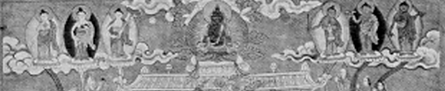
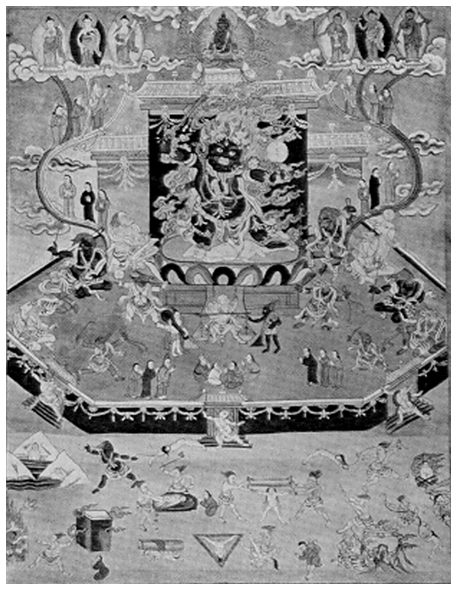
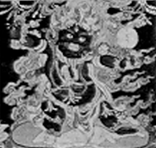
The structure of the Tibetan Judgment Scene is quite complex. Included is a barrier that divides the domain of judgment (above the barrier) from the domain of rebirth (below the barrier). Directly above the barrier are the Buddha, the Lord of Death, and those who assign lokas. From here, two pathways lead to the lokas, each holding several fortunate solus (that have defied rebirth). But the scene holds much more than that. For instance, there are a number of deities who emerge from various corners to perform specific ritualistic acts, each highly symbolic and intricate. For our purposes, however, a description of the most essential elements should be sufficient. The central figure in the scene is Dharma-Raja, the Lord of Death. He wears the third eye of spiritual wisdom on his forehead and stands enhaloed in flames of wisdom, on a solar throne. His head-dress is adorned with human skulls and a serpent forms his necklace. In his left hand he holds the mirror of Karma, in which every good and evil act of the deceased under judgment is reflected. Furthermore, he sit underneath the Bodhi tree that accommodates the Lord Buddha (cf., detail from the main picture, top center above the Lord of Death, the Buddha is flanked by the lokas, three on each side).
Directly in front of the Lord of Death stands Sprehu Gochan, holding the scales. Each soul that appears before the Lord of Death carries either white or black pebbles (see picture below). Those carrying white pebbles are souls that have recognized the workings of Illusion, avoiding temptation from Sangsara; they walk down the pathways of the Buddha of the loka to which they are assigned. Those carrying black pebbles are souls that continue to be under the domination of Karma; they are hurled down the abyss. The River of Forgetfulness carries them to Mount Meru and the place of their rebirth (cf., detail of the main picture, below). Floating down the River of Forgetfulness, the souls return to the Place of the Wombs where they are reborn.

The sight of these terrifying visions fatigues the soul and the sound of his own breath, like laughter issuing from a hollow, frightens him. He falls into a swoon. Upon revival, the soul returns to the death-chamber, where he lately saw his earth-plane body. It is at this point that the realizes that he has died, he is, however, still under the impression that he dwells in a body of flesh and blood. Soon, with the realization of death becoming stronger, his thought-body becomes weak and the soul feels naked. He begins to search for the place of his rebirth, the place in which his judgment had been set. Before finding this place, however, the soul must find a body that can take him there.
In the third or the Sidpa Bardo a body is assigned to the soul, and the soul's relentless search for his place of rebirth begins. This is a bardo body, a seemingly fleshly body resembling the soul's earth-plane body but endowed with miraculous powers. It casts no reflection in a mirror or pond and it casts no shadow on a wall.
Donning this bardo body, the soul continues the search for his place of rebirth. He journeys toward Mt. Meru, enduring rain and snow, harsh Karmic winds and terrifying sounds of mountains crumbling, of seas overflowing, and of fires roaring.
The search is ceaseless; the soul perseveres undistracted until the womb from which he is to be born is found. Now many dull lights shine upon the soul. By the power of Karma the soul is bathed in the light of the place in which he is to be reborn. If the soul is to be born as a Preta (unhappy ghost), for instance, he is enveloped by the dull red light of the Preta-world and experiences visions of places of darkness and gloom.
Finally, the time comes when the Lama instructs the soul to find the appropriate womb from which he will be born. As the soul enters the womb so chosen, the recollection of the body of past life becomes more and more dim, the body of future life becomes more and more clear, and the soul is eventually reborn.
|
The Scene through the air-inlet
We encounter the narrator one late afternoon on the thirteenth of Farvardin. 8 He is painting in his room while all the other inhabitants of the city of Ray have rushed to the countryside to pay their respects to the dead. The door and the windows of his dwelling are closed so that he can concentrate on his painting.
Suddenly the door of the dwelling opens and the narrator's uncle enters. The narrator, "as if inspired," begins to search for a wine-flask; the wine therein has been made in celebration of his birth. This wine-flask is not within his reach nor can he reach it without using a stool.
While reaching for the wine flask, through a chink in the wall, the narrator sees the following scene being played outside his dwelling: an ethereal being, a girl, in a fine black dress stands opposite an old man who squats under a cypress tree. The old man wears the clothes of Indian mendicants. A brook separates the two. The girl, holding a black lily, tries to cross the brook and offer the lily to the old man. Failing that she falls into the brook. The old man laughs so hysterically that han ethereal being, a girl, in a fine black dreis shoulders shake.
|
Now let us reconsider this scene in tandem with the Tibetan death rituals. The uncle (Lama) inspires the narrator (consciousness of the deceased person) to bring him a cup of the rare wine (Clear Light) prepared on the occasion of his (narrator's) birth. While reaching for the wine flask, the narrator's thoughts give expression to his hidden Karmic desires and, rather than concentrating on finding the wine-flask, he is entranced by a most hallucinatory vision. Like a wonder-struck child watching moving pictures cast upon a screen, he watches a bent, stooped old man (the Islamicized version of the Lord of Death) squatting beneath a cypress (Bodhi) tree. A young girl--an angel (the narrator's own soul) stands before the old man, carrying a most undesirable token, a black lily (black pebbles). She bends to offer the lily to the yogi from across a brook (River of Forgetfulness) that separates them. She fails and falls into the brook. At this the old man, who bites the index finger of his left hand (holds the mirror of Karma in his left hand), shakes with hybrid laughter, startling the narrator.
|
The impact of the scene on the narrator is intense. As he recalls the incident later, he calls it "an incident which has shocked me so much that I shall never forget it; its ominous brand will poison my life throughout from the beginning to the end of eternity where no man's understanding can fathom." 9 In fact, Hedayat lifts the description of the narrator's overwhelming disappointment upon realizing that he has mistaken Karmic manifestations for the Clear Light, and places it among the major opening paragraphs of the novella. The passage clearly shows how devastated the soul becomes upon the realization of the immensity of its past errors; it also shows how fascinating, enchanting and transient the pleasures one derives from the phenomenal world can be, and how costly:
In this base world, full of poverty and misery, for the first time I thought a ray of sunshine shone on my life. But alas it was not a sunbeam, it was only a transient beam, a shooting star, which appeared to me in the likeness of a woman or an angel. And in the light of that moment, lasting only about a second, I witnessed all my life's misfortunes, and I discovered life's magnitude and grandeur. Then this beam of light disappeared again in the dark abyss in which it was destined to disappear. No. I could not keep this transient beam for myself. 10
The narrator sees two things and they appear to him in sequence. As he searches for the wine-flask, he encounters a pair of eyes so attractive that the prompting that he had received regarding the wine-flask abandons him altogether. Rather, he becomes spellbound. The second thing he sees is the consequence of his inability to carry out the first action, i.e., bringing down the flask. This consequence registers itself almost instantly in the color of the lily that his soul-mate carries to the old man. We know that he had made the recognition of this scene the fulcrum of his past life, making sure that he would recognize and dismiss it. Instead he finds himself to be attracted to it even more intensely.
Recall that the terrifying behavior of the Deities frightens the soul, causing him to fall into a swoon; then begins the soul's search for his place of rebirth. In the novella the following happens. The girl's fall into the brook causes the old man to laugh hysterically. Upon hearing this laughter, as expected, the narrator falls into a swoon. When he comes to, again as expected, he goes back to his room to serve some of the wine to his uncle, but his uncle has left . The open door symbolically points to the narrator's need to find the place of his rebirth, the place which, incidentally, is the same as the place where his judgment was held.
It is worthy of note that the narrator's recognition of his error has the potential of guiding him to a tranquil life, after being set face-to-face, of course. What he still needs to know is that the rare wine in the flask is the elixir that dispels desire. The discovery the of the nature of the wine and of its relationship with desire remains in the narrator's future and is disclosed in the second, the more life-like part of the novella.
The Journey
It is virtually impossible to provide an account of the manner in which Hedayat interlaces the narrative of the Buddha-carita with the actions of the soul in the Sidpa Bardo whereby Hedayat moves the action in The Blind Owl from the narrator's dwelling to Shah Abdol Azim. 11 Neither is it actually necessary to carry out such an explication de texte of the novella for our purpose. What follows, therefore, is a brief summary of the relevant events in the rest of the first part of The Blind Owl viewed through the Tibetan materials.
When his thought-body dies, the narrator needs to get rid of it. In this he is assisted by his bardo body (carriage driver who looks like his uncle and who is as agile as a youth). With the help of the old man he sets forth in the direction of Shah Abdol-Azim (place of the wombs). They arrive at the foot of a stark, black mountain (Mt. Meru). Hedayat's description of this foreboding region corresponds with the Lamas' description of Buddhistic cosmography almost to a fault. 12
At Shah Abdol-Azim, the old man offers the narrator an ancient raq jar that he had found earlier and disappears. This jar is the womb from which the narrator is to be reborn as a Preta, or unhappy ghost.
While resting in the womb, as expected, the narrator feels his past life diminishing. Eventually, he falls down a crevasse (abyss of rebirth) and awakens in the womb--a familiar place.
In the womb
At the beginning of part two, the narrator describes the setting of the second part of the story and identifies the protagonists of the tale. This part of the novella centers on the events surrounding the narrator's birth, of which he is told many versions. He chooses his nanny's version as the most credible.
The birth story is the nucleus of the second part of the book. Viewed superficially, it constitutes only the opening, but viewed analytically, it is the entire story of the second part. Hedayat frames the birth story and the second part of the novella, in such a manner (the nature of the characters, the setting and the time frame allow such a manipulation), that at the beginning of the birth story the narrator enters the dungeon womb as his own begetter and, at the end of the novella, he walks out of it, a deranged odds-and-ends seller (for details see below).
As mentioned, the events in part two are more life-like than those in part one; they also represent a more earth-plane replica of the narrator's relentless struggle with the forces that had brought about his downfall in part one. In other words, the enchanting eyes of his first experience now appear as a Nag-serpent in a dungeon on the one hand and as a whore of a wife on the earth-plane on the other hand. In either case the narrator finds himself to be dominated by the power that he had failed to defeat earlier. The question is, will he be able to recognize the fact that the Nag-serpent and the Whore are none but the ethereal being of his former experience? Will he relate the ethereal being, the possessor of the enchanting eyes that had destined him to this dungeon womb, with the Whore and, beyond that, with desire?
The birth story indicates that the narrator's father and uncle are identical twins. They travel together from Ray to Banaras. There they both sleep with a Bugam Dasi, the narrator's mother, only one of them "lawfully". To determine the father of the nursing child, both men are thrown into a dungeon in which a Nag-serpent has been let loose. After the trial one of the men emerges. The survivor is unrecognizably deranged and no one has since been able to determine whether the narrator's father is this deranged man, or the man who never left the dungeon. 13
The birth story is quite incredible and there remain many questions: what happens to the Nag-serpent? What happens to the man who never comes out of the dungeon? The narrator ponders the fate of these creatures as much as he thinks about his own. Recalling the events of his past life, he philosophizes that if he has brought himself into the womb that now holds him, i.e., if he is here because of his own inability to restrain his own karmic desires, then who is his father and who is his uncle? No one but he himself. What is then the nature of the characters that surround him, the butcher, the odds-and-ends seller, the Whore, and the others? They are all apparitions thought into existence by his own intellect in the same way that he had created the judgment scene intellectually during the crucial moment when he was supposed to concentrate and brign down the wine flask in his previous experience.
The butcher, a self-serving man, deals with weighing, cutting up and evaluating things. He is meticulous, accurate and frighteningly professional. His main instrument is a bone-handled long-bladed knife (power of brain in the skull); he is reminiscent of the Wrathful Deities. Apparitions personifying reason, they proceed from the psychic brain center symbolized in the novella by a window that opens to the butcher's shop.
The odds-and-ends seller, not the thinking man that he appears to be, is a thoughtless, "cosmic" being. As an apparition, he is the personification of the Peaceful Deities. He is as aged as are the cosmic symbols (sickle [moon], beads[planets], gapped comb [mountain ranges], etc.) that he views ceaselessly on his display. As a retired potter, he is responsible for the existence of the jar (the womb) which he hides from the public. A modicum of the philosophy of Umar Khayyam on the nature of the revolving atomistic particles adds great depth to the characters of both the butcher and the odds-and-ends man.
Retiring to the dungeon scene once again, as the narrator's certainty that he is his own begetter increases, his mother Bugam Dasi, symbol of the propensities that have the potential to distract man and destine him to rebirth, becomes increasingly identifiable with the ethereal being of his previous bardo experience. As the story progresses, earth-plane characters lose their identity as real characters in a work of fiction. The father and the uncle, the father-in-law, the butcher, and the odds-and-ends seller all melt into one indistinguishable being: the narrator. In the final analysis the reader finds himself in the same setting, dealing with the same characters as he was in the first part. The struggle, too, is the same. It centers, once again, on the narrator and his ability to recognize his wife for what she is and deal with her accordingly.
The narrator recalls that in his earlier experience, he inadvertently lost his only remedy for achieving a tranquil world to the eyes of the ethereal girl. The passing of the wine-flask as a family heirloom from his mother to her further substantiates this hunch. In time, the narrator recognizes the wine-flask to be the only means that keeps him a slave to the Whore. Jolted out of ignorance, he says:
Now I recognize what a valuable gift she (his mother) has given to me! 14
Cognizant of the miracle that the wine-flask can work for him, the narrator becomes determined to extract it from the possession of his foster-sister. The closest earth-plane solution for the acquisition of the wine-flask is marriage. The marriage solution, however, does not prove useful since the girl refuses to sleep with the narrator; thus the marriage is never consummated, and appears that it never will be.
Unable to communicate with the Whore, the narrator becomes sick and eventually dies. Rather than cooped up in his dwelling, as he was at the end of his past life, now he walks in the full light of a burning sun. In addition, this time, as we know, he is equipped with a highly significant bit of information totally lacking in his previous experience--he knows that only what he thinks into existence can exist. He is determined, therefore, not to repeat the mistake of his previous bardo. In other words, he tries to put as much distance as he possibly can between the enchanting eyes of his nemessis and himself. In the passage below, a recreation of the judgment scene, is indicative of the amount of progress that he has made since his last encounter with the ethereal being:
|
Suddenly I noticed that a small girl emerged from behind the trees and went in the direction of the fort. She wore a black dress made of very fine and light warp and woof; apparently of silk. Biting the index finger of her left hand, she moved freely as if sliding in a carefree mood as she passed. It seemed to me that I had seen her before, and that I knew her: but due to the distance between us, and due to her being directly under the intense light of the sun, I could not recognize her and she disappeared suddenly. 15 |
In the Bardo Thodol, the result of the judgment scene is always conclusive: the soul is either saved or hurled down the abyss. Hedayat's use of the scene in this case leaves the result inconclusive. The narrator, as the scene shows, is not attracted to the ethereal being as he was in his previous expereince, nor is there a brook into which the girl could fall. The significant thing for understanding the rest of the second part of the novella is that from here on the narrator has the upper hand.
The technique used by Hedayat in framing the story from this point on is probably best described by Hedayat himself: a hide-and-seek technique in which the Whore holds the "bottle" that is vitally important to the narrator's salvation. And, ironically, the same bottle holds the unquestionable elixir for the death of the Whore.
After she is recognized in the judgment of the second bardo, we find the Whore held prisoner by the narrator. This is evident from yet another version of the judgment scene that appears on an Indian curtain strategically placed in this part of the story. As for the narrator, he has to learn some even more intimate information about the ways of the Whore before he can dispossess her of her power:
|
What a strange, terrifying curtain it was! Depicted on it was a stooped old man resembling the Indian yogis. He wore a turban and sat underneath a cypress tree. In his hand he held an instrument which looked like a setar. 16 In front of him stood a beautiful young girl, like a Bugam Dasi, or a dancer of an Indian temple. Her hands were in chains and it seemed that she was being forced to dance in front of the old man. 17 |
The urge to redeem the wine-flask becomes stronger. The narrator, however, does not have the necessary vision to see through the "veils" that hide the 'Light' from him. To learn the ways of the world, he consults the odds-and-ends man (his own sense of attachment to the phenomenal world). The odds-and-ends man, as if responding from the depths of the narrator's own self, responds:
Don't you look at what you buy? 18
Veils of ignorance begin to fall, and for the first time the blind owl sees a dawning of the light he has been seeking. He acquires a super-natural insight enabling him to round out the character of the Whore. The next time the Whore comes to him, therefore, the narrator looks at her not with the desirous eyes of the youth who peeked at her from behind the trees when she was pulled out of the Suren river, 19 but with the critical eyes that see through her like a dagger of the mind would:
Until now whenever I looked at her I was not aware (that she was the girl who I played hide-and-seek with on the bank of the Suren river), but now, as if a curtain was removed from before my eyes, for some reason, I recalled the meat in front of the butcher's shop. To me she was like a lump of lean meat. All the traces of her inherent attraction had totally abandoned her. She was a mature, sober, made-up woman whose only concern was living--a genuine woman--my wife! 20
The wine-flask, the 'fountain' of the narrator's immortality, lies behind the flickering existence of the Whore who is now helplessly dominated by the narrator. The same urge that compelled the narrator to mutilate the body of the ethereal girl in the previous experience--the butcher instinct--compels him to invade the Whore's bed-chamber:
I said to myself: "Now that my arrest is inevitable..." 21
Chanting his favorite song (cf., Mantra) 22 to help him ward off distraction, the narrator enters the bed-chamber, holding his bone-handled long-bladed knife firmly in his hand. The Whore tries to disarm him, but he does not relent:
I took off my cloak and my scarf; I took off my clothes, but for some reason, I entered the bed still holding to the bone-handled long-bladed knife. 23
The dungeon womb that thus far has been dark and foreboding for the blind owl is now neither dark nor foreboding. The fearsome Nag-serpent (the Whore), too, is tame and huggable:
Her cool, silvery body, my wife's body, enveloped me as would a Nag-serpent tighten his coils around his prey. 24
In the bed, desperately struggling, the Whore bites the narrator on the lip (symbolic of the Puja of the Naga-king to the Buddha), transferring the poison to him. Holding the third eye of the Dharma (cf., Dharma Raja, the Lord of Death) in his hand, the narrator (who is his own begetter) walks out of the dungeon womb, deranged.
The end of the story is predictable. The grave-digger returns to collect the jar (the womb) for the use of other unfortunate beings. He disappears into the same mist from which he had emerged. About the role of the characters in his future experiences, the narrator who is no longer a victim to the thought processes that victimize ordinary beings, says:
The red embers in the pot of fire in front of me had turned to cold ash unable to withstand a single breath. My thoughts, too, were like the embers--hollow and ash-like--unable to withstand a single breath. 25
The Message
The concept of the Clear Light from Tibetan death rituals is employed in this analysis as an extra-literary device to aid us understand several things. First, to discover the structural makeup of the enigmatic scene that the narrator sees through the chink in the wall of his closet; second, to understand the nature of the characters, setting, and the time element in the novella; third, to clarify the role and the import of certain symbols in the work in general; and, fourth to determine the reason for the balanced two-partite division in the work. Social, political and cosmic meanings of the work are discovered automatically once the elements mentioned above are discussed and grasped.
It is not always necessary to buttress the examination of the structure of a work of fiction with an exhaustive study of its background. In the case of The Blind Owl, however, due to the repressive steps taken by the government of the time we need to make an exception. Reza Shah's government was against any type of expression of freedom, covert or overt. Would not it be prudent for Hedayat, therefore, for self-preservation as well as for the well-being of his family, to literally bury his message in Indian traditions? The narrator of the novella says it best:
"...In all these, I sought what I was deprived of; something which belonged to me and which I had been denied."26
These are the words of a very frustrated man on the verge of making a vital life and death decision. What the narrator confesses to, right before the words quoted above are spoken, is love for something dear for him, something which naturally belongs to him but which is denied him. We have seen throughout the story how relentlessly he pursues freedom and pines for a peaceful life away from others. Throughout the work he strives to recognize the elements that veil ignorance and deny him liberty. It is thus for the sake of liberty, for the sake of breaking away from the binding strings of the Whore, that he decides to resort to violence. By fetching his bone-handled long-bladed knife (far-reaching power of the mind) and using it (unleashing his frustration on paper for everyone to read) without any quams, he combats the forces that perpetuate evil and corruption.
At the beginning of the novella, the narrator is a painter of pencase covers who, like the rest of the residents of the ancient city, is tied to a ridiculous profession. Like the other residents of Ray--butchers, odds-and-ends sellers, doctors, jurists, tripe-peddlers, philosophers and other such urban residents--he adheres to ritual and follows edict and dogma blindly and uncritically. Fortunately for him, the judgment scene that he sees through the air-inlet of his dwelling reveals the very strings with which the Whore manipulates her puppets. As a result he gives up the money that he receives from his uncle and goes into the business of writing for himself. The way to his salvation will be long and lonely, but he feels he is on the right track.
From the lonely corner of his grave-like dwelling, he sets out to perfect his world; his aim is to recognize and document every corruption and every evil deed so that he can expose, in the bright light of day, the deeds of the creature that denies him what is rightfully his. Once he achieves perfection, he intensifies his single-handed struggle against the operation of the Whore. He knows that once his dagger of the mind begins its dissection, the other residents of Ray--his father, his uncle, the odds-and-ends seller, the hearse-driver and the rest--will rise in unison against the repressive rule of the Whore; they will join his struggle.
Here the reader of the novella might expect a real confrontation for which the last passage quoted above serves as the inevitable resolution.From the narrator's point of view, however, the struggle is already over. What remains is to record the account of the victory as a lesson for the uncritical adherents to dogma.
The semantic framework of The Blind Owl, as is evident from the discussion of a scene from the work, is rather complex. The chief element of the matrix, liberty, is discussed on three distinct levels: personal freedom, community salvation, and freedom from the binding elements of the cosmos. The latter being emphasized the most. The achievement of each of these freedoms entails an intense search for the truth, and a relentless struggle before the goal is attained. It should not, therefore, surprise us to find that Hedayat, a child of the Constitution era, when Iranians struggled to attain individual human rights, should adopt two pioneering books, the Buddha-carita and the Bardo Thodol, both successful models of emancipation, as the framework for his story.
According to The Blind Owl, salvation for the individual is possible as long as the individual is willing to pay the price. He must give up interest in childish desires for the ordinary and initiate a tireless quest in pursuit of Truth. What about the community of tripe peddlers, jurists, doctors, butchers and philosophers? Can they be saved? Is there any salvation for a community of frustrated pen-case cover painters who relate to a Whore, and who blindly obey her deceitful wishes? No. As long as the situation remains such that the Whore can cloud their vision with vestiges of transient glory and as long as that community slavishly and unquestioningly continues to paint pen-case covers for petty "gains" (cf., the piece of gut thrown by the butcher to the dog), there exists little hope for salvation for them.
In The Blind Owl, Hedayat emphasizes the importance of individual salvation, stressing that individual reform is the prerequisite for community reform. Every individual in Ray must realize the intrinsic significance of his own inborn gift of freedom; he should individually struggle to unshackle the fetters that bind him to the authority of the Whore. There are no Messiahs forthcoming! The individual can become a recluse and attain a degree of false freedom; or he may, like the narrator of The Blind Owl, wage an unending war against ignorance and, by enlightening his fellow residents, prevent illusion from perpetuating ignorance in his community.
As a member of the cosmos, however, man is powerless. He is born without his consent, he lives in spite of himself and dies against his wishes. Thus, while repressive authority on the community level can be crippled by the disobedience or the desertion of the man who would be free, the crushing notion that the revolving atomistic particles of the human body are shaped and reshaped by the whimsical ways of Time, is unshakable--one cannot leave the cosmos.
In the past man has questioned the existence of authority by eliminating the notions of reward (heaven) and punishment (hell) offered by the scriptures. He has eliminated or replaced many a tyrant, but his struggle with the cosmos has always remained depressingly inconclusive. For example, when the narrator compares the picture in his tin-can with that on the ancient raq jar, he finds that the compositional elements of the two are identical, and that over the many centuries that have intervened between the first painting and the next, nothing significant has changed.
Rarely do people challenge the domineering authority of the cosmos; thus its repressive rule remains paramount. A few, however, like the Zurvanites and Umar Khayyam, have tested the binding force of the cosmos. Umar Khayyam's agony, which is so vivid in his Quatrains, is indicative of the weight and pressure of the cosmos as it crushes its victim.
The attainment of peace and freedom exacts a high price. The prerequisite for Nirvana is the loss of interest in childish desires. When such prerequisite is fulfilled, however, there remains little incentive for living; life on the earth-plane becomes a burden. Hedayat's brief but profound note to Jamdlzadeh says it all:
The crux of the matter is that I am tired of it all. It has to do with my nerves. I pass my nights in a situation much worse than that of a sentenced criminal. I am tired of things. There is nothing that can give me incentive or comfort, nor can I deceive myself any more. A gap has severed the communication line between circumstances, life, etc., and me; so that we cannot understand each other any more. 27
More than a complaint about social injustice (although that is an important factor), this passage is one of Khayyamian bitter laughter; the laughter of a man who has lost interest in childish desires and who is pitted with a Nag-serpent in a cosmic dungeon. He laughs hysterically and his shoulders shake violently as his ancient shadow appears against the silvery light of the Nag.
SELECT BIBLIOGRAPHY
Bancroft, Anne. Religions of the East. New York, 1974.
Bashiri, Iraj. Hedayat's Ivory Tower: Structural Analysis of The Blind Owl, Minneapolis, Minnesota, 1975.
Boyce, Mary. A History of Zoroastrianism, Volume 1. Leiden/K61n, 1975.
Cowell, E.B. "The Buddha-carita of Asvaghosha," Buddist Mahayana Texts, New York, 1894.
de Santillana, Giorgio, et al. Hamlet's Mill, Boston, 1969.
Eliade, Mircea. Shamanism: Archaic techniques of Ecstasy, V. Bollingen Series LXXVI, Princeton, 1964.
___Yoga: Immortality and Freedom, Bollingen Series LVI., Princeton, 1958.
Evans-Wentz, W.Y. The Tibetan Book of the Dead, New York, 1975.
Hedayat, Sadeq. Traranehay-e Khayyam, Tehran, 1935.
___Baf-e Kur (The Blind Owl), 12th edition. Tehran, 1969.
Hinnells, John R. Persian Mythology, London, 1973.
Humphreys, Christmas. Buddhism, Baltimore, 1969.
Kamshad, Hassan. Modern Persian Prose Literature, London, 1966.
Nikooyeh, Mahmood. "Buf-e kur, per lashez" (The Blind Owl: Pere Lachaise), Rudaki, No. 18, Tehran.
Rilke, Rainer Maria. The Notebooks of Malte Laurids Brigge (trans. M. D. Herter Norton), New York, 1949.
Rank, Otto. The Double, A Psychoanalytic Study, Chapel Hill, 1971.
Taqizadeh, S.H. Old Iranian Calendars, Prize Publication Fund, Vol. XVI. London, 1938.
|