The Shahname of
Firdowsi
by
Iraj Bashiri
copyright, Bashiri 1993 and 2003
The central figure in the myths that Firdowsi collected and versified is Yazdan,
the Lord of the life force and of discernment:1
In
the name of the Lord of both wisdom and mind,
To nothing sublimer can thought be applied [.] 2
Firdowsi praises Yazdan as
the most sublime ruler, waging an eternal, cosmic war against evil. As the
embodiment of the good and of discernment, the omniscient Yazdan created a
world. Ahriman, the embodiment of evil, following a long-standing stratagem,
lurked in the shadows waiting for an opportunity to destroy that world. Yazdan,
Firdowsi says, created the world out of nothingness:
The
first thing needful for thee is to know
The sum of primal elements which He,
Who maketh all things, made from naught to show
The greatness of His own supremacy.3
At the center of Yazdan's creation is truth,
symbolized as a ball of fire from which everything else emanates. The existence
of the earth, Firdowsi says, is a consequence of the cooling of that ball of
fire, the existence of water is a result of the further cooling of the earth,
and the growth of plants is a consequence of the intermingling of elements on
earth. Animals and humanity complete Yazdan's creation.
Firdowsi distinguishes humanity as the crown
of Yazdan's creation. It is to human beings, Firdowsi declares, that Yazdan has
passed His abilities and discernment. To help humanity in its pursuit of truth,
Yazdan has created the sun to light the world and, more importantly, to serve
as a visible symbol of an unswerving quest for truth. Yazdan created the moon
so that its waxing and waning would indicate that both kingdoms--light as well
as darkness--might prevail. Humanity's aim, however, must be to identify itself
with the full moon.
To pass His wisdom down to mankind, Firdowsi
insists, Yazdan created a "chain" of command, a hierarchy beginning
at His own level, leading into the domain of the Yazatas (lesser deities
responsible for the spiritual and the physical well-being of creation) and the
Farahvashis (souls of the believers). Through this chain, Yazdan assured His
personal supervision of the spiritual affairs of the individual believer, as
well as control of all activities within His kingdom. This control was vital
for Yazdan's scheme because, in the final analysis, the prevalence of good over
evil depends entirely on the degree of good and evil exercised by human beings
on earth.
The members of the assembly of Yazadan
contributed to the enhancement of Yazdan's creation by meeting the needs of the
physical world. This assembly assessed the abilities of all the individuals on
earth, and recognized one to be supreme. This recognition, translated into farr
(i.e., recognition of a mortal endowed with the principles of just rulership)
allowed Yazdan to confer upon that unique individual the divine right to rule.
The farr, upon its creation, was
tested in the intermediary world, a universe inhabited by cosmic beings, where
each individual is the equivalent of a later physical world. In that universe,
the farr fell on Kayumars4
who, soon after, gathered all other beings around him on top of a mountain and
apprised them of his kingly status:
This
order, Grace, and lustre came to earth
When Sol was dominant in Aries
And shone so brightly that the world grew young.
Its lord was Gaiumart,5 who
dwelt at first
Upon a mountain; thence his throne and fortune
Rose. He and all his troop wore leopard-skins,
And under him the arts of life began,
For food and dress were in their infancy.
He reigned o'er all the earth for thirty years,
In goodness like a sun upon the throne,
And as a full moon o'er a lofty cypress
So shone he from
the seat of king of kings.
The cattle and the divers [sic] beasts of prey
Grew tame before him; men stood not erect
Before his throne but bent, as though in prayer,
Awed by the splendour of his high estate,
And thence received their Faith.6
The assembly led by Yazdan's first deputy on
earth, Kayumars,
worried Ahriman. He decided to frustrate Kayumars' efforts and destroy his will
to serve, but even the murder of Kayumars' son, Siyamak, did not effectively seal
Yazdan's plans for the propagation of truth. Kayumars had already taught the
secret of just rulership to Hushang, another son of Siyamak.7 Kayumars, who ruled for thirty
years, provided his people with their first code of laws.
Defeated, Ahriman retreated, while Yazdan
continued to perfect His cosmic kingdom by allowing the new king to discover
fire. This discovery led to the discovery of metals and of weapons with which
to combat evil. Hushang also harnessed the rivers and produced lush fields and
meadows. He domesticated animals and used their products as a source of untold
prosperity for Yazdan's kingdom.
Tahmuras, who succeeded Hushang, as
the third king of the Pishdadiyan dynasty, chose wisdom
as his weapon against Ahriman:
[With
Wisdom, I shall create Order
Following that with a palace and a court,]
I will restrain the Div, will reign supreme,
And use the useful for the common gold." 8
Under Tahmuras, the domestication of animals
was perfected, weaving was introduced, and plans were devised to eradicate the
race of the divs.
These plans called for an extraordinary king. Could Tahmuras be that king?
Tahmuras,
Purged of his faults and glorious with the Grace,
Bound Ahriman with spells and rode him horsewise
At whiles around the world.9
Ahriman did not give up easily. Once it
became apparent that he could not withstand the full impact of Tahmuras'
assault, he took refuge in a ruse. He offered to teach Tahmuras the thirty
common languages of man and beasts, including Latin (rumi), Arabic (tazi), Old
Persian (parsi), Soghdian (soqdi), Chinese (chini), and Middle Persian
(Pahlavi). Using the knowledge thus gained, Tahmuras elevated the level of
prosperity of his kingdom. Under Jamshid, the next king who ruled for
seven hundred years, the farr encompassed both the secular and the
spiritual domains:
"Mine
is the Grace," he said, "I am both king
And archimage, I will restrain ill-doers
And make for souls a path toward the light." 10
In administration, Jamshid followed
tradition. He introduced the finer approaches to weaving and the production of
elegant and luxurious objects. He also launched a number of innovations, among
them the division of people into four distinct castes and guilds.11 Under Jamshid, artisans,
merchants, priests, warriors, and tillers of the land knew their place in
society:
Then to the joy of
all he founded castes
For every craft; it took him fifty years.
Distinguishing one caste as sacerdotal
To be employed in sacred offices,
He separated it from other folk
And made its place of service on the mountains
That God might be adored in quietude.
Arrayed for battle on the other hand
Were those who formed the military caste;
They were the lion-men inured to war--
The Lights of armies and of provinces--
Whose office was to guard the royal throne
And vindicate the nation's name for valour.
The third caste was the agricultural,
All independent tillers of the soil,
The sowers and the reapers--men whom none
Upbraideth when they eat. Though clothed in rags,
The wearers are not slaves, and sounds of chiding
Reach not their ears. They are free men and labour
Upon the soil safe from dispute and contest.
. . . . . . . . . .
.
The fourth caste was
the artizans [sic]. They live
By doing handiwork--a turbulent crew,
Who being always busied with their craft
Are given much to thought. Jamshid thus spent
Another fifty years and did much good,
For each man learnt his place and others' too.12
Jamshid brought the full import of the farr
within his control and used it to improve both his own status as king and the
living conditions of his subjects. Using knowledge placed at his disposal by
the divs, he built magnificent palaces and embellished them with
precious gems. To immortalize his efforts at good government, which had
resulted in the eradication of death from the face of the earth, and to welcome
the arrival of a new epoch, he inaugurated a magnificent celebration. Called
the Now Ruz (new year), the celebration of the event continues to the present
day. Jamshid's actions seemed to have sealed the fate of Ahriman, but not for
long:
The
people scattered jewels, and bestowed
Upon the day the name of New Year's Day,
The first of Farwardin and of the year,
When limbs repose from labour, hearts from strife.
The noble chieftains held a festival,
Called for the goblet, wine, and minstrelsy,
And ever since that time that glorious day
Remaineth the memorial of that Shah.
Thus things continued for three centuries,
And all the while men never looked on death [.]13
While preoccupied with the rearrangement of
the visible aspects of his kingdom, Jamshid allowed his domain to fall victim
to Ahriman, whose agents, by introducing writing and geometry, had led the king
away from his mission. Jamshid was now obsessed with the idea that he should
reach the stars:
These
works achieved, Jamshid ambitioned
Rank loftier still, and by his royal Grace
Made him a throne, with what a wealth of gems
Inlaid! which when he willed the divs took up
And bare from earth to heaven.14
The excessively opulent world of Jamshid now
became the source of his arrogance. The deputy of Yazdan on earth summoned his
chiefs and mu'bads to aggrandize himself. "Who among the kings of
the past," he asked, "eradicated death from the face of the
earth?" But he did not stop there. Feeling that he was in full control of
the physical aspect of the world, Jamshid reached to supplant Yazdan. "You
owe me your life and your repose," he proclaimed to his chiefs and mu'bads,"
and that makes me your God," Jamshid concluded.
Jamshid's conceit cost him his farr:
[A]nd
God's Grace departed from him,
The world was filled with din, the Court deserted,
. . . . . . . .
[T]he crime that equalled him with God,
Brought on disaster and o'erturned the state.15
Victorious at last, Ahriman assumed the
rulership of the world. But everywhere he turned, vestiges of Yazdan confronted
him. The land was prosperous, and death no longer existed. Drawing on Ahriman's
knowledge of geometry and writing, Jamshid had perfected the physical aspect of
Yazdan's creation.
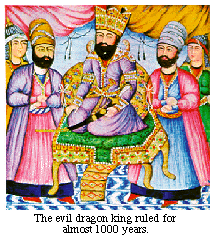 Puzzled,
Ahriman cast a demonic scheme. Assuming the form of a human-consuming dragon,
he ascended the throne and demanded daily sacrifice to appease his voracious
appetite. In droves, people were killed and fed to the beast to keep him happy.
Could Ahriman depopulate Yazdan's world?
Puzzled,
Ahriman cast a demonic scheme. Assuming the form of a human-consuming dragon,
he ascended the throne and demanded daily sacrifice to appease his voracious
appetite. In droves, people were killed and fed to the beast to keep him happy.
Could Ahriman depopulate Yazdan's world?
The
purpose of the foul Div shrewdly scan:
Had he conceived perchance a secret plan
To rid the world of all the race of man? 16
But lengthy as Zahhak's rule was, it came to an end
before he could devour the last human being, that is, before he could eradicate
the seed of Kayumars, Fereydun.17 Fereydunconfronted the evil
Zahhak and imprisoned him in a cave in
Kayumars was the first human being and the
first monarch of the cosmic age. Fereydun, son of Abtin, is the first king of the mythic
age.18 He ruled for five
hundred years; his long rule affords us a better look at his administration and
time. We learn, for instance, that he inspired unity and might in the early
stages of his rule but that, in the end, his kingdom was fraught with discord
and division.
Fereydun divided his world into three
kingdoms. He assigned Rum and the west to his eldest son, Salm. He then assigned him an army and
charged him with the defense of the western borders.19 He assigned Turan and
When Iraj ascended the throne in the
heartland, Fereydun stayed in residence with him. Salm and Tur conspired and,
before mounting an assault on the heartland with their combined forces,
informed Fereydun of their intentions. Knowing his sons well, Fereydun ignored
their threat; he did not ask Iraj to step down. But Iraj, good at heart,
decided to visit his brothers and bring them joy even at the expense of giving
up his crown.
When Iraj arrived in Turan, Tur assaulted
him and, fearing that the combined forces of Turan and
For the first time in Iranian history,
Fereydun marshalled the priests, the nobles, and the other classes of society
to aid the throne in achieving its goal. When the preparations for mobilizing
the army were complete, Fereydun asked Manuchehr to take the center. He
assigned the left wing to Garshasp and the right to Saam and Qubad.
Even though Manuchehr's army displayed the
Kaviyan flag, the banner forged from the blacksmith Kaveh's leather apron, Salm and Tur
refused to recognize the legitimacy of his claim to kingship:
What
though there was a daughter to Iraj,
Hast thou a right to signet, crown, and throne?21
Fereydun, also referred to as the Dragon
king, ruled for 500 years. When he stepepd down, he was succeeded by Manuchehr.
Manuchehr ascribed his legitimacy to King
Fereydun rather than to Iraj. He then attacked the combined forces of Turan and
Rum and routed them. Tur and Salm retreated and pondered their plight. They
decided to ambush Manuchehr and kill him. Their plot, however, was discovered
and both were eventually eliminated. Their heads were sent to Fereydun to bury
at the side of Iraj's head.
A major event of the time of Manuchehr is
his elevation of Saam and the House of Nariman to rulership. To show his
gratitude, Manuchehr bestowed Sistan and Zabulistan to the great hero and
supported him in making major decisions. As for Saam, he had lived a long life
but was still childless. Furthermore, when one was granted, he was an albino
child, one about whom Saam's courtiers were afraid to talk, let alone show him.
Once he did see his son, Saam was devastated. He took the child to the
mountains and left him there to die. The child's lot, however, was set
elsewhere. He was picked up by the fabulous bird, the Simurgh, who raised him alongside
her own brood.
Years later, when Saam realized his mistake
and returned to the mountain for his son, Simurgh returned his son, Zal, to him. When
leaving them, Simurgh left one of her scarlet feathers with Zal and instructed
him to set it on fire whenever he felt he might need her help. Shortly after
they returned home, Saam put Zal in charge of his kingdom and went to
Mazandaran.
At the time, the
Convinced that the couple should get
married, Saam traveled to the palace of the king of
Hardly a year passed before Rudabeh became
pregnant. The unusual size of the baby forced Zal to ask the wise Simurgh for
assistance during the birth. Simurgh directed the physician to cut a section in
Rudabeh's side and take the child out. They called the child Rustam.
After a long reign of 120 years, Manuchehr
entrusted his throne to his son, Nawzar, and died. During Nawzar's rule Saam,
too, died of old age in Zabulistan. Saam's death signalled an opportunity to
Pashang, the king of Turan, to attack
To restore
The last Pishdadian king, Garshasp, ruled
for nine years. He died at exactly the time when Afrasiyab was preparing his
army to invade
The only known survivor with royal blood was
a man who lived somewhere to the north of the great salt desert. His name was
Qubad. If he were to be found and placed on the Iranian throne as Kayqubad, Zal
thought, tranquility would return to
In the wars that followed the ascention of
Kayqubad, Pashang did not do well. His son, Afrasiyab, was defeated by Kayqubad
and his assembly of knights. Forced to evacuate all the lands south of the
Oxus, Pashang sued for peace, asking that the border originally demarcated by
Fereydun be accepted as the boundary between
Tur
brought calamity on blest Iraj
Upon a question touching crown and throne.
On this I say that feuds should not endure
For ever, and if vengeance for Iraj
Was owing it was wreaked by Minuchihr.
In that first settlement by Faridun,
Whose object was a just apportionment,
It will be well for us to acquiesce
And not transgress the precedents of kings.
From
Whose boundary is Jihun, that is our share.
When Faridun was Shah Iraj ne'er saw it,
But had from him his blessing and
If we transgress these boundaries and fight
We make earth strait to us, the scimitars
Will clash, God will be wroth, and we shall lose
Our portion in both worlds. What Faridun
Divided unto Salm;, Tur , and Iraj,
Let us retain and then be friends henceforth,
For earth itself is worth not so much bale.22
After a hundred years, the glorious rule of
Kayqubad, too, came to an end. His son, Kayka'us ascended the throne. Under
young Kayka'us,
It was amid this prosperity that Kayka'us
decided to invade Mazandaran and annex the abode of the demons to
Before long, Kayka'us managed to send a
messager to Zal and apprise him of his situation. Zal dispatched Rustam to
rescue the king. After passing what has come to be known as his Haft Khan
(seven labors), Rustam reached the cave guarded by the White Demon. There, he
killed the White Demon, used three drops of his blood to restore the prisoners'
eyesight, and brought all of them back, safe and sound, to
After he was rescued from Mazandaran,
Kayka'us went to Sistan and spent a month in that region as a guest of Zal.
Then he invaded Hamavaran (
The situation was not simple, however. At
the same time Afrasiyab, hearing about Kayka'us's plight, prepared his army to
invade
Even though the king of Hamavaran had allied
himself with the rulers of Berberistan, and
One spring day, tired of war and of
Zabulistan, Rustam rode out of the court and retired to the countryside to
enjoy nature and refresh himself. He did not return to the palace that night or
the night after that. Rather, he spent his time hunting, cooking, resting and traveling.
Unknowingly, he was getting closer and closer to the
One morning, upon waking up, Rustam found
that his horse, Rakhsh, was not where he had left him. He searched all around
his camp site, there was no sign of Rakhsh. He continued his search until he
came to the
The king of Samangan received Rustam,
apologized for what his warriors had done, and returned Rakhsh to him. Then,
since it was late in the day, he invited Rustam to spend the night in Samangan
and leave early the next morning. That night, the king entertained Rustam until
late into the night. He praised the young champion, and wished him a prosperous
life. Rustam then retired to his bedchamber to rest.
Sometime during the night, a noise awakened
the paladin. It was Tahmineh, the daughter of the king
of Samangan. She had heard much about Rustam and had paid him a visit to see
him for herself. The two talked for a while and fell in love. Within a few
days, before Rustam had to return to his duties at the court, they got married.
Before he left Tahmineh, Rustam gave her an
amulet for the child to be born. The child, after he was of age, was to wear
this amulet, come to the court of Persia, and seek his father. Before that
time, however, he was to be kept hidden from Afrasiyab, and his father's
identity was not to be divulged to anyone. When the child was born, Tahmineh
called him Suhrab.
She followed Rustam's instructions and, until he was fifteen, kept Rustam's
identity a secret from him.
Afrasiyab, the king of Turan, however, knew
the child's identity. Thus, when young Suhrab decided to find his father and
join him, so that together, father and son, could depose Kayka'us, Afrasiyab
sent for the young warrior. He entertained Suhrab, placed 12,000 warriors at
his command, and ordered him to invade
As a result of an altercation between Hazhir
and Suhrab, Kayka'us learned about the coming of Suhrab to
Upon hearing the news, Kayka'us dispatched Giv to summon Rustam to
the capital. Rustam, however, being in a jolly mood, ignored the king's behest
and took his time reaching the capital. Furious at Rustam's insubordination,
Kayka'us ordered both Rustam and Giv to be hanged. When Tus moved to execute the order, Rustam
pushed him aside and left the palace.
In an effort to soften the king's stance, Gudarz gave a full
account of Rustam's contributions to the crown. His account made Kayka'us
realize Rustam's worth to his kingdom and apologized to Rustam. Rustam then
accepted the command of Kayka'us's army and moved east to confront Suhrab.
The night before the actual combat, the
champions tried to learn more about each other. Rustam visited Suhrab's camp
and saw the youthful warrior who resembled Saam, but did not recognize him as
his own son. Suhrab, who hoped to become united with Rustam and help him ascend
the throne of
On the day of battle, unbeknownst to each
other, father and son exchange spears, swords, maces, and arrows. But neither
is victorious. Unable to finish their fight, they arrange to return the next
day.
That night, Suhrab describes Rustam to Human
asking if Rustam could be his father. Human assures him that that is not the
case. The two champions wrestle again the next day. Suhrab throws Rustam to the
ground and is about to cut his throat. Rustam decevies the youth by resorting
to a ruse. two out of three falls, he says, is the Iranian rule of the game.
Suhrab agrees and lets him live. The next time, however, as soon as he has the
opportunity, Rustam stabs Suhrab with his poisoned dagger wounding him
mortally.
While dying, Suhrab assures his murderer
that his father, Rustam, will avenge his death. Confused, Rustam asks for proof
of what he says. Suhrab shows him the armband which only Tahmineh could have
given him. Quickly, Rustam sends Gudarz to Kayka'us to procure some of the
king's special antidote. Kayka'us procrastinated because he was as worried
about the union of the father and the son as was his enemy, Afrasiyab.
Eventually Rustam came for the antidote himself, and received some. But it was
already too late. Suhrab had died moments earlier.
The Life and Martyrdom of
Prince Siyavosh
The wars between the neighboring kingdoms of
Son of Kayka'us and the grandson of
Kayqubad, Siyavosh was born to the king of
He
questioned her: "What is thy lineage,
For thou art fairy-like in countenance?"
"I am of high birth on my mother's side,"
She said," my father sprang from Faridun.26
My father's father is prince Garsiwaz,27
Whose tents now occupy yon border land."28
The champions' quarrel was settled by the
king who gave the girl to neither. Instead, he placed her in his own harem where
she gave birth to Siyavosh.
At the age of about seven, Siyavosh was
entrusted to Rustam to be taught chivalry and the ethic of kings. Rustam took
the child to Zabulistan and treated him as if he were his own son.29 In Zabulistan, Siyavosh
learned riding, archery, and wrestling. He was also instructed in the fine arts
of conversation, drinking, and merry-making.
When Siyavosh was about twenty years of age,
he returned to the court and was assigned his own quarters. For the next seven
years, Kayka'us honored the youth, tested him, and in time bestowed the
governorship of Quhistan upon him. Siyavosh remained in Quhistan until his
mother died. He then returned to the court to mourn her death.
Learning about the return of Siyavosh, the
ladies of the harem--sisters of the prince and wives of the king--asked their
sire to send Siyavosh to them. The king obliged:30
Thy
sisters and Sudabah, in affection
A mother to thee, are within the bower.31
Siyavosh asked Kayka'us to exempt him from
the visit, but Kayka'us persisted. When Siyavosh entered the harem, he met
Sudabeh, his step-mother, who held him tightly in her arms for an unusually
long period. Her close embrace disturbed the prince:
When
Siyawush appeared within the veil
Sudabah hastened to descend the throne,
Advanced with graceful gait, saluted him,
Embraced him long, long kissed his eyes and face,
And wearied not to look at him.32
Joseph-like in mien, Siyavosh was endowed
with outward as well as inner beauty. Recognizing Siyavosh's merit as a future
king, Sudabeh, who had married Kayka'us for his power rather than for himself, tried
to attract the prince to herself and marry him to her daughter. The prince
refused:
"Far
better hold my pure heart's funeral rites
Than take a consort from among my foes.
I have been told by famous warriors
Of all the doings of Hamavaran [.]" 33
Failing, the frustrated Sudabeh impudently
offered herself to the prince. She apparently thought that by engaging the
youth in an act for which he could be blackmailed, she would reach her goal:
I
stand before thee and I give to thee
Myself and my sweet life. I will fulfil
Whate'er thou asketh me--thy whole desire--
And let my head be taken in thy toils."34
The prince, refusing to soil his covenant
with his father, resisted Sudabeh's temptations. Frustrated, Sudabeh accused
him of having made lustful advances. She informed her husband that the prince
had assaulted her with the intention of raping her:
Then
he tried to force me,
And handled me with hands as hard as stones.
I would not grant his wishes. All my hair
He tore and caused these scratches on my face [.]35
The prince, of course, denied the
allegations, which placed Kayka'us in a quandary. Sudabeh who continued to
accuse the prince of rape finally produced a stillborn child as proof of her
accusations. Kayka'us took the matter to the assembly of the mu'bads for
advice. The assembly advised the king to ask both Siyavosh and Sudabeh to undergo
the trial by fire.
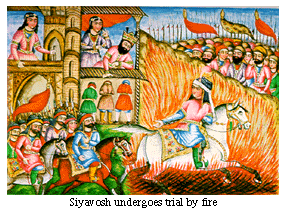
Sudabeh refused. Siyavosh, on the other
hand, accepted. On the next day, he rode his horse through a mountain of
burning wood and emerged, unblemished:
The
noble hero nathless reappeared,
With rosy cheeks and smiles upon his lips.
A roar went up as men caught sight of him:
They cried: " The young Shah cometh from the fire!"36
Wounded, Sudabeh recoiled and worked other
magic to make life at the court difficult for the prince. The unwise Kayka'us,
too, unwittingly stoked the feud, by taking the case to the mu'bads for
a decision and by forcing Siyavosh to undergo trial by fire. This allowed
Sudabeh to torment the innocent youth even more.
An opportunity for escape appeared when
Perchance
All-righteous God will set me free
Both from Sudaba and my sire's distrust [.]37
Kayka'us accepted Siyavosh's proposal and
put an army together for him. Rustam was summoned to assist Siyavosh, and an
army of 12,000 men from Pahlav, Pars, Kuch, Baluch, Gilan, and the plain of
Saruch was assembled. Accompanied by his champions and five mu'bads,
Siyavosh headed for Zabulistan.
After a month in Zabulistan, Siyavosh and
Rustam continued their march, having added armies from Zabulistan, Kabulistan,
and
At
Siyavosh wrote a silken letter to Kayka'us
and apprised him of his efforts to date. "In the course of a three-day
battle," he wrote, "I conquered
Kayka'us cautioned Siyavosh against haste.
He reminded the prince of Afrasiyab's vile and cunning nature: "You have
won a battle against Afrasiyab," the king wrote in reply, "haste
might well cause you to lose the war. Rather than rushing into a war, you must
keep your army together and wait where you are. Let temptation work on
Afrasiyab and make him cross the
On the other side of the Oxus, Afrasiyab was
informed by Garsivaz that Siyavosh, Rustam, and a mighty host from
Garsivaz' glorification of the enemy host
provoked Afrasiyab's anger. He had Garsivaz removed from his presence, ordered
a thousand of his lords to transform Sughd into a Chinese dreamland, and
prepare a banquet for him.
After the banquet, Afrasiyab retired to his
quarters where the reality of the day's news descended upon him as a
frightening dream in which he found his entourage and pavilion stranded in a
desert teaming with vipers while vultures circled overhead. A violent wind blew
his banner away, and streams of blood washed away his pavilion. He saw
thousands of his warriors decapitated and strewn about the battlefield. Each
warrior in the attacking Iranian army carried a spear with a head on it and
carried a severed head on his lap. A thousand warriors wearing black robes
assailed and captured him, tied his hands, and took him to Kayka'us who,
flanked by his very young son, mocked him. Upon seeing him, Siyavosh sprang up
and sliced Afrasiyab into two. The intensity of the dream woke Afrasiyab. His
screams brought his courtiers, including Garsivaz, to his side.
Following Garsivaz' advice, Afrasiyab
assembled his mu'bads, swore them to secrecy, and paid them handsomely. Then
he discussed the contents of his dream with them. Trembling, the mu'bads
agreed to interpret Afrasiyab's dream on the condition that the result of their
interpretation not be taken personally. Afrasiyab agreed. The mu'bads
then disclosed that the prince in Afrasiyab's dream was Siyavosh and that he
would rout Turan if Afrasiyab were to continue his war with
The interpretation affected Afrasiyab
greatly. To avoid further cause for vengeance, he assembled his champions,
lords, and nobles the next morning to discuss the war with them. After much
praise of his own past triumphs, he suggested that Turan should opt for peace.
"After all," he said, "two-thirds of the world still belongs to
us. Why not make it a tranquil one?"
For
our part let us give the world some respite;
Death should not come upon men unawares.
The more part of the world is at my feet:
My court is in
For see how many of the mighty men
Bring heavy tribute to me year by year!
Now if it be your minds I will dispatch
An embassy to Rustam;, and forthwith
Knock at the door of peace with Siyawush,
And send him every kind of precious gift."41
The problem thus settled, Afrasiyab stayed
in Sughd and sent a delegation, with appropriate gifts, to the Iranian prince.
The delegation, headed by Garsivaz, offered to sign a peace treaty:
I
do not set my face against
All from the bank of the Jihun to Chin
Is mine, my home is Sughd;--a realm distinct.
In truth it is through Tur and Valiant Salm;
That all the world is thus turned upside down,
And since the innocent Iraj was slain
Our warriors' brains have lost their wits. Iran
Is not divided from Turan, but wars
And feuds prevented friendship. Now I trust
That God will give good days and joyful news.
He raised thee from the country of
And giveth thee the friendship of the brave.
Let thy fair fortune dower the world with peace,
Let war and every evil disappear.
Now Garsiwaz hath come to add his wits
To thine, and as the valiant Faridun
Erst shared the world among his gallant sons,
So be it now [.]42
A day's journey down the Oxus brought
Garsivaz to
Siyavosh presented the treaty to the war
council which, after weighing the pros and cons of Afrasiyab's offer, decided
to accept the terms provided that Afrasiyab offer a token of his goodwill as
well.
Siyavosh's terms were stringent they
specified that the Turanian army withdraw from previously held Iranian
territory in the Oxus region and that a hundred of Afrasiyab's relatives, named
by Rustam, be sent as hostages to
Afrasiyab frowned at the idea of sending his
close relatives as hostages but, in the end, accepted the terms:
The
monarch out of those whom Rustam; named
Selected some five score of his own kin,
And sent them unto Siyawush, bestowing
Upon them many gifts and benefits.
He then bade sound drums and clarions,
He struck the royal tent, evacuated
Bukhara, Sughd;, and Samarqand;, and Chach,
The land and ivory throne of Sipanjab,
And led his troops upon the way to Gang
Without excuses, pretexts, or delays.43
Elated with this easy victory, Siyavosh
reciprocated Afrasiyab's kind gesture by sending the Turanian king many
precious gifts. He also dispatched Rustam with a letter to Kayka'us:
I
came to
But when Afrasiyab had news of me
The sparkling liquor darkened in his cup:
He saw that he was in a strait; the world
Was black and fortune fallen. His brother came
With gifts and many fair slaves richly dight
To me to seek protection from the Shah.
Afrasiyab will yield the crown and throne
Of kings, content with his own realm; observe
His station; never tread
But wash all strife and vengeance from his heart,
And send as hostages a hundred kinsmen.44
Kayka'us rejected the peace treaty,
informing Rustam that he wanted Afrasiyab dead. He further rebuked the national
champion for having been duped by the guileful Afrasiyab. To the prince he
wrote: "Prepare a huge bonfire and burn all the gifts sent by Afrasiyab.
Send the hostages to
Rustam pleaded with Kayka'us to reconsider
his order. He hoped that the king would not force the young prince to break his
promise to the enemy. He reminded Kayka'us that Siyavosh had followed the
king's orders and remained on the south shore of the
Kayka'us did not trust Afrasiyab. He felt
that the demonic king had used magic to convince the gullible youth.
"Would Afrasiyab care one bit," asked the king, "for the safety
of his people in bondage?"
When
God had meant that vengeance should be taken
And ills had asked a recompense of ill,
Ye sought to gain a heritage thereby,
And that it was which occupied your hearts.
Afrasiyab hath led your wits astray
By riches plundered from the innocent.
A hundred hapless, misbegotten Turkmans,
Who do not even know their fathers' names!
He will think little of such hostages:
They are to him as water in a stream.45
Kayka'us then ordered Siyavosh to relinquish
his command to Tus and return from
"A
hundred
Brave cavaliers, the kinsmen of the king,
Such famous men, our friends and innocent!
If I shall now dispatch them to the Shah,
He will not ask or think about their case,
But hang them all alive upon the gibbet.
How shall I justify myself to God?
Ill will befall me through my father's acts;
If I so madly fight Afrasiyab
Without a cause I shall incur God's wrath,
And people will cry shame [.]" 46
By openly defying his father and his king,
Siyavosh placed himself in a precarious situation. His position was further
aggravated by his farr (i.e., the wisdom, intelligence, personal
fortitude and the foresight of a man who would be king). Was it not his farr
that had frightened Afrasiyab and brought him to the negotiation table? What
was he to do?
If
I return
To court, surrendering the host to Tus,
That also will bring evil on my head.
I see ill right and left, and ill in front;
Sudaba too will do me naught but ill,
And I have not an inkling of God's will!"47
The night of decision, dark as the face of
Ahriman, was before him. It refused to divulge what the next day would bring.
But could it conceal the future from a man who carried the farr? Using
his divine foresight, Siyavosh looked into his future and saw the final
outcome, an outcome that, in the final analysis, spoke well for his decision to
defect.
The next morning, Siyavosh summoned Bahram
and Zange-i Shavaran and discussed the matter of relinquishing his command with
them. "I am not happy at court," he said to the champions, "this
was the reason I accepted this command in the first place. And I am not happy
with my father's grandiose schemes to elevate himself at my expense":
"Now
if the Shah
Is merely fighting for aggrandisement
He may have war and territory too,
But why such wanton bloodshed, such revenge
Stirred up in others' hearts?
. . . . . . . . . .
. . . .
The Shah
would rob me of both worlds, and yield me up
To Ahriman!" 48
"I have a covenant with the
Creator," Siyavosh continued, "a covenant compared to which my
father's wishes pale.49 All
my experiences in this world have been painful ones. What the future brings
cannot be different":
Would
I had died, or never had been born,
Since I am fated to endure such bale
And taste of every poison in the world;
And yet the tree hath not attained full growth
Whose fruit is venom and the leafage loss! 50
"I have come to the conclusion,"
Siyavosh said to the Iranian champions, "that I have no alternative but to
defect to the enemy. I am, therefore, relinquishing the command of this host to
Bahram until the arrival of Tus. He is to put everything in order and hand the
command down to Tus when the champion arrives. I also want Bahram to apprise
Tus of the numbers, thrones, and treasures that are kept under the auspices of
this command." The warriors were overwhelmed:
Bahram
was sorely troubled when he heard,
While Zanga; son of Shawaran wept blood,
And cursed the country of Hamavaran.51
"And as for you, Zange," the
prince continued, "I would like you to accompany the gifts and hostages
from Turan back to Afrasiyab. While there, I would like you to represent me and
ask Afrasiyab to allow me safe passage through Turan to a place where I can
stay hidden from Kayka'us":
"Go
tell Afrasiyab of what hath chanced.
Say: 'Through this peace my lot is one of war:
Thine are the sweets, the pang and poison mine,
Yet will I keep my covenant with thee
Albeit I shall lose the throne of might.
God is my refuge, heaven my covering,
The ground my throne. I rashly disobeyed
And cannot face the Shah. Give me a cistern
Where God appointeth and I may not hear
Aught of the evil nature of my sire,
But find for once a respite from his ire.' " 52
Afrasiyab listened to Siyavosh's message
carefully. He then summoned his commander-in-chief, Piran, and discussed Siyavosh's
proposal with him in private. After considering Kayka'us' future plans and
Siyavosh's claim to the future rulership of
"Dost
thou not see that Kai Kaus is old
And must depart? Then Siyawush will take
The wide world, wealth untoiled for, hall and palace;
Thus wilt thou gain both realms, their crown and state:
The man that geteth them is fortunate."53
Convinced of the possibility of a great
future, Afrasiyab invited Siyavosh to Turan and assured him of his own support
as well as the support of his people:
"For
all Turan will do thee reverence,
And I for my part long to have thy love.
Then thou and I will be as son and sire--
A sire who is a slave before his son." 54
Encouraged by Afrasiyab's kind words,
Siyavosh addressed his army, asking the commanders to heed Bahram. He then set
forth to meet the envoys who had crossed the
At
sunset,
When air grew dark and earth ungenial,
The prince, his face obscured by tears, marched forth
Toward Jihun with all his company.
When he had reached Tirmidh;, doors, roofs, and streets
Were full of scent and colour like the spring
Up to the gates of Chach: thou wouldst have said:--
"It is a bride with crown and necklaces."
At every stage were carpets laid and viands
Prepared, the whole way to Kachar Bashi,
Where he dismounted and remained a while.55
The Turanians, especially Piran and his
entourage of a thousand noblemen, welcomed the prince:
On
hearing: "Siyawush hath crossed the river
With troops to us, his envoy hath arrived,"
Afrasiyab bade all the chief estates
Go forth with kettledrums to welcome him.
Piran chose out one thousand of his kin
To meet the prince with gifts [.]56
On the way to Afrasiyab's court, Piran
talked to the prince about his own feelings toward Afrasiyab and about the
prince's future with him. "Afrasiyab," Piran said, "is like a
father to you; he loves you dearly and although all the world might see him
differently, Afrasiyab is wise, intelligent, and God fearing. I am one of his
relatives, and I alone have a host of a hundred thousand warriors in these
parts."
Siyavosh's heart, however, was elsewhere.
The farther they rode into Turan, the heavier his heart became:
For
he recalled the hocktide in Zabol
When it was decked up to Kabulistan,
And he had gone as guest of Rustam; there
With all the famous men for company,
And how the folk had showered down gold and gems,
And sifted musk and ambergris o'erhead.57
If Siyavosh had any reservations, the
welcome that Afrasiyab gave the party erased them from his heart. The two
hugged each other affectionately and kissed. They became great friends:
Afrasiyab
gave heart and soul to him,
And could not sleep for thinking.58
Afrasiyab, however, continued to regard
Siyavosh as his only sure avenue to the domination of the lands of the Kayanian:
"[My
son! be ever glad and conquering.]
Thou art a prince, the glory of the throne,
A royal crown and backbone of the host." 59
Siyavosh accepted his fate as an exile in enemy
territory. He accompanied the king on his hunting expeditions and, within a
year, gained the respect of the Turanian army:
Thus
while a year went by
They shared all griefs and pleasures equally.60
During this time, Siyavosh married Jarirah,
Piran's daughter and settled down. A son, Farud, was born to them. Dictated by
circumstances and encouraged by Piran, he also proposed to marry Farangis,
Afrasiyab's daughter. His proposal tested Afrasiyab's trust in Siyavosh:
I
know not whether love will take the prince
Back to
On us; but why drink poison wittingly?
One must not lightly take a serpent's breath.
. . . . . . . . . .
Piran replied:
"O king! Let not thy heart
Be grieved hereat. Those born to Siyawush
Will be possessed of wits, reserved, and shrewd.
Trust not what readers of the stars may say,
Deal with his case according to thy wisdom,
For from this noble pair a prince will spring,
Whose head will be exalted to the sun
As king both in
Then those two kingdoms will repose from strife [.]" 61
Patiently arguing, Piran convinced Afrasiyab
that a union between his family and the seed of Fereydun and of Kayka'us would
ultimately heal the wounds of both war-torn lands. Afrasiyab finally agreed.
Piran then involved Gulshahr, his consort wife, in the matter:
Piran
dispatched a message to Gulshahr;
Like smoke that she should go without delay
To Farangis to take her to the prince.
Thereon Gulshahr; told happy Farangis
That she should go that night to Siyawush,
And ornament his palace with a Moon.62
When the marriage between Siyavosh and
Farangis was over and the festivities were at an end, Afrasiyab gave Siyavosh
the rulership of the eastern provinces of Turan and invited him to settle wherever
he pleased. Siyavosh chose Khutan, Piran's land and, accompanied by the old
warrior, moved to the city of
"The
king saith: 'O illustrious chieftain!
I have bestowed upon thee all the realm
From here to Chin: go round and view the lands.
In any city where thou findest ease,
Contentment, and no more to be desired,
Abide in gladness and prosperity;
Stint not thy soul one moment of delight.' "
. . . . . . . . . .
. . . .
They went with
merriment toward Khutan
With all the famous men escorting them,
Because Piran, that general favourite,
Was of that state, and Siyawush had promised
To spend a month with him.63
In the seclusion of Khutan, Siyavosh
reviewed the past and thought about the events that had catapulted him into
Turan. Guided by the farr, he arrived at a frightening conclusion. He
foresaw that a war between
Piran did not believe Siyavosh. Within a
week, however, a letter arrived. In it Afrasiyab commanded Piran, the commander
of the Turanian army, to take his army and rush to the confines of the empire:
"Choose
from the warriors
A host and go toward the
Thence cross [Makran to
And continue your march] to the river
Demand the tribute from the provinces,
And over-run the borders of Khazar."64
Siyavosh's premonitions proved correct.
Gradually Afrasiyab became concerned about Siyavosh's quick ascent to
prosperity. To obtain more information about the events in Gang Dezh, he sent
his brother, Garsivaz, there for a visit. He asked Garsivaz to spy on Siyavosh
and report anything that struck him as unusual.
Garsivaz was jealous of Siyavosh and
Farangis, and of Siyavosh's newborn son, Farud, by the daughter of Piran.
Hoping that one day he would rule the beautiful Gang Dezh himself, upon his
return to Afrasiyab, he gave a damaging report on Siyavosh and his activities:
Garsiwaz
Said to his brother: "Siyawush, O king!
Hath wholly changed, the envoys of Ka'us
Come often secretly, he correspondeth
With Rum and Chin, and drinketh to his father [.]"65
Court intrigue reached new heights when
Garsivaz was made the liaison between the palaces. He concocted events on
either side and sowed discord far and wide. He frightened both kings,
especially Afrasiyab who was already in awe of Siyavosh. About his visits to
the court of Siyavosh, he responded:
Now
Siyawush showed no regard for me,
Nor even came to meet me on the way,
Would hear no words, would not peruse thy letter,
But set me on my knees below his throne.
He had much correspondence with
And kept his city's portals shut on us.
What with a host from Rum and one from Chin
There is a constant bruit within the land.
Unless thou actest promptly thou wilt have
Naught left but wind. While thou art hesitating
He will attack thee, and obtain both realms,
For should he lead his army towards
What man would dare come forth to challenge him? 66
Infuriated, Afrasiyab mobilized his army and
headed for Khutan. Upon hearing of this move, Siyavosh prepared his pregnant
wife, Farangis, to face the future without him:
This
is the fifth month of thy pregnancy
With our illustrious and growing babe:
This precious Tree of thine will bring forth Fruit,
A glorious monarch; name him Kai Khusrau;,
And in thy sorrowing find peace in him [.]"67
Siyavosh informed Farangis of his own
imminent death and foretold that sometime soon an Iranian champion would come
and secretly take her and the child she carried to the Oxus river and to
And
there will come a saviour from
One with his loins girt up by God's command,
Who will convey thee and thy son in haste
Toward the Jihun. Thy son will have the throne,
And rule o'er fowl and fish. A host will come
For vengeance from
. . . . . . . . . .
. . . .
To vindicate mine
honour! Battle-shouts
Will rise, and Kai Khusrau; will vex the age;
Then Rustam;'s Rakhsh; will trample earth, despising
Turanian folk, and thou wilt see no vengeance
Ta'en for me till the Resurrection-day
Save by the mace and trenchant scimitar.68
At the end, he instructed his steed, Bihzad,
to allow no one but the avenging Kaykhusrau to ride him:
Long
while he whispered in his charger's ear,
And said: "Be prudent, have to do with none.
When to avenge me Kai Khusrau; shall come
It is on thee that he must put the bridle,
So now renounce the stable once for all,
For thou shalt carry him to his revenge.
Be thou his charger, trample on the world,
And with thy hoofs sweep foemen from the earth." 69
Having completed his will and testament,
Siyavosh killed all his other horses, burned his palaces with their untold
riches, and rode Bihzad to meet Afrasiyab. In the field, as his thousand
Iranian warriors faced the army of Afrasiyab, Siyavosh ordered his commanders
to refrain from fighting. He was captured by Afrasiyab who turned him over to Garu-ye Zereh to be slain
on the roadside:
"Take
him
Beside the road and let him be beheaded
On some bare spot where grasses never grow,
And pour his blood upon the burning earth.
Let there be no delay and have no fears." 70
Afrasiyab refused to comment on the sin for
which Siyavosh was being executed. All he recalled were the words of Garsivaz:
The
plain is full
Of vultures feeding on Iranian dead,
And if thou fearest vengeance there is cause.
Should Siyawush cry out earth would appear
All mace and scimitar from Rum to Chin.
Hath he not done thee wrong enough that thou
Shouldst listen weakly to what others say?
The snake's tail thou hast crushed and bruised its head;
Now wilt thou deck its body with brocade?
If thou shalt spare his life I will depart
To some retreat and perish."71
Garu-ye Zereh and Damur also added their
voices to that of Garsivaz, urging Afrasiyab to kill Siyavosh and save his
realm from all future threats. Afrasiyab remained hesitant. He could not
justify Siyavosh's death to himself:
"I
have myself beheld no fault in him;
Albeit astrologers declare that ill
will come to me through him, and if I shed
His blood revenge will raise dust in Turan
And dim the sun [.]" 72
And Farangis asked for mercy:
Why
hast thou wrapped thy heart up in deceit?
Dost thou not from thy height perceive the abyss?
Take not a monarch's and a guiltless head;
The Judge of sun and moon will disapprove.
When Siyawush departed from Iran
He did thee homage--thee of all the world--
Gave umbrage to the Shah, left treasures, crown,
And throne to make thee his support and shelter.
What hast thou seen in him to make thee quit
The path of right? No man beheadeth kings
And long retaineth his own sovereignty.
Wrong not my blameless self too, for the world
Is fleeting and is full of sobs and sighs.73
Despite her efforts, Farangis could not
reach her father. Afrasiyab ordered Garu-ye Zereh to transfer Siyavosh to a
fort high in the mountains and, away from Farangis, behead him.74 Garu-ye Zereh followed his
master's orders:
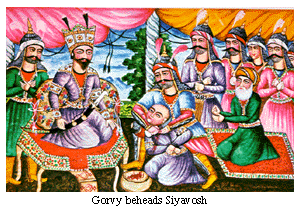
When
he was past the city and the host
They bore and dragged him bound upon the plain,
And then Gurwi received from Garsiwaz
A blue-steel dagger for the bloody deed.
He dragged the prince on by the hair afoot
And when he came to where the mark had stood.
. . . . . . . . . .
Flung to the ground
the mighty Elephant,
And showed no shame or reverence for rank,
But set a golden basin on the ground,
Turned up the prince's face as 'twere a sheep's
Cut off the silver Cypress' head and filled
The bowl with blood. Gurwi took up the bowl
And emptied it where he had been commanded.
From that blood presently there sprang a plant,
Which I will teach thee how to recognise,
For it is called "The Blood of Siyawush." 75
Gathering a Host
Upon his ascension to the throne of
[He
revived the times of Faridun and Jam
And tired not of dispensing justice,]
The world was full of happiness and peace,
The hands of Ahriman were barred from ill [.] 76
Zal-the son of Saam and grandson
of Nariman77 -his
son, Rustam, and the nobles of Kabulistan arrived in
"Paladin!
Live ever glad and happy, for thou art
The foster-sire of Siyawush and likewise
Art of all men most wise and reticent." 78
After a few days of rest and getting
acquainted with all the visitors who had come to pay their respect and announce
their support, the king set out on a hunting expedition. He requested that
Rustam accompany him:
The monarch of the world went forth to hunt
With Rustam, that illustrious paladin [.] 79
The hunt, however, served as a
cover for the king's real intentions-a full-fledged survey of the Iranian marches
and of the devastated land. After this assessment, Kaykhusrau went on a
spending spree. He ordered cities that had fallen on bad times to be
refurbished and citizens who had lost their property to be reimbursed. The
town-by-town inspection finally brought Kaykhusrau to
Here
he visited the Azargashasp fire temple, where he prayed to the Creator:
Approached the
Prayed in that Fane of Fire and praised the Maker.80
On his way from
[H]ow many paladins
Had died, and how their wives and children suffered,
Thus saying: "Thou beholdest many cities
Waste in
Kaykhusrau swore by the Fire that
he would be steadfast in his resolve and that nothing would distract him from avenging
the death of his father, not even Afrasiyab's kinship to him.83 As a token of his truthfulness, he made
a solemn pledge to that effect and had it recorded in the Pahlavi language and
witnessed by Rustam, Zal, and the other Iranian warriors:84
This they recorded in the olden tongue
With scented ink upon a royal roll,
And Zal and Rustam signed as witnesses,
And likewise all the other mighty men.
The written oath attested in due form
Was put for safety into Rustam's hands.85
On the eve of his departure, Kaykhusrau
visited the fire temple again and sought the Creator's support:
"O righteous Judge, the only God,
The World-lord, the Sustainer, and the Guide!
Thus didst deliver me, a hostless boy,
Out of the Dragon's breath. Afrasiyab
Thou knowest reckless, not afraid to injure;
His curse is on the waste and peopled lands;
Revenge against him filleth guiltless hearts.
He hath poured fire upon these goodly coasts,
Hath sifted o'er the brave the dust of woe,
Unjustly shed the blood of Siyawush
Upon the earth, and rent our souls thereby.
The hearts of kings are filled with dread of him;
His throne and diadem are this world's bane.
Thou knowest that he is of evil nature,
And both a miscreant and sorcerer." 86
Finally, he addressed the champions of
Nimruz, Kabulistan, and
[T]hen the Shah
Called all the archimages of the realm,
And spake to them at large in fitting terms.
He closed the door of audience for two sennights,
And had the muster-roll compiled afresh.
He bade the commissaries to call over
The names of great and small, and had them written
In solemn form befitting paladins.
The kin of Kai Kaus five score and ten-
Chiefs of the host-came first upon the list [.] 87
The list is impressive. It reveals the
structure of the military and shows how the various principalities in the
kingdom contributed to the defense of
The house of the king of kings,
Kayka'us, contributed a hundred and ten commanders. Fariburz, son of Kayka'us, led these
champions and their warriors the house of Nowzar, led by Zarasp (son of Tus), contributed
eighty champions; the house of Kishwad, led by Gudarz, contributed
seventy-eight mountaineers and horsemen of the plains; the house of Gazhdaham,
led by Gustaham,
contributed sixty-three fighters. Other houses offered similar numbers of
champions, horsemen, and fighters. Each house carried a distinctive banner. The
house of Gudarz, for instance, carried the Kaviyan banner, representing the
royal house. So numerous were the contributions that the mu'bad lost count:
Apart
from these, the lords and paladins,
The princes and the mighty men of worship,
Were more than any archimage could reckon,
So many were the chiefs with Grace and glory!
They wrote upon the monarch's muster-roll
The names of all efficients [.] 88
Rather than mobilizing the army
at once, the king gave a feast and bestowed wealth and titles on the
prospective heroes. The defeat of Palashan, Afrasiyab's commander-in-chief,
embodied the top prize.89 Bizhan,
the son of Giv, accepted the challenge. He also pledged to bring the crown of
Afrasiyab to Kaykhusrau.
As the ceremonies continued, other champions
entered the bidding. Giv accepted to set fire to a huge pile of wood that had
been placed strategically in a gorge on the Kasseh Rud90 to impede any assault on
Afrasiyab's domain. The most difficult mission, however, was Gurgin's. He was
to deliver Kaykhusrau's challenge to Afrasiyab and bring back the Turanian's
reply:
"This
is a present meet for one
Whose wisdom is the king of his pure mind-
A daring, prudent man and eloquent,
Who turneth not from lions in the fight-
If he will carry to Afrasiyab
A message, weeping not for dread of him,
And will convey his answer back to me.
Who of this noble company will dare?"
Gurgin son of Milad held forth his hand,
And gat him ready for that enterprise.91
After all tasks were assigned and rewards
bestowed, the king and Rustam talked further about the future, especially about
the Turanians and their hegemony over the lands in Zabulistan:
"Illustrious, glorious Shah!
There is a district in Zabulistan,
That formed a portion of the realm of Tur
Till Minuchihr drave all the Turkmans out.
It is a goodly and a glorious land;
But when Kaus grew hoar and spiritless,
When fame, the Grace, and prowess quitted him,
Turanians seized it and Iranians ceased
Therein. The folk now carry to Turan
Both toll and tribute, heeding not the Shah.
The march is full of elephants and treasure.
The innocent are troubled by this folk
With constant pillage, massacre, and raid,
And all the insolency of Turan.
Now that the kingship of
Thine from the ant's foot to the lion's claw,
'Twere well to send a valiant paladin,
And mighty host, to make this people bring
Their tribute to the Shah and look to him.
This region ours we can defeat Turan." 92
Since that land had much to offer in the way
of elephants and precious stones, and since the people did not like the
overlordship of the Turanians, Rustam suggested to the king to liberate that
realm and annex it to
The king, recognizing the merit
of the champion's strategy, suggested that since the land under discussion was
contiguous to Zabulistan, the seat of Rustam, an army could be sent under the
leadership of Faramarz, Rustam's son, to reduce
that domain. Rustam accepted to send his son to annex the region.
Tus
Equipped and ready for battle, the great
army, presented itself to the king. The king appointed Tus, a kindred of
Nowzar, as the commander-in-chief. He advised the lower ranks to follow the
commands of Tus, and he advised the aged warrior not to forsake his loyalty to
his sovereign, to observe the law of the Creator, and to aid the farmer, the
craftsman, and the businessman. Finally, he made it clear to the commander that
the army should not go by way of Kalat, the seat of Siyavosh's other son,
Farud: 93
Thou shalt on no account pass by Kalat,
For, if thou dost, things will go hard with thee.
To Siyawush (his soul be as the sun,
His place all hopeful in the other world!)
The daughter of Piran once bare a child
But little shown in public by his sire.
He is my brother and resembleth me.
He is a youth of mine own age, high-fortuned,
And liveth with his mother at Kalat;
A world-lord he who hath the Grace and troops.
He knoweth no Iranian e'en by name,
And from that quarter thou must turn thy bridle,
For he hath troops and famous men of war
Upon a mountain steep and hard to reach [.]" 94
Tus; accepted the
King's command, saying:
"In
thy counsels is success,
By that way which thou biddest will I go,
For good alone must come of thy behest." 95
Tus' army arrived at a fork in the road
where one way led to the waterless desert and the other, passing Charam,
provided good pastures and provision for the army at Mayam. Against
Kaykhusrau's advice, Tus chose the latter road. Gudarz reminded the general of
the shah's desire that the army should follow the desert road and not approach
Kalat, but Tus did not pay any attention to him. The army chiefs directed the
host on the road to Charam.
Hearing about the approaching
army, Farud brought his horses and livestock in his fort and shut the gate. 96 Then, following the advice of his mother, Jarirah, he
rode with Takhar to the crest of the mountain to view the army, recognize its
paladins, and introduce himself to them.
At the same time that Takhar was identifying
the Iranian commanders for Farud at the top of the mountain, Tus spotted Farud
and Takhar from the base of the mountain. He asked for a volunteer who could
climb to the peak and deal with the two:
"We need an enterprising cavalier
To hasten to the mountain-top to learn
Who these two warriors are and wherefore there.
If they be ours let him bestow on them
Two hundred lashes on their heads, if foes
bind them and drag them hither faces downward [.] 97
Bahram, from the house of Gudarz,
volunteered to perform the task and, at the peak, asked the two to identify
themselves. Farud identified himself as the son of Siyavosh and the brother of
the king. Then, showing Bahram his royal birth mark, Farud added that he wished
to meet Bahram and some of the other Iranian commanders so that he could bestow
gifts upon them. "It is my wish," Farud added further, "to ride
with the army of
Bahram, in turn, introduced himself and paid
homage to the prince. In response to Farud's request to join the Iranian army
to seek revenge for his father, Bahram was skeptical, given the political
situation of that obtained in
"O prince young and accomplished,
And valiant cavalier! I will report
Thy words to Tus, and kiss his hand while urging
Compliance. Still our chieftain is not wise,
His head and brains brook not good counselling.
He is accomplished, rich, and nobly born,
But nameth not the Shah. When Giv brought home
That glorious one, Tus was provoked with him,
Gudarz and Giv, supported Fariburz,
And said: 'I am descended from Naudar:
The kingship of the world is rightly mine.'
He very well may disregard my words,
And in his anger quarrel with myself [.] 98
When, at the end of their meeting, Bahram
was ready to leave the peak to take Farud's message to Tus, he gave the prince
some advice. "My prince," he said, "if Tus sends anyone other
than myself to this peak, it means that he intends to wage war against you.
Retire to your stronghold and fortify it as best as you can."
Back in the Iranian camp, Bahram apprised
Tus of the identity of the warriors and of the youth's royal lineage. Tus
became angry and denounced Bahram:
My words to thee were: 'Bring the man to me,
Ask him no questions.' If he be a king
Who then am I, and wherefore am I here
With this array? A man of Turkman race,
Like some black raven on the mountain there,
Is hindering the progress of the troops!
Among the froward offsprings of Gudarz
I can see naught but mischief to the host [.] 99
Thus discrediting Bahram by
attributing his loyalty to the farr to egoism, Tus asked for another
volunteer who would climb the mountain and decapitate the bold
"Turk." Rivniz, Tus' son-in-law, accepted the
challenge. On the mountain, Farud tried to discourage the Iranian warrior by
shooting at his horse, but Riv continued to climb on foot, Farud then shot him
dead with one arrow. Tus sent Zarasp, his own son, and Riv's brother-in-law.
Farud killed him as well.
Seeing how his warriors fell before Farud,
Tus took to the saddle himself and headed for the peak. Takhar advised Farud
not to stay and fight. "My prince," he said, "you are not a
match for the mighty Tus. We must return to the fortification and find a way to
defend ourselves." Farud, however, remained on the peak to battle Tus.
"If you do not wish to return to the fort," Takhar pleaded,
"then kill Tus' horse. Princes are not likely to fight when they lose
their steed." Farud followed Takhar's direction and killed Tus' horse. As
predicted, the loss of his horse stopped Tus' advance up the mountain. Tus
returned to the army disheveled and confused. Giv then accepted the challenge.
Takhar identified him as
"It
is the raging Dragon,
Whose neezings make birds topple from the air,
Who put Piran thy grandsire's hands in bonds,
And brake two Turkman hosts! He hath unfathered
Full many a little child. His foot hath been
On many a river, mount, and wilderness.
Full many a father too hath he unsonned,
And treadeth underfoot the lion's neck.
'Twas he that bare thy brother to
And crossed Jihun although he saw no boat.
They call him Giv-a very Elephant
Or river
Farud treated Giv in the same way that he
had others. He forced the warrior to return to the Iranian camp, as Tus had, to
be ridiculed. In the case of Giv, the return was painful. He had to confront
not only the other warriors, but also his own son, Bizhan. The latter was now
determined to take on the "Turk" at all costs. He would not listen to
anyone, not even to Gustaham:
For I have sworn a great oath by the moon,
The world's Judge, and the Shah's own diadem,
That if I am not slain I will not ride
Back from the mountain but avenge Zarasp." 101
Recognizing the invincibility of Bizhan,
Farud decided to return and shut himself up in the fort. Bizhan pursued him.
Before Farud reached the fort, Bizhan killed Farud's horse, injured Farud's
back and incapacitated his arm. Farud ordered his warriors to stay in the fort
and keep the gate securely shut.
Bizhan's feat had opened the pass to the
Iranian army. Tus then swore to kill the "Turk" and revenge the death
of his son, the valiant Zarasp:
"I will send up this hold's dust to the sun.
To avenge beloved Zarasp the cavalier
I will attack without delay, will make
This Turkman wretch a corpse, and with his gore
Engrain the stones like coral to the core." 102
That night Jarirah, Farud's mother, had a
terrifying dream. In her dream she saw a blaze engulf the entire Sepid Kuh,
consuming the fort and its inhabitants. When she awoke from this nightmare, she
went to the window of her apartment to view the mountain and the surrounding
countryside. The whole place was filled with Iranian troops. This further
discouraged her. She knew that the end had come and that the wounded Farud and
his warriors were no match for the Iranian army. Taking matters into her own
hands, she made sure that none of the fort's wealth passed into the hands of
the Iranian looters.
To carry out this plan, she mutilated and
killed all the Arabian horses in the stables and set the fort ablaze. This
done, she went to her mortally wounded son's apartment and killed him in his
sleep. She then killed herself.
Three days after the capture of Farud's fort
on Sepid Kuh, the Iranian army resumed its march on Turan. On their way they
slew all the Turanians they met and left their bodies on the road as examples.
Finally they reached the
On the Turanian side, Afrasiyab re-appointed
Piran his commander-in-chief and asked him to immediately gather troops from
all over Turan to fight the Iranians who were, at the time, impeded by a snow
storm.
The Iranians were baffled by the intensity
of the cold and the amount of the snow. Bahram attributed the storm to the
wrath of the Creator for the death of Farud:
A tempest rose and none took thought of fight;
A dense cloud came like flying dust, their lips
Congealed with cold, the tents and camp-enclosures
Were turned to ice, snow carpeted the mountains,
And for a sennight's space earth disappeared.
There was but little food or rest or sleep:
Thou wouldst have said: "Earth's face is turned to stone."
They slew and ate their horses. Multitudes
Of men and cattle perished. None at last
Possessed a charger. When the eighth day came
The sun prevailed, the earth was like a sea,
The troops were mustered, and Tus spake of fight [.] 103
On the eighth day, Tus assembled his warriors.
He asked Giv to make good on his promise, for which he had received a generous
reward from the king, and set fire to the pile of wood placed strategically in
a gorge by the Turanians to obstruct the movement of the Iranian army into
Turan. In spite of Bizhan's offer to carry out the task for him, the aged Giv
rode past Kasseh Rud and set the obstacle ablaze. The wall of wood burned for
three weeks. On the fourth week, the Iranian army continued its march to
Garugard, sending contingents out to scout the countryside.
Garugard was the seat of the Iranian Tazhav,
who had defected to Turan. He held the territory to the north of the
Tazhav dispatched Afrasiyab's shepherd,
Kabudah, to assess the strength of the Iranian army and bring him news of the
Iranian host. When Kabudah failed to return, Tazhav decided to approach the
Iranian camp personally and secure the necessary information. His small
detachment was ridiculed by the Iranians:
If thou art marchlord and king's son-in-law
How is it that thou hast not mightier powers? 104
Giv tried to persuade the traitor to go to
Tus and beg forgiveness, but Tazhav refused to denounce Afrasiyab and pay
allegiance to the king of
Then Ispanwi alighted from the steed:
Tazhav's face was all tears at losing her,
Yet sped he on to reach Afrasiyab,
And all the while Bizhan was in pursuit,
Who when he spied the moon-faced Spanwi,
Her musky hair descending to her feet,
Came to her, took her with all gentleness,
Made room for her behind him, and returned
Toward the army of the paladin. 105
After Afrasiyab received Tazhav and heard
him out, he rebuked Piran for having ignored his orders to mobilize an army. He
commanded the aged warrior to stop procrastinating and assemble the border
guards and meet Tus with a mighty army. Piran obeyed his king's behest and
mobilized a mighty force. He planned to reach the Iranians by taking a shortcut
through uncharted territories:
Piran commanded: "Quit the accustomed route,
Take the short road; the foeman must not hear
Of these my noble and illustrious troops,
So may I bring this great host like a mountain
Down unawares upon yon army's head." 106
Piran's decision was based on intelligence
from Tazhav to the effect that the Iranian army spent most of its time drinking
and that it did not expect to be attacked any time soon. This correct assessment
gave Piran the edge. And in the battle that followed many Iranian warriors
fell:
The more part of the Iranian troops were slain,
The rest had come back wounded [.] 107
Having inflicted yet another misfortune on
Tus' treatment of Farud and the news of the
army's defeat at the hand of Afrasiyab infuriated the king. Summoning the
scribe, Kaykhusrau dictated a letter to be delivered to Fariburz. In the
letter, he removed Tus from command and appointed Fariburz in his place.
Upon his return to the court, Tus was
further humiliated by Kaykhusrau in front of his peers. Pronounced unfit for
royal service and for royal company, Tus was banished to his estate, where he
was to spend the rest of his days.
Upon assuming command of the
army, Prince Fariburz dispatched Ruhham to
Piran with a message and a complaint:
Now
night-attacks are not the wont of heroes
And mighty men that brandish massive maces.
If thou wilt cease from arms we too will cease;
If thou preferrest war then we will fight [.] 108
Ruhham was well received by the Turanians.
After listening carefully to Fariburz' views on the war, Piran said that it was
the Iranians who had started the aggression against the Turanians and not the
other way around. And he made it clear that he understood the dilemma that Tus'
unwise decisions had created for the Iranians. To the new commander of the
Iranian army, therefore, Piran offered one month respite to decide whether he
wished to continue the hostilities or sign a peace treaty with Turan:
If ye will use the month that we accord
In marching from the frontiers of Turan,
And in a swift retreat to your own borders,
Ye will behold your reputation saved;
But if not we will close with you in fight;
Ask not for any armistice henceforth." 109
Fariburz decided to continue the war and the
two armies fought a number of battles. In the decisive battle, the Turanians
succeeded in cornering Fariburz, the mainstay of the Iranian army; they even
killed Riv, Kayka'us's son. Only the bravery of Bahram, who snatched the fallen
prince's crown, saved
Yet Bahram the warrior
Charged lion-like the foe and carried off
The crown upon his spear-point, while both hosts
stood wondering [.] 110
In the course of the day, the Iranian army
was greatly reduced in number, and by the day's end it began a retreat. The
Turanians rejoiced:
The Turkman cavaliers, with joyful hearts
Released from travail and anxiety,
Returned to their own camp with haughty mien [.] 111
To celebrate Piran's victory, Afrasiyab
summoned the old warrior to his capital and entertained him and his men for two
weeks. Then he presented Piran with some of the most precious pieces in his
treasury and advised him to keep a lookout in the direction of
Piran listened attentively, and when the
king's words were finished, he and his champions left for
The
The defeat of the Iranians in Turan brought
Of Rustam's wondrous deeds there is no scant,
His legend in the hearts of all is rife;
A crocodile in water, elephant
On land, wise, shrewd of heart, a man of strife,
Consummate both in war and valiancy,
A man of knowledge, wit, and weight was he. 112
Firdowsi also describes the mood of the
defeated forces returning to
Upon arrival, the king did not admit the
champions; even though, in private, he attributed the entire calamity to the
will of God. "If it were not Your will," he implored to Yazdan,
"I would have a thousand of the greats of the army sent to the
gallows":
I should command to set
A thousand stakes forthwith upon the open,
And Tus and all that carried arms with him
Should be impaled. I mourned my father's death,
My heart was filled with sorrow, pain, and trouble,
And now there is new vengeance for Farud,
For I must needs smite off the head of Tus.
I said: 'Avoid Kalat, avoid Charam,
Though people should shower drachms upon thy head,
Because Farud is with his mother there.
He is a hero of the Kaian race-
A warrior.' Should he know vile Tus or why
The army marched? Of course he would attack,
And from the mountain slaughter many chiefs.
Why did inhuman and insensate Tus
March in such haste against that hold? 113
But more than Tus, Kaykhusrau blamed
himself. Why did he bestow lavish gifts upon Tus? Why had he equipped Tus with
a mighty army to fight his own brother? Farud, too, he lamented was a victim of
circumstances like his father. Tus merely followed the dictates of Ahriman:
None know I worse than Tus, and he is ripe
For chain and pit. Brainless and veinless too
The wretch is as a dog to
The Iranian champions were dismayed. They
shared Kaykhusrau's grief, but they were unhappy that the shah should not admit
them to the court. Distressed, they approached Rustam and apologized to him for
what had happened. They explained that the events had been preordained and that
they had had no intention of fighting Farud, the king's brother:
God willed it so!
Who wished to fight Farud? 115
Besides, they justified Tus' act
as the act of a father whose son and son-in-law had been killed in the course
of the same day. Tus simply lost control, they said.
Rustam agreed to mediate their case and make the army's difficult situation
clear to the king. That evening, Rustam visited the court. He kissed the
threshold then pleaded with the king to reconsider his decision regarding the
army and Tus. He enumerated the reasons that the champions had provided and
added, out of personal experience, that the death of a son is hard to bear. 116
The king welcomed Rustam's interpretation of the event and praised the national
champion for his wisdom and counsel. He then allowed Tus to enter. Tus kissed
the threshold and paid homage to Rustam. From the champion, he turned to the
king and praised him profusely, expressing regret for his actions. The king
accepted Tus' expression of regret but did not allow the impact of the defeat
to remain hidden:
O'er the Turanians' waste the Iranians' hands
And feet and trunks lie scattered! 117
"The amount of anger and the zeal for
revenge-which rest at the heart of
The champions individually paid their
respects and swore to fight to the bitter end for him. The king praised his
paladins:
Khusrau then summoned Giv and seated him
Upon the throne of greatness, praised him much,
Bestowing many a gift and mark of favour,
And said: "Thou seekest toil on mine account,
But sharest not my treasures [.] 118
The king said that Tus should
not have made the difficult decisions alone. In matters such as going to Kalat,
fighting Farud, and facing the Turanian army, he should have drawn on the
knowledge and expertise of capable warriors like Giv. In the end, however, Tus
was appointed the task of returning the Iranian army to Turan. In this way, the
shah thought, the commander could not only redeem himself but also avenge the
murder of Siyavosh, the task for which he had originally been commissioned.
Soon after this meeting, Tus mobilized a huge army and met the Turanian forces
at the
Upon arriving at Shahd, Piran sent an
express messenger to Tus, hoping to win the Iranian commander over. Tus interpreted
Piran's conciliatory language as a signal that the Turanian warrior, often
sympathetic to
If thou speak'st sooth we have no quarrel.
Drop fealty, abandon thy surroundings,
And bar this door of fear and road of loss.
Go to the Shah alone, he will requite thee,
Give thee a royal crown and paladinship.
When he recalleth thy good deeds thy pangs
Will pain him to the heart. 120
Upon hearing Tus' message, Piran sent
another express messenger. This one, however, to Afrasiyab. In his message,
Piran apprised his king of how he had duped the Iranian commander with
illusions of his defection and asked Afrasiyab to assemble a large army:
Choose a warrior-host
Or else the war will be inglorious.
We may uproot the foe and fire their land,
Else in their vengeance for prince Siyawush
The Iranian army ne'er will rest from strife." 121
The struggle for supremacy
between
Tus
too advanced; earth rang with clarion-blare.
"And so from luckless Wisa," he exclaimed,
"A miserable Tree like this up-springeth!
Hast thou indeed come forth to fight since thou
Hast come forth mounted and with spear in hand?
By the Shah's life and head I would oppose thee
Without my breastplate, mace, and Ruman casque,
Just like a pard that clutcheth at its pray
Among the mountains [.] 122
Human chided Tus for having ignored his own
central role in the Iranian army and for having responded to a challenge for
single combat. He asked Tus to return to his army and send warriors who had
been praised by the shah, young warriors who sought recognition. He asked for
Bizhan and Giv of the Azadegan House. Furthermore, he told Tus that it would
not be right for the Iranian army to lose its commander-in-chief. What would
become of its organization?
But no amount of praise, not even placing
him among such champions as Zal and Rustam, could persuade Tus to give up the
fight. On the contrary, he tried to bring Piran's brothers to his side and
possibly stop the war:
The Shah directed:-
'Harm not Piran. He is my foster-sire,
Experienced, and my friend. Strive not with him
Unjustly, wantonly, and see that he
Hear thine advice.'" 123
Since the outcome of these combats almost
invariably meant death for one of the combatants, they usually spent a long
time, sometimes too long, trying to convince each other to call the fight off.
As in this case, other paladins entered the field and encouraged the combatants
to stop the talk and proceed with the fight. Interestingly enough often the
mediators, too, became a party to furthering the haggling:
If Tus slay me
Men still will use the mace and kettledrum.
Piran is living and Afrasiyab,
Who will avenge me promptly, but if Tus
Shall perish by my hand none of his troops
Will reach
Why railest thou at Tus son of Naudar?" 124
Tus did not relent and the fight continued
for the rest of the day. When at that time the outcome remained inconclusive,
the combatants decided to return in the morning and finish their fight. That
night, however, Piran talked to Bazur, a man well versed in magic and the occult.
"In the morning," Piran told
Bazur, "I intend to attack the Iranian position and settle this account. I
want you to ascend the nearby mountain and, as soon as the Turanian army
attacks, call down a snow storm upon the Iranians."
The next day, before Tus and
Human resumed their fight, the Iranian army was afflicted with unspeakable
cold; the intensity of the cold was such that the troops could not hold on to
their weapons. 125 While responding to that unprecedented calamity, Turanian contingents
arrived and killed as many of their numbers as they could. Tus, finding his
beleaguered troops surrounded by a mighty Turanian host, ordered his commanders
to gather the Iranian army and head for the mountain where they would have a
better chance of defence against the numerically superior forces of the enemy:
"I purposed when I sent the cavalier
To carry news of us before the battle,
That Kai Khusrau should send the son of Zal
To lead the reinforcements to the field."
He loaded up and, thinking of the slain
With anguish, called his men to horse again. 126
When the army reached the
Hamavan mountain, Tus asked Giv to assign those of the troops who had had a
respite to Bizhan and to take the rest of the army to the highlands himself. 127 On the Turanian side, Piran sent scouts to the
Iranian camp to estimate the strength of the remaining forces. The scouts returned,
reporting that the Iranian army had left, leaving all its baggage in the field.
Piran consulted his commanders. The Turanian army, they advised, must use Tus'
defeat and annihilate the foe. Piran did not agree. It would be prudent for the
Turanian army to wait, he said, until Afrasiyab's enormous army arrives. The
combined forces of Turan, he argued, can then be brought to bear on
Piran replied: "In war the foot of haste
Is feebler than delay's. A sea-like host
Is gathering before Afrasiyab
Let us delay till that great power with all
Its warriors and fighting-men shall come;
Then will we leave none living in
Such is the counsel of the wise. Enough [.] 128
Human disagreed with Piran's strategy of
delay. He contended that Tus' relatively large army, were it to escape the
Turanians, would eventually join up with the forces of Kaykhusrau. The
leadership of Kaykhusrau's army would undoubtedly be given to Rustam. Since a
large portion of that future foe was trapped in a distressful predicament, why
allow it to escape? We must find Tus' army and annihilate it, Human argued:
Be sure of this,
That they were forced to flee and once for all
Show us their backs. We will not let them reach
Khusrau and muster at his court afresh;
Then from Zabulistan will Rustam march
Upon us, this delay cause [sic] fearful loss.
Now is the time for me to fall on them,
And put in practice ruse and artifice [.] 129
Piran gave in. He told Human to use his own
judgment and treat the defeated Iranian army as he saw fit. In time, Human
found Tus' army and led Piran's forces to it.
When the combined forces of Human and Piran
faced the numerically inferior troops of Tus, Piran tried to convince Tus of
the futility of his resistance, especially since the house of Gudarz had lost
all its warriors. "The enmity between
Tus' predicament, however, was unique. His
troops had been forced up a mountain, while the surrounding countryside teamed
with enemy troops. It was only a matter of days, according to Piran, before
shortages would force them to either surrender or die. Tus, however, mounted a
two-pronged strategy to dislodge his forces. First he attacked the Turanians at
night and refurbished his army's dwindling supplies. Secondly, he sent a letter
to the shah and asked for reinforcements:
Assuredly my speedy camel-post
Hath reached ere now the monarch of the world.
My letter will inflame his heart anew,
The elephantine chief will come to aid us,
And with a noble company of Lions. 130
When the news of Tus' second defeat reached
Kaykhusrau and he was informed that the army had been forced to move to the
Hamavan mountains for protection, he dispatched a delegation of Iranian nobles
to Kabulistan to summon the mighty Rustam to the court. When Rustam arrived,
the shah praised him as the protector of the Iranian crown, the killer of the
White Demon, and the Rider of Rakhsh. He then mentioned Tus' defeat and the
great loss that the demise of the Gudarz warriors meant to the Iranian army. He
asked for the champion's help.
Rustam returned the shah's kind words with
similar praises. He told the shah that he, Rustam, had always been a protector
of Iranian lands and that he had proved his allegiance to
Thou art the world's king, and a slave am I
Girt to perform thy hests. Let not the Shah
Grieve for the slain, but let thy foes look wan.
With belted waist will I draw near to Tus,
And gird me to avenge the Iranians,
For liver-wounded have I been and girt
With mourning for the scions of Gudarz." 131
Rustam's words pleased the shah greatly. He
asked the royal treasurer to open the treasury to the champion so that he could
take as much money as he needed. He then asked Rustam to lead the warriors of
Zabulistan and Kabulistan along with 30,000 Iranian troops and reach Tus at the
Hamavan range as soon as possible. He further asked Rustam to assign the
command of the army to Fariburz, Kayka'us' son, so that the prince could avenge
the wrong that had been done to the house of Kayka'us by the Turanians.
On the Turanian side, Piran mobilized his
army and brought them to the foot of the mountain. Rather than following
Human's advice and attack the Iranian army, however, he continued his own
strategy of delay. The experienced commander thought that time was on his side
and that the Iranians would not last long on the mountain without provisions:
Since without your fighting
The foe will come to hand, why change delay
For haste? Why should we fight? Ten horse will serve
As scouts upon the plain. Wait we until
Our foes lack food and drink, and ask for quarter.
Unless they can subsist on thorns and flints
When provand faileth they will take to them
And die." 132
The Hamavan encounter was
"Troops throng from every side-a host whose dust
Would make a desert of the
Upon the battle-day. A chief is there
From Ma wara 'u'n-Nahr his head is raised
O'er circling heaven; a hundred lions' strength
Is his; he quelleth mighty elephants!
In height a cypress and in looks a moon,
A potentate whose toys are crowns and thrones,
Kamus, this chief of chiefs, will have his will
Upon Gudarz and Tus. The troops comprise
All those that dwell 'twixt Sipanjab and Rum.
I reckon first the Khan of Chin, whose crown
Is heaven, his throne the earth [.] 133
Piran is one of the most interesting
characters of the Shahname. He is a Turanian whose loyalty to Afrasiyab cannot
be questioned. He has his own sphere of influence, Khutan, and his own army.
Despite all he had received from Afrasiyab, however, Piran is partial towards
the Iranians. He married his daughter to Siyavosh, and aided Kaykhusrau, the
enemy of Turan to escape.
As the numbers of Afrasiyab's allies swelled
and other commanders, mostly monarchs, came to the front, Piran's role became
less and less prominent. But still the combined forces followed his behests.
The experienced warrior effectively held the various participating armies at
arm's length. He discussed other commanders strategies at the assemblies but,
in his heart, he was devoted to the strategy of delay. "The Iranians would
either give up and surrender or die of starvation," he thought. "And,
in either case, the greater army, while necessary to frighten the Iranians and
confine them to the mountain heights, will not have to fight directly. The thought
of winning a victory without a fight pleased him:
"I will go forth
To meet them. They have had a longsome march,
Equipped for fight and full of care. They hold
Their heads as high as doth Afrasiyab,
For they have treasure, lustre, throne, and state.
I will go forth and see what men they are,
How many, with what chiefs and warriors,
Will do obeisance to the Khan of Chin,
And kiss the ground before his throne withal:
I will behold Kamus, the exalted one,
And find Tus an opponent in Shangul.
Returning hither I will gird myself
To rob the Iranians of the breath of life,
And, if they cannot hold their own, will make
Day dark and strait to them [.] 134
Furthermore, Piran knew well that the war
with
The division of the army and the deployment
of three or four major armies, each with a particular aim, was practiced by
both
In ancient times, armies did not have the
entertainment facilities of the medieval and contemporary armies. They spent
their free time celebrating a victory or, in the case of a defeat, licking
their wounds while ruminating about the future. They were greatly concerned
with their destiny, especially when they were placed between a rock and a hard
place, as was Tus' army at this time. The morale of every force, therefore,
depended on the strength of character of its commander-in-chief and of the
paladins who served him. If the commander-in-chief was weak, the champions
chided him in private. ,p> Religion played a pivotal role in these wars and
the Creator, the One on Whose behalf the war was being waged, was repeatedly
asked for aid. Indeed, it was part of the duty of the mu'bads to remind
the troops of the Creator's good will and to dispel pessimism propagated by
Ahriman.
The Iranian army was gradually plagued by
pessimism. Tus, the commander-in-chief, sank into depression. He thought that
the Iranian army was doomed. Only Rustam, he admitted, could save
Giv said to Tus: "O general of the Shah
What aileth thee to think upon mishap?
We need not look for ill; God is thy Helper;
We are His worshippers, and have broadcast
Much seed of good. Such fortune hath the Shah,
The lord of scimitar and throne and crown,
That God will not withdraw His help from us,
And leave our enemies to work their will.
With Rustam's coming all our soldiers' cares
Will end. Let no man cease to trust in God
Though day should turn to night. Let not thy heart
Be straitened needlessly because our foes
Forbear to fight one day: they have not shut
Heaven's door on us. Fear not the foe's designs.
If God most high ordaineth loss for us
Quit vain imaginings for come it will [.] 135
As the forces from the surrounding kingdoms
converged around the mountain, the Iranian commanders began to despair. It was
obvious that, given their strategic situation and their numbers, there was
little hope of leaving the mountain stronghold alive. One night, Tus assembled
his warriors and gave his last speech. "We shall attack the Turanian army
tonight," he concluded, "and we shall fight to the death."
Their gloom, however, was soon transformed
to joy; news came from the scouts that an Iranian army, headed by Fariburz,
Kayka'us' son, had just come into view and would reach Hamavan early the next
day. With this addition, the ranks of the Iranian army swelled. Piran remained
in the Chinese camp until the Khaqan of China's army was ready to move in the
direction of the Hamavan range. Then, accompanied by Kamus and the other kings,
Piran came to the battlefield. The Iranian army faced them in full strength.
The Khaqan of China did not mask his
displeasure upon seeing the Iranians. He rebuked Piran for having
underestimated the strength of the enemy. "The Iranian army before
us," he said to Piran, "is not the miserable bunch of which you
spoke. It is a force to be reckoned with":
[B]ut when the Khan afar
Looked forth and heard the Iranian horsemen's war-cry
It pleased him and he said: "Behold a host
Of men-o'erthrowing, warlike cavaliers!
Piran the chieftain told us otherwise,
But brave men's qualities should not be hidden.
The chieftain masketh the pit's mouth with brambles,
And thither will his horse speed at the chase.
What better is it vainly to besmirch
The foemen's prowess on the day of fight?
I have not looked on cavaliers and chiefs
So stamped with chivalry and manliness." 136
The command structure of the Turanian army
was more complex than that of Tus. This was due to the participation of the
many kings that Afrasiyab had summoned from the surrounding domains to assist
Piran in battle.
Afrasiyab, the supreme ruler, occupied the
highest level of the structure. He was not to be seen. The supreme commander of
the fighting forces in the field was the Khaqan of China of China, who
commanded the largest army. Following the Khaqan of China in strength was Kamus
the Kushan. He commanded the Kushani or Transoxanian army. He was a paladin
himself and sought to gain fame by fighting the strongest paladin
Below the supreme command were the national
champions. Piran ranked first among this group. He not only commanded his own
forces (the forces of Khutan), but also assigned Afrasiyab's champions to
positions of responsibility.
In order for the Iranians to win this war,
they had to defeat Piran and the forces of Afrasiyab. Before that, however, at
least in Piran's stratagem, they had to eliminate Shangol, Kamus, and the
Khaqan of China of China. Only the defeat of Piran would force Afrasiyab to
emerge as the supreme leader of Turan and the adversary to be annihilated.
Piran, although overtly identified as the
commander-in-chief of Turan, was actually a relatively low-ranking official.
His status and lack of authority in the expanded army is revealed gradually.
Indeed, were it not due to his close relationship with Afrasiyab, he would not
have enjoyed the assignments he received or attend to the important, and
sometimes difficult, tasks that he managed.
When the combined forces of Turan and the
reinforced army of
The Khaqan of China did not approve of this
plan. Kamus then suggested an alternate plan. He proposed to assemble all the
armies in one place and unleash their full power upon the Iranian army. He
further proposed the attack to be undertaken immediately so that the Iranians
would not have a chance to integrate their reinforcements into their ranks
before deployment. "This strategy," Kamus claimed, "would take
the Iranians by surprise and defeat them within a day." Kamus' plan was
accepted and the Turanian commanders prepared for their final assault on
Firdowsi, Hakim Abu al-Qasim is very keen on
etiquette and protocol. Often he spends many bayts, putting a dialogue in its
proper perspective so that all the requirements of the culture are met. A good
example of Firdowsi, Hakim Abu al-Qasim's care occurs here, when Gudarz
welcomes Fariburz, the king's son, and a paladin sent with the fast-moving
reinforcement contingent in advance of Rustam's slower-paced army. The burning
question is whether Rustam is on the way or whether the army that Fariburz has
brought is the entire reinforcement army. Were Gudarz to ask the question
straight out, it would be an insult to the person and the army of the prince.
So Gudarz improvised. He enumerated the large number of divisions and the
mighty men that commanded the Turanian army. The prince consoled the aged
warrior by enumerating those who would fight on the side of
It became known only gradually that Rustam
had been assigned the supreme command, making him the counterpart to the Khaqan
of China of China, and that he had issued directives to the effect that all
fighting must stop until he reached Hamavan:
Gudarz made answer: "What did Rustam say?
His words should be reported." Fariburz
Replied: "Illustrious one! the peerless Rustam
Bade us not fight. 'Stay on the field,' he said.
'Ye must not show yourselves before the host,
But take your ease until my flag appeareth.' "
Then Fariburz, Gudarz in company,
Marched toward
A new assessment of the Iranian forces threw
more doubt on Piran's capabilities. His esteem at the Khaqan of China's court
reached a low ebb, and his strategy of delay came under heavy criticism by
Kamus the Kushan. Once Piran's duties were relegated to Kamus, the latter
openly rebuked Piran for having procrastinated and thereby jeopardized the
lives of many kings, commanders, and people. "For five months," said
Kamus, "you had the mighty army of Afrasiyab at your command to subdue a
rag-tag band of Iranians. What happened? I personally am not afraid of either
the large army of
Kamus said: "Keep thyself to thine own force.
Thou hast the warriors of Afrasiyab-
An army like the waters of the sea-
Yet what hast thou accomplished in five months
Against a foe so small? Now that the earth
Is full of troops led by the Khan, Manshur,
And me, let us display our prowess; thou
Hast locked the door but we will bring the key.
Although the world's face be as silk of Chin
With soldiers from
Yet, should I fight alone, the Iranians
Were nothing. Thou wilt say of them: 'They are not.'
Thou wouldst scare me with illustrious Rustam;
Him will I slaughter first; if once I catch him
His name shall not be talked of any more. 138
Piran thanked Kamus for his graciousness and
wished him well. Only then the Khaqan of China of China, who had thus far
ignored Piran, addressed the aged warrior. "You should not have praised
the enemy," he said to Piran in protest. "Nevertheless," the
Khaqan of China continued, "I reaffirm Kamus' pledge to defeat
Piran was obsessed with the idea that the
Turanian army, irrespective of its size and of the might of the monarchs and
commanders that contributed to its strength, was a match for the Iranian army
only if Rustam were not a part of the latter army. Whenever he expressed
happiness at Rustam's absence, however, he was ridiculed. The appearance of
Fariburz instead of Rustam elated Piran, a pleasure that he could not hide.
Others in the Turanian camp did not share his opinion:
Why this grief? What need is there
To weep because of Rustam or of Tus?
With all our soldiers, maces, elephants,
And scimitars we block the wind itself.
Why fear then Rustam, Tus, and Kai Khusrau?
What are the Iranians but as dust to us? 139
Piran, however, did not learn his lesson.
Hearing that Rustam's black pavilion was pitched among the tents of the Iranian
army and that Tus and Gudarz had been entertained by the national champion, he
despaired. Ignoring the many paladins surrounding the Khaqan of China, he made
his paranoia about Rustam apparent. The assembly, especially Kamus, was not
impressed. "I shall not despair," said Kamus, "even if
Kaykhusrau himself entered the battlefield. I am a mighty warrior. Neither Rustam
nor his Zabuli warriors frighten me. As for you, Piran," Kamus concluded,
"you must control yourself. Return to your camp and prepare your men for
war":
"O wise one!" said Kamus,
"Thy heart produceth naught but ill surmise.
Know thou that Kai Khusrau hath come to war,
But do not therefore vex thy heart in vain.
Why harp so much on Rustam? Name no more
Zabulistan. If he beholdeth me
With flag in hand his heart will mourn at fight.
Go thou, array the host, lead forth the troops,
And bring the standards to the battlefield.
When I go forth to combat with the host
Ye must not loiter. Now shalt thou behold
The combating of men. The wilderness
Shall be a sea of blood." 140
In the Iranian epic, the horse plays a major
part. At times the very life of a paladin depends on the intelligence of his
steed. For instance, Farud saved himself a confrontation with Tus, a
confrontation that might have ended his life sooner, by obliging the champion
to fight on foot-an act forbidden by monarchic tradition. Similarly, Siyavosh,
when he was convinced that his death was near, talked to Shabdiz and instructed
the horse to obey only Kaykhusrau and lead him to the kingship of
Rakhsh, Rustam's famous mount, figures
prominently in many episodes of the Shahname. At this juncture, Rustam used him
as part of his strategy to surprise the enemy. Concealing Rakhsh and, thereby,
his own identity, Rustam persuaded paladins like Kamus and Shangol to enter the
battle on their own to be killed. This is how Rustam's ruse was set up.
Rustam told Tus and other champions that he
intended to rest Rakhsh for a day-the first day of battle-so that the animal
could ward off the fatigue of having run twice his usual distance. Since it
would be impossible to command without a horse, Tus was appointed commander at
center. Fariburz and Gudarz were placed on Tus' right and left respectively.
The Turanian army had a similar arrangement with the Khaqan of China at center
and Kamus and Piran on the right and the left wings, respectively.
Rustam's strategy worked. The
war began with the customary challenges and counter challenges. Finally, a
Turanian champion, Ashkabus, challenged the
Iranians. Rustam gained Tus' permission to respond to the challenge and walked
into the center. His appearance confused the enemy. Without Rakhsh, no one knew
who he was or where he hailed from. Seeing Rustam on foot before him, Ashkabus
laughed and asked the champion's name. Rustam did not identify himself. He
merely said that Tus had sent him to the battlefield to take Ashkabus' horse
and to teach him a lesson in fighting on foot. The Kushani was not at all
convinced that Rustam could defeat him with only a bow and arrows. He sped his
horse to run Rustam down. Rustam shot Ashkabus' horse dead with his first
arrow. The Kushani then realized the power of Rustam's arm. He got up quickly
and showered Rustam with arrows. Rustam shot through Ashkabus' coat of mail and
killed him instantly.
Kamus and the Khaqan of China watched the
combat closely and, as soon as Rustam left the field, inspected Rustam's arrow,
which was larger than any they had seen. It resembled a spear. Once again
Khaqan of China rebuked Piran for having given him false information on the
strength of the Iranian fighting men:
The
Khan's heart aged
When he beheld the feathers and the point.
He spake thus to Piran: "Who is this man?
What is his name among the Iranian chiefs?
'They are a paltry remnant,' were thy words,
'Not on a par with men of high degree,'
Whereas their arrows are like spears! A mountain
Hath little heart to fight them; thou didst make
The matter small indeed, but thine account 141
Piran expressed his astonishment.
He said that he did not know of anyone in the Iranian army who could pass an
arrow through a tree. Giv and Tus are indeed great warriors, Piran admitted,
but they are nowhere near the warrior who had just left the field. In spite of
Piran's equivocation, Kamus knew well that the mysterious warrior was Rustam.
"Could this mysterious paladin be the same Sagzi 142 of whom you have frightened us to death?" Kamus
asked Piran, sarcastically:
[H]e surely is the warrior,
The man of Sigz, of whom thou spakest oft,
And he hath come upon the field afoot,
Come to give succour to the Iranian host." 143
"Who is this Sagzi?" Kamus wanted
to know. "What does he look like? What words does he use in his opening
statement on the day of battle? What tactics must I know were I to face this
Rustam?"
"For your sake," said
Piran, "I hope you will never have to face the Sagzi. On many occasions,
even Afrasiyab has had difficulty coping with him. 144 He is
Late in the day, a meeting was held in the
Khaqan of China's pavilion. All the warriors including Kamus, Manshur, Fartus,
Shamiran from Shoghn, and Shangol from
In the morning, before the armies faced each
other, the Khaqan of China advised the other commanders to ignore Piran and
overwhelm the Iranians. The warriors paid homage to the Khaqan of China and
proclaimed him the ruler of
On the Iranian side, Rustam assembled his
warriors and told them that despite their previous losses under Tus, the
Iranian army was still a major fighting force. He reminded them that they were
fighting for Kaykhusrau and that, at the end of the war, much fame and fortune awaited
them.
The two armies then put their commands in
order. On the Turanian side the Khaqan of China assumed the command at the
center. Kamus led the right and Hind the left wings. On the Iranian side,
Fariburz assumed the command of the left and Pur-i Kishwad the command of the
right wing. Tus remained in the center as the commander of the whole army.
Rustam's strategy for singling out the major
leaders and killing them off one by one worked. He expected the major challenge
to come from Turan. It did. Kamus rode out the next day and challenged the
mysterious paladin. Rustam walked out into the open carrying a heavy mace and a
noose.
The two exchanged routine opening statements
and engaged each other in single combat. Kamus reached for his sword to decapitate
Rustam but failed. Rustam, on the other hand, caught the Turanian's midsection
in his noose. Kamus struggled to free himself but, after a while, he lost
consciousness and fell off his horse. Rustam then tied Kamus' hands up and
brought him to the Iranian camp. He threw Kamus at the feet of the Iranian
warriors and told them they could do with him anything they pleased. "What
I wish you not to forget when dealing with this man," said Rustam,
"is that he had intended to destroy not only
The Iranians tore Kamus' body to pieces.
The Khaqan of
With the death of Kamus, the Turanian army
was plunged into disarray. No one believed that the Kushani champion could be
eliminated so easily. Questions regarding the identity of the mysterious
paladin were on every tongue. The Khaqan of China was warned that the Turanians
would refuse to fight as long as the Iranian paladin's identity was not known.
As Rustam's strategy continued to work for
When direct action failed, the Turanians
used other tactics. Human visited Rustam in disguise and tried to identify the
mysterious paladin by leading him through a maze of questions, the answers to
some of which could reveal the identity of the champion. But this, too, did not
help. The conversation, however, was not totally fruitless. Human learned the
reasons for the Iranian champion's crusade. "The murder of Siyavosh,"
Rustam said, "is the main reason for the war between
When Rustam named those whom he
wanted the Turanians to turn over to the Iranians, Human paled. They were
Garsivaz, the main cause of the bloodshed; Garu-ye Zereh and his son; the house
of Viseh, which included Human, Lahhak, Farshidvard,
Kulbad, and Nastihan. "If you deliver these individuals to me,"
Rustam said, "I shall cease hostility against your people and your nation;
you will no longer need to wear your armor. But if you refuse, you will receive
more of the same treatment."
Rustam's words shook Human who recognized
his own family identified as the cause of the hostilities between the two
peoples. "With such power and greatness," Human asked Rustam,
"why are you a mere champion? You could easily be the king of
"Forget about my identity," Rustam
replied firmly. "Inform the Turanians about my demands. More than anyone
else, Piran carries the burden of the death of Siyavosh," Rustam continued.
"Send Piran to me. Together, we might find a solution."
"I have no doubt," said Human when
he met Piran and the Turanian champions, "that the Iranian champion is
Rustam of Zabul. He spoke eloquently about his grievances and listed his
complaints. I was first on the list of those whom he recognized as the
contributors to the downfall and death of Siyavosh. He also mentioned Piran,
the Viseh champions, and all those who have, at one point or another, harmed
Piran regarded the appearance of Rustam in
the war as a bad omen and warned Human of the calamity that Rustam could bring
on Turanian lands. Then, rather than going to Rustam forthwith, he went to the
Khaqan of China of China to apprise him of this new development.
The Khaqan of China knew little about
Rustam, so Piran told him how Rustam, the Lord of Zabul, had nurtured Siyavosh,
how he regarded Siyavosh as a son for whose revenge he was ready to sacrifice
all. "I am going to talk to him," said Piran, "and see what the
future brings."
The Khaqan of China encouraged Piran to face
up to Rustam. "If the champion is willing to forego the war," the
Khaqan of China said, "ask for plenty of war damages. If, on the other
hand, he seeks revenge, we shall give battle and we shall make his life
miserable. After all, he is a mortal, and all mortals die. Besides, for every
man in the Iranian army, we have three hundred," said the Khaqan of China
with pride. "I will fight him personally and show him what a warrior upon
an elephant can do."
When they met, Rustam introduced himself as
Rustam of Zabul. He then saluted Piran both in the name of Kaykhusrau
(xorshid-i rowshan ravan) and of the king's mother, the daughter of Afrasiyab
(dokht-i Afrasiyab).
Piran returned the salutations with
appropriate mentions of Zavareh, Faramarz, and Zal. "I
know," said Piran, "that you loved Siyavosh like a son. I loved him
the same way. He was my son-in-law. I hid Kaykhusrau and his mother in my house
against the will of my king. I made their escape to
Piran's words did not strike Rustam
favorably. "I considered you an upright Turanian," Rustam said.
"Besides, I thought you would appreciate my solution for ceasing
hostilities. We are talking about a murdered king. If you wish the hostility to
be settled with bows and arrows, so be it! Before that, however, let me reiterate
my solution. I request that the Turanian leadership deliver to
Piran pondered his situation for a while. He
then responded that he needed to consult with Manshur, Shangol, and the Khaqan
of China of China before he could give an answer. "Besides," Piran
said, "I should send a messenger to Afrasiyab and apprise him of your
demands."
When Piran returned, he assembled the
warriors of the house of Viseh and briefed them. "What Rustam wants,"
Piran said, "is those who were responsible for the death of Siyavosh.
Looking around me here, I don't see anyone who, in one way or another, is not
involved in the war and the reasons for it. The Iranians might just as well ask
for us all."
In the camp of the Khaqan of China, Piran
was met by the armies of Kushan, seeking revenge for the death of Kamus. They
demanded that Afrasiyab, the perpetrator of the calamity, show himself and
fight like a man in the war he had created, rather than hide in his palace and
issue orders. "We shall gather an army," they said, "of
Kushanis, Chinese Buzgush, Sagsar, and Mazandaran we shall set fire to Sistan;
we shall hang Rustam of Zabul and see his family mourn for him as we mourn our
fallen warrior. We shall burn Rustam's body and scatter his ashes to the wind.
But first give us Afrasiyab!"
Once again, Piran lamented that his army
should face a paladin like Rustam. He despaired. Shangol, the king of
In the Iranian camp, Rustam gathered his
warriors (Tus, Ruhham, Gudarz, Giv, Fariburz, Gustaham, Kharrad, Gurgin, and
Bizhan), along with his learned men and mu'bads. He briefed the
gathering about his meeting with Piran and praised the aged warrior for his
upright stance in all affairs. Rustam further detailed the help that Piran had
extended to the king and his mother when they were in Turan and hoped that he
would not have to kill the aged warrior with his own hands. "As long as
they deliver the individuals involved and the treasures that were taken to
Turan, we shall be satisfied," he said.
Gudarz disagreed. He explained how, on a
different occasion Piran had worn the same disguise and promised to return to
his army and bring an end to hostilities. "Instead," Gudarz said,
"Piran sent word to Afrasiyab and asked for reinforcements. Piran is as
much a friend of
Rustam agreed with Gudarz that Piran would
never be a friend of
Said
Rustam: "Be thy words
And wisdom wedded. He is as thou sayest.
We and that old man differ, 'tis no secret;
But, in as much as he hath done us good,
I would not fight him to the bitter end.
Remember how he acted toward the Shah,
And how he mourned the fate of Siyawush.
If he should break his word and set on us
I have my lasso at my saddle-straps
To take fierce Elephants. But I will fancy
No ill at first; we may escape a conflict;
But, if he should be faithless, he shall find
The outcome pain and grief." 145
In the morning, the drums sounded in front
of Tus' tent, and the army was mobilized. Rustam appeared in full armour. The
son of Kishwad took the right wing, Fariburz the left, and Tus stood at the
center. Rustam took the leading position.
The Turanians took up a similar arrangement:
the Khaqan of China with his elephants provided a solid center; Kundor with
thirty thousand warriors carrying javelins took the right, and Gahhar with
another thirty thousand troops carrying bows, arrows, and Chinese shields took
the left. Piran, leading the army, reminded Shangol of his vow to fight Rustam
and avenge the death of Kamus. The war began.
Piran's main concern was Human, his brother,
whom he did not wish to be seen by the Iranian champion. With two thousand
warriors, he assigned Human the rear center, behind the Khaqan of China and his
elephants. He then rode to Rustam, praised the champion and wished him well.
"I apprised my chiefs of your proposal," he said, "and am sorry
to say that I found compromise difficult. Treasures and valuables they could
give up. But they would not discuss delivering people. Those you name are the
relatives of the king; there is no way that relatives of the king could be
delivered to the enemy. Furthermore, matters are no longer in Turanian hands.
People from all confines of the earth (
Rustam listened patiently. He expressed his
disappointment at Piran, adding that Kaykhusrau, the king of the world, had
warned him of such a ruse. Explaining that he had tried to give Piran the
benefit of the doubt, he told how the aged Gudarz had also spoken against him.
"I see now that they both were right," Rustam said. "You are a
liar. You have lived a miserable life, and more is yet to befall you. I invited
you to splendor and to a meaningful life at the court of the young king. You
chose to remain in the plains among the lowly. You deserve what you have."
Piran paid his respects to Rustam and left. Rustam then addressed his
commanders:
"My loins are girt for battle, be it yours
To think but of revenge, and let each warrior
frown, for no small strife fronteth us to-day,
But one that will appraise both wolf and sheep.
The reader of the stars hath said to me:-
'My heart is troubled by this coming fight;
'Twill be betwixt two mountains, troops in mass
Will bathe the world in blood, the veteran chiefs
Will gather, and the strife unman the world;
Then feud will cease to stalk, the steel mace grow
Like wax.' Have no misgivings, whosoe'er
May come to fight with me, for I will bind
His hands within the twisted lasso's coils
Although the starry heavens be his ally [.] 146
Shangol moved to position in front of the
Turanian army and challenged Rustam. Rustam felt relieved that a stranger had
challenged him. "I shall," Rustam said, "route the armies of
The brief encounter with Rustam changed
Shangol's attitude. He advised the Khaqan of China that the Iranian paladin was
too strong to be faced alone. "A whole contingent must surround him and do
away with him," he said.
"Do I recall a speech very different
from what I hear?" said the Khaqan of China sarcastically. He then ordered
the full force under his command to attack Rustam and kill him.
Swarms of enemy troops surrounded Rustam who
was, in turn, surrounded by the Iranian troops for protection. Urging his
cohorts to fight bravely, the struggling champion attacked and killed Savah, a
relative of Kamus who carried the Turanian banner. The banner of the Kushans
fell into the hands of the Iranians. Rustam then headed for Gahhar on the left
wing. Gahhar fled to the center to take refuge with the Khaqan of China. Rustam
pursued him relentlessly and killed him. The Turanian black banner, too, fell
into the hands of the Iranians.
With both wings of the enemy's army
destroyed, Rustam took a hundred experienced warriors and headed for the
center. He cut his way through until he reached the Khaqan of China's white
elephant. The Khaqan of China, realizing that defeat was imminent and that he
had lost both of his wings, sued for peace. Rustam refused. The Khaqan of China
agreed to withdraw to
[Rustam] flung the lasso coiled and took the heads
Of cavaliers, neared that white elephant,
And then the Khan of Chin grown desperate,
Smote with the goad the creature's head and, roaring
Like thunder in the month of Farwardin,
Took and hurled forth at Rustam deft of hand
A double-headed battle-dart in hope
To worst him and to take his noble head;
But Rustam, scathless, flung his lasso high,
Dragged from his elephant the Khan of Chin
Noosed by the neck, and dashed him to the ground,
Where others bound his hands and drove him on
Toward the Shahd afoot without his crown,
His litter, throne, or elephant, and there
They made him over to the guards of Tus [.] 147
After the defeat of Kamus, Manshur, Shangol,
and the Khaqan of China of China, Piran whisked his champions off the
battlefield into uncharted territory known only to him. Rustam, unhappy about
the flight of the very instigators of the murder of Siyavosh, chided Tus for
allowing the enemy to flee. He sent search parties in pursuit of the Turanians,
but the searchers returned empty-handed. "With the house of Viseh still
standing," Rustam told his champions, "Afrasiyab remains a mighty
force. He has the army of Khutan to aid him. We must apprise the king of our
progress and ask for direction."
Rustam chose Fariburz, Kayka'us' son, to
accompany a letter and the booty they had won back to
The king received the news with delight. He
praised the Creator and cautioned Rustam against the ruses of the enemy.
"Before long," Kaykhusrau warned, "the Turanians will regroup
and reappear on the battlefield. Be forewarned, therefore. As long as Afrasiyab
lives,
On the Turanian side, Afrasiyab was informed
of the defeat of Kamus, Manshur, and the Khaqan of China of China. He assembled
his council of ministers and his warriors, and spoke, as Piran would, about
Rustam and the ominous future that awaited Turan. The council did not agree. It
argued that only the Slavs and the Chinese had fielded their men and had lost.
"Turan," they said, "had remained as invincible as it had ever
been. Afrasiyab the council decreed, should open his treasures to the army and
recruit as many troops as possible for a final encounter with the
Iranians." Afrasiyab agreed.
Meanwhile, Fariburz returned from
The battle at Hamavan is one of the decisive
battles in the Shahname. In the course of this battle, Afrasiyab lost the
greater part of his army, especially the international force that he had
forged. He lost the highlands of the Pamirs, his most trusted natural barrier
against Iranian assault, and became even more vulnerable in the southwest where
he had lost his stockade at the
Rustam seized the opportunity to continue
his march into Turan and face the combined armies of Afrasiyab and his new
allies. Despite Afrasiyab's supernatural skills and the "powers" of
his new allies, Rustam was not defeated. Fleeing before the Iranian national
champion, Afrasiyab sent all his treasures to Almas Rud, crossed the
When the Iranian army finally returned from
Turan, the champions were met by the king at Pahlav. Seeing the king's crown,
Rustam dismounted and paid his respects. The king embraced the paladin, praised
his valor, and led him to his pavilion. The other champions followed. In the
pavilion, the king placed himself on the throne with Rustam at his right. The
other champions assumed their places according to protocol. Throughout the
night they talked about the war and about Rustam's defeat of the various foes.
Rustam spent the next month at court. He
then asked permission to travel to Zabul and visit the aged Zal. The king gave
his permission. And when the champion's entourage headed for Zabulistan, he
showered Rustam with precious gifts.
Piran of Viseh
After his flight before Rustam, Afrasiyab
traveled to Khallukh country. There he assembled his counsellors, commanders,
and champions-Piran, Garsivaz, Qarakhan, Garsiyun, Human, Kulbad, and Ru'in-and
complained:
"Since I assumed the crown of sovereignty,
And sun and moon bestowed on me their light,
I have held sway among the potentates,
And nobody hath turned aside my rein;
Thus ever since the war with Minuchihr
Now from
Upon my life at mine own palace-door!
The craven hath become courageous,
The Stag hath ventured to the Lion's lair!
We must be up and doing in this strife,
Or they will make our marches reek [.] 148
"What must be done is clear,"
Afrasiyab said. "We must place the combined forces of Turan and
Happy of the outcome, Afrasiyab sent letters
to the Faghfur, to the king of Khutan, and to other rulers sympathetic to his
cause. Within two weeks, a large army assembled in Khallukh. Afrasiyab opened
the treasures of Turan, accumulated since the time of Tur, and gave out untold
sums for arms for a mighty army. He even allowed his wild horses to be tamed
and trained for service in battle. When all was ready, he divided his forces as
follows:
1. 5,000 warriors were assigned to Shideh,
Afrasiyab's son, to guard the marches of Khwarazm.
2. 5,000 Chinese troops were assigned to
Piran to cross the Oxus and establish a Turanian kingdom in
3. The rest of the army he kept with himself
in Khallukh country.
When news reached Kaykhusrau that the
Turanian armies had occupied the upper and the lower Oxus he too assembled his
champions-Zal, Rustam, Gudarz, Giv, Shidush, Farhad, Ruhham, Bizhan, Ashkash,
Gustaham, Gurgin, Zange, Gazhdaham, Tus, and Fariburz-and directed them to
select 300,000 warriors from India, Rum and Arabia and to prepare to march on
Turan within the next forty days:
Those that reach not the presence of the Shah In forty days shall not
obtain a crown." 149
Hardly two weeks after the announcement, the
whole country had responded. Large numbers of commanders and nobles flooded the
capital. Like Afrasiyab, Kaykhusrau opened his treasury to the army and
equipped it well. And when ready, he divided his forces as follows:
1. Rustam, with 30,000 choice warriors, was
commissioned to capture
"Famed hero!
Lead these toward Sistan and
When at Ghaznin make for the upper road,
So thou mayst win a signet, crown, and throne;
But when thou hast achieved the sovereignty,
And pard and sheep are drinking at one trough,
Give Faramarz the signet and the crown
Together with such troops as he may choose;
Then sound the kettledrums, the horns, and pipes,
And stay not in Kashmir or in Kabul,
Because this war against Afrasiyab
Depriveth me of provand, rest, and sleep." 150
2. Luhrasp,
of the Kayanian line, was assigned the marches of Alan[an] and Ghuz Dizh on the
Caspian to check the movement of the Slav and Rus who might aid Shideh in
Khwarazm.
3. Ashkash, with 30,000 troops, was
commissioned to engage Shideh and capture Khwarazm.
4. Gudarz, son of Kishwad, was assigned the
main army and was asked to march on Turan by way of the ford at Tirmidh.
Gudarz' army included the troops of Zange, Gustaham, Shidush, Farhad, Kharrad,
Giv, Guraza, and Ruhham.
When the main army was ready to pull out of
Pahlav, the king said goodbye to the aged Gudarz. "Fight only when
necessary," the king advised. "Rather than thinking of yourself, as
was the case with Tus, think about the outcome of your deeds; respect the
rights of people whose lands you cross; send a wise man to Piran, reason with
him, see if he can be brought within the fold, and pray to the Creator for
victory."
When he arrived at Zibad, Gudarz summoned
Giv and, with ten thousand warriors, sent him to Piran. Gudarz instructed Giv
to tell Piran that his past sympathy in the matter of Siyavosh would enable he
and his family to defect to
Having received Gudarz' instructions and
command, Giv traveled from Zibad to
Piran prolonged the negotiations for two
weeks so that he could send word to Afrasiyab about the arrival of Gudarz and
about his need for reinforcements. Afrasiyab sent thirty thousand men, asking
Piran to engage and exterminate the Iranians so that they would never again
entertain the thought of ruling Turan.
The daily arrival of fresh troops gave Piran
confidence. He told Giv to tell Gudarz that his request was not acceptable.
"I do not wish," said Piran, "to swap my lordship for slavery,
and I find it hard to believe that anyone would want me to pledge my family as
hostages. In addition, word has come from King Afrasiyab ordering me to fight.
I have no option but to obey."
Giv apprised his father of Piran's rejection
of the terms and about the daily flow of reinforcements into the Turanian camp.
Soon after, Piran crossed the
I
spake to that effect before the Shah
When he gave orders for the troops to march:
I said to him: 'put from thy heart the love
Of one whose heart and tongue do not accord.
Piran's whole love is for the Turkmans let
The Shah wash hands of him.'" 151
Before long, Gudarz left his Zibad
headquarters in the highlands and headed for the plain. Piran met him at
Kanabad. The battlefield was arranged so that the Iranian army had the mountain
to its right and a river to its left. The troops were arrayed so that no enemy
could penetrate the ranks:
1. On the right wing stood Fariburz, aided
by Guraza and Zawara Hazhir protected the baggage at the rear of the right
wing, and 10,000 warriors guarded the right flank.
2. Giv, aided by Gurgin and Zange and 10,000
warriors protected the rear.
3. On the left wing stood Ruhham, aided by
Gustaham, Guzhdaham, and Furuhil the archer. 10,000 warriors protected this
flank.
Gudarz placed watchmen on the
mountain-top to survey the territory and apprise him of the movements of the
enemy. He himself remained in the center front; before him was Fariburz and
behind him Shidush. The Darafsh-i Kaviyan banner
accompanied him closely.
Gudarz' arrangement worried Piran as he
surveyed the battlefield. He found that all the avenues for mounting a
successful attack against the Iranian host were closed. Following his usual
inclination, he resorted to a ruse. He sent his son, Ru'in, into a thicket to
approach the enemy troops from the side and force them out so that he [Piran]
could pounce on them. But this strategy did not work. The Iranians stayed put,
and a stalemate of three days and three nights followed, with both armies
remaining under full armor. Frustration mounted.
On the fourth day, Bizhan tried to persuade
his father, Giv, to attack the Turanians in spite of his grandfather Gudarz.
But Giv, veteran of the war with the Pechenegs and of Lavan, was not moved. He
rejected Bizhan's request for a thousand warriors and advised the youth to
muster more faith in the judgment of the aged:
This
ancient veteran would have the Turkmans
Advance to battle. When they leave the hills
He will attack in force, and thou shalt see
How he will ply the whole march with his mace. 152
On the Turanian side, Piran was facing a
similar situation. After a week of inaction, Human, Piran's brother, wanted him
to attack. Piran gave four reasons why he should not. The most important of
these was that the Iranian position was impregnable. They must be dislodged
before they can be destroyed, Piran argued.
Human disagreed and, accompanied
by an interpreter, 153 went to the Iranian camp. The Iranians asked the interpreter about
Human's identity and about the purpose of his call. They were told that he was
Piran's brother and that he had come to fight the best champion that
Through the interpreter, the Iranians told
Human that they had strict orders from Gudarz not to engage in single combat.
Having been refused by the underlings, Human worked his way into the heart of
the army camp and challenged the champions, even Gudarz himself. The commander
reiterated the policy of not fighting until it was time. "This should not
prevent you, however," Gudarz said to Human, "from going to Piran and
bragging that all Iranian champions feared you and dared not fight you!"
Infuriated, Human headed back for the
Turanian camp. On his way he shot down four heralds to provoke the Iranians. No
one moved. Bizhan, however, could not tolerate witnessing a single enemy
warrior challenge an entire army and be allowed to return unharmed. Ignoring
his father's advice, he went to his grandfather, Gudarz, and asked permission
to fight Human. He also asked for the armour and the helmet of Siyavosh so that
he could wear them when he fought to revenge the fallen king's murder.
Gudarz suggested that a more experienced
person than his grandson should fight Human. This further annoyed Bizhan.
"You did not see me fight the Pechenegs," Bizhan said, "and you
were not there when I fought against Farud. I want to prove myself. If you
deprive me of the honor of this fight," Bizhan threatened, "I shall
take my case to the king himself. I shall renounce chivalry." Filled with
admiration for his grandson, Gudarz agreed. "You will fight Human, and I
shall ask your father to hand you Siyavosh's helmet and armor," he said.
Gudarz convinced Giv that he should hand
Siyavosh's helmet and armour to Bizhan and allow the youth to fight. Kinship,
Gudarz said to his son, is a family matter. It cannot interfere with the
correct conduct of the order of the king. The order is to revenge the murder of
Siyavosh, and that is what the youth wants to do. We have no right to prevent
him and destine him to a life of misery and self-doubt.
In the field, through the interpreter,
Bizhan challenged Human to return and fight. Human accepted the challenge,
provided they delay the fight till the next day, which Bizhan accepted.
The next morning, to keep the armies away
from the scene, Bizhan suggested that they put some distance between themselves
and the mountains of Kanabad. A place near Zibad was chosen for their battle
ground. Interpreters were to apprise the respective kings of the details of the
fight.
The struggle went on for a whole day before
both champions agreed to rest and refresh themselves. When resumed, Bizhan
finally succeeded in unseating and immediately decapitating Human. Bizhan then
thanked God that he had been able to revenge Siyavosh. He tied the decapitated
head to his saddle and headed for camp:
I have no portion in this doughty deed,
Not having pluck to fight an elephant,
Yet have cut off Human's head in revenge
For Siyawush, and my sire's seventy brothers.
Now may his spirit be in thrall to mine,
His body rent to pieces by the lions."
He bound Human's head to the saddle-straps
Upon Shabrang and flung the trunk to the dust [.] 154
When Human's interpreter paid his respects
to Bizhan, Bizhan asked the Turanian to apprise his countrymen of the outcome
of the fight. Bizhan himself returned to the Iranian camp where Gudarz ordered
a celebration and lavished great treasures upon him.
Upon hearing of the death of his brother,
Piran ordered Nastihan, another brother, to take ten thousand warriors and
ambush the revelling Iranians. This battle, too, went badly for Turan. Bizhan,
whom Gudarz chose to lead the Iranian host, killed Nastihan and brought yet
another victory for
These events did not discourage Piran. On
the contrary, he prepared for a major offensive. On the Iranian side, Gudarz
withdrew from Kanabad to Zibad. Fearing that Piran might receive further
reinforcements, he wrote a letter to King Kaykhusrau. In the letter, Gudarz
explained his negotiations with Piran through Giv, and told of the battles in
which Human and Nastihan had been killed by Bizhan. "There is a great
possibility," wrote Gudarz, "that Piran might bring Afrasiyab, who is
already near the
[T]hat
done,
Gudarz spake thus about Afrasiyab-
"He hath approached the river; should he cross
Thou knowst that we cannot stand against him,
O monarch of
Unless Khusrau shall come to our support,
And set a crown upon his warriors' heads;
But if Piran shall come alone the troops
Will need no help; Khusrau shall learn how I-
His slave-have by his fortune used Piran
And furthermore the conquering Shah perchance
Will condescend to let his servant know
What Rustam-binder of the Div-hath done,
And what Luhrasp hath done, and wise Ashkash." 154
Gudarz gave the letter to Hazhir, who spent
the next week on the road to Pahlav, where he handed his father's letter to the
king. Kaykhusrau entertained the messenger, bestowed great gifts upon him, and,
when he was ready to return to the front, sent a reply to Gudarz in which he
explained his decision to parley with Piran: "I felt obliged to consider
Piran's past and give him a chance to save himself. But it is apparent that
Piran's heart is with Turan. From now on you are free to fight him. As far as
the appearance of Afrasiyab near the
And thirdly, thou hast said: 'Afrasiyab
Will cross the river, having marched thereto
Because Piran hath sent to ask for aid.'
The matter is so, and we thus reply:-
'Know, O my thoughtful sage, mine officer
Approved in all things! that Afrasiyab
Abideth not by the Jihun to fight
With us; the Khan is marching forth from Chin
Upon him; he is ambushed on both flanks,
Or rather, through the innumerable host,
Whose chiefs are now disposed around Turan,
. . . . . . . . .
Afrasiyab is threatened on all sides,
And therefore marcheth to the river-bank. 155
"As regards your query about Rustam and
the other champions," the king continued, "Rustam has captured
As soon as Hazhir left Pahlav, Kaykhusrau
opened his treasures to recruit the largest army ever assembled to meet not
only the Turanians but the Chinese as well. Witnessing the increasing army and
activity in the Iranian camp, Piran felt that he should dissuade Gudarz from
fighting him. He wrote a letter to the Iranian commander: "If your
intention was revenge, you have already killed enough of my people. If it is
revenge for the murder of Siyavosh that fuels your hatred against Turan, he was
only one man. How many should be sacrificed for one? If you seek to expand
When the letter was complete, Piran chose
Ru'in, his son, to take it to Gudarz. Gudarz received Ru'in affectionately and
entertained him for a week while the Iranians decided the right course of
action and an appropriate reply to Piran. At the end, Ru'in took Gudarz' reply
to Piran. It read: "Your past activities fail to support the good will
that your letter communicates. I extended a hand of friendship to you by
sending my son with a request to cease hostility. You opted for war. You have
consistently sided with Salm, Tur, and Afrasiyab. How can you change? Doesn't
this very war rage because of you? How can you talk about the destruction of
innocent lives? Didn't you allow the murder of an innocent king? I see no harm
in sending your family to
When the letter was written, Gudarz
assembled his learned council and his warriors and read the letter to them.
They all approved his course of action. He then dispatched Ru'in with the
letter.
Seeing all avenues to compromise closed,
Piran decided to fight, if not for victory, then to avenge the deaths of Human,
Nastihan, and the nine hundred warriors who had been killed in the recent wars.
He opened his treasures to the army and sent a messenger to Afrasiyab. He
apologized for past differences on account of Kaykhusrau, and informed
Afrasiyab that an army, as large as the army that Manuchehr had mobilized
against Turan, waited at Zibad to attack Turan.
Piran then detailed the battles of Bizhan
with Nastihan and Human, as well as his own war in which nine hundred of the
king's men had been killed. "The bad news," Piran warned Afrasiyab,
"is that Kaykhusrau himself is coming to the aid of Gudarz. Without my
king here, in person, my army will not withstand the Iranian force."
Afrasiyab, himself harried by armies from
surrounding lands, responded with praise for the aged warrior. He blamed
himself for allowing Kaykhusrau to reach
Upon the arrival of the messenger, Piran
assembled his lieutenants to hear the message of their king. He gave them
courage, but in his own heart he knew that Afrasiyab could not win the war. He
wondered at the workings of Time, the way it had pitted a grandfather and a
grandson-two kings-against each other. But war was war, and he had to fight.
On the day of the battle, Giv dispatched his
warriors to defend the wings and the rear. To Bizhan, however, he gave a
special mission. "Head for the heart of the enemy and challenge Piran. I
am sure that, on account of his brothers, Piran will not resist your challenge.
If you kill Piran," Giv concluded, "Afrasiyab will lose his main
support and his kingdom will collapse. If that happens, his army will be spared
certain annihilation."
Giv's psychological assessment of Piran was
not on target. Piran did not engage Bizhan in battle. Rather, he reached Giv
and battled with him. Neither Giv nor Piran succeeded in destroying the other,
and the outcome of the battle remained uncertain.
At night, the war effort was reassessed.
Gudarz and Piran talked to their respective warriors and made arrangements in
case they did not return from the field the next day. Gudarz appointed his able
commander, Gustaham, to lead his army if he were to be killed. He told Gustaham
not to continue the war, but to wait further orders from the king. Piran made
similar arrangements, informing his remaining relatives that if he were killed,
they should leave the battlefield and head for Turan immediately.
The next day, Piran suggested a new
arrangement for the war. He proposed that ten Iranian fighters and ten Turanian
warriors engage in mortal combat and that the heads of the two armies do the
same. The winner of the mortal combat would be accepted as the commander of
both armies. Gudarz, who had always wanted to have the opportunity to fight
Piran in exactly such a situation, accepted the terms. The following warriors
faced each other in mortal combat. The result of the combat appears in the
rightmost column:
Turan Iran result Garu-ye Zereh Giv Garu-ye
Zereh was captured Kulbad Fariburz Kulbad (Piran's brother) killed Barman
Ruhham Barman (Piran's brother) killed Siyamak Gorazeh Siyamak killed Andariman
Gurgin Andariman killed Ru'in Bizhan Ru'in (Piran's only son) killed Zangaleh
Faruhal Zangaleh killed Ukhast Zange Ukhast killed Kahram Bartah Kahram killed
Sepahram Hazhir Sepahram killed
The two commanders, Piran and Gudarz, also
fought. Having lost all his men, however, Piran was alone and insecure, while
Gudarz boasted of an army supporting him. "Give up the fight and let me
take you to Kaykhusrau alive," Gudarz advised Piran after the latter
received his first decisive blow. The wounded Piran refused. Instead, he tried
to kill the Iranian commander with his javelin but succeeded only in injuring him.
Gudarz in turn threw his spear at Piran and killed him.
As promised, Gudarz allowed Piran's army to
return to Turan. Farshidvard and Lahhak left the battlefield as their brother
had instructed and headed for Turan. They were apprehended in the desert by
Gustaham and were killed.
When Kaykhusrau finally arrived at Gudarz'
camp and his pavilion was erected, he saw Piran's body among the Turanian dead.
He instructed that Piran, to whom he owed a great deal, be given a royal
funeral. He further instructed that Garu-ye Zereh, the murderer of Siyavosh, be
cut up, limb by limb. "Decapitate him like a sheep when no more limbs
remain," the king ordered. "As for the army of Turan,"
Kaykhusrau said, "I forgive them all as long as they swear to follow my
decrees and fight for
Finally, the moribund Gustaham, wounded by
Piran's brothers and returned to camp by Bizhan, was presented to the King, who
viewed the dying man and wished that he should not die. He then untied a sacred
bracelet from his arm, a bracelet that had the blessing of the farr and
that had come down to him from Jamshid, Hushang, and Tahmuras. He tied the
bracelet around Gustahm's arm. He also ordered physicians from
The Great War of Kaykhusrau
With Piran dead and his house overthrown,
Kaykhusrau moved his army into the field. He held court, summoned his
victorious commanders from the marches, and sent letters to the rulers of the
world for assistance:
[He] sent this letter in the ancient tongue
To all the chiefs and nobles: "Kai Khusrau,
The victor, seated on his elephant,
Hath dropped the ball; the land is like the
Let there be neither rest nor sleep for you,
But only vengeance on Afrasiyab." 156
After the commanders arrived and innumerable
nobles responded to his call, Kaykhusrau praised Rustam, Tus, and Gudarz.
Opening his treasure chests to the army, he arrayed his host:
On the left wing, Gudarz, of the house of
Kishwad, was aided by Hazhir, Shidush, and Farhad. The nobles of Barda' and
On the left hand of the king, Dilafruz, was
aided by such descendants of Kayqubad as Sammakh, king of Sur and Giveh, king
of Dawar. Bizhan, Ruhham, Gurgin, and the warriors of Ray were assigned as
backup.
At the center was Kaykhusrau, aided by
30,000 select warriors. The warriors of Zarasp and Azargashasp protected the
rear.
Tus was on the right hand of the king, aided
by Manushan and Khuzan--kings of
Rustam, aided by the warriors of Zabulistan,
took the right wing.
Kaykhusrau formed a moving wall of elephants
carrying towers in the center front to protect the marching troops. The towers
were manned by bowmen from
Arraying a host of this size entailed not
only the elaborate right, left, and center, but many auxiliary contingents as
well. To meet the needs of the host, Kaykhusrau placed troops under his lesser
commanders. These commanders oversaw the rule of justice, rounded up cattle for
slaughter, and spied for the king. They reported directly to the king and
apprised him of enemy positions.
Meanwhile, the Turanian monarch resided
beyond Chach at Baikant. 157 He enjoyed life on his ivory throne, while his myriad of warriors
devastated the fields of Khallukh all the way to the Krushan 158 lands, where his
relatives held sway. He intended to strike camp and join Piran in the
battlefield.
One night, about midnight, a swift messenger
arrived with a report about Piran. The wounded soldier informed Afrasiyab of
the sad fate of Piran and of the death of Lahhak and Farshidvard. The sight of
the army of Kaykhusrau, the messenger said, shook the confidence of the
Turanians.
Upon hearing this, the shah dismissed all
but his closest advisors. He stepped down from his throne in a rage, threw his
crown to the floor, and cried openly:
He
sorrowed for the soldiers, then he sware
A mighty oath and cried in grief and anguish:--
"By God, I will have none of ivory throne,
My head shall have no commerce with the crown,
My tunic shall be mail, my throne a steed,
My crown a helmet and my tree a spear.
Henceforth I wish not feast and banqueting,
Or e'en provision for the crown itself;
I want but vengeance for my famous men,
My swordsmen and my men of high emprise,
On base-born Kai Khusrau, and may the seed
Of Siyawush be lacking to the world." 159
When news came that Kaykhusrau had reached
the
The Turanians cried as he spoke. "We
recognize no king but you," they said. "We share your grief for the
fallen warriors and pledge to fight Kaykhusrau with all our might."
The army's pledge pleased Afrasiyab. He
opened his treasury and made the warriors masters of his flocks of wild steeds.
Then he dispatched thirty thousand warriors to
Afrasiyab summoned his eldest son, Qarakhan,
gave him half of his army, and commanded him to march on
It took the army a week to cross the river
on the thousand boats furnished for the passage. On the other side, the army
reassembled on the Amu plain. Upon setting foot on the shore, Afrasiyab who had
brought up the rear, ordered his heralds to report on the positions of all
troops. The army, they reported, is situated between the Caspian Sea and the
Having assessed the situation, Afrasiyab
organized his army before it set up camp. To the rear left he placed Jahn with
100,000 Chigils; on the left wing, Shideh with 30,000 troops; as the rear
central core he placed Garsivaz with 40,000 troops; on the right wing, Qarakhan
(governor of Balkh) with 30,000 Chigil Turks; and on the rear right, Giv with
30,000 troops from Taraz, Ghuz, and Khallukh. In addition, a contingent of ten
thousand cavalrymen was given the task of attacking the Iranian army at various
places to create confusion in the enemy ranks. Thus organized, he ordered the
army to face the southwest (Nimruz), from which direction an attack was
expected. A wall of elephants protected the army from attack.
Similarly, Kaykhusrau assembled his
commanders and planned his strategy. He assigned Gustaham the protection of
The
Shah, when he had reached the waste, inspected
The bearing and equipment of his men.
The army's route was toward Kharazm, where sands
And plains were fit for strife, with Dahistan
To left, the stream to right, the sands between,
Afrasiyab in front. 160
Upon spotting the Iranian army, Afrasiyab
ordered the drums sounded and the army mobilized, while the thought of fighting
his grandfather saddened Kaykhusrau.
Accompanied by Rustam, Tus, Gudarz, Giv, and
other notables, Kaykhusrau surveyed the Iranian position, assessed his forces,
ordered a moat to be dug around the army, and sent scouts out to survey the
enemy positions. At night, he ordered the section of the moat between the
armies to be filled with water. The armies remained in their places for two
days and nights; as the stalemate continued, star-gazers went hastily about
assessing the heavens with their astrolabes to determine which king would be
the victor.
On the fourth day, when there was still no
movement on either side, Shideh addressed his father. "No king," he
said, "except that fatherless brigand (i.e., Kaykhusrau), would have the
audacity to challenge you, especially since Siyavosh was killed for a just
cause":
Thou
didst hold Siyawush as son, didst bear
A father's pains and love for him, beteeming
No noxious blast from heaven to visit him.
Thou didst distaste him when assured that he
Aimed at thy crown, thy throne, and diadem,
And if the king of earth had spared his life
The crown and signet both would have been his.
The man that now hath come to fight with thee
Shall not have long of this world. Father-like
Thou didst encourage this black reprobate,
Forbearing to consign him to the dust;
Thou didst support him till he spread his wings,
Fit through thy favour for the throne of gold,
And bird-like flew Iranward from Turan
Thou wouldst have said: 'He never saw his grandsire.'
Look at Piran's own deeds of kindliness
Toward that faithless and unworthy man;
Yet he forgot Piran's love and fulfilled
His heart with vengeance and his head with strife,
And when he caught Piran as he desired
He put that kindly paladin to death. 161
"Why has he come with a large army to
fight his own grandfather? Why does he refuse money, the throne, and the crown?
Why is he not seeking horses, swords, and treasures? Because he lusts for a
relative's blood," said Shideh. "You are my father and, beyond that,
my king. Do not disappoint the army. Astrology is not the answer to our
problem. The Iranians recognize the sword, and it is with the sword that we
must respond to their intrusion. Allow me to move my army and rout them."
Afrasiyab disagreed. "Piran and many
others were killed near this very spot. The hearts of the Turanians ache for
them. This army must remain in this spot and look at the Iranians long enough
to develop a formidable desire for revenge. Once that peak is achieved, then it
is appropriate to attack haphazardly, killing off their warriors at
random." Shideh volunteered to be the first to fight:
I
passion for a combat with Khusrau
Because he is the new king of the world,
And if he shall encounter me, as I
Doubt not, withal he shall not scape [sic] my clutch,
The Iranians shall be broken--heart and back--
And all their projects marred, while if another
Come forth I soon will lay his head in dust." 162
"Kaykhusrau is not likely to fight
you," responded Afrasiyab. "He will want to fight me, his
grandfather, if he fights at all. And that would be good only if the armies are
spared a great struggle":
"O
inexperienced one!
How should the king of kings encounter thee?
If he would fight I am his opposite,
'Tis mine to trample on his name and person,
And if we meet thus on the field both hosts
Will rest from strife." 163
In order to give his son an opportunity to
face Kaykhusrau in a less hostile setting, Afrasiyab sent Shideh to Kaykhusrau
with a plea to cease hostilities. "Apprise Kaykhusrau of my
feelings," said Afrasiyab. "Tell the young king that it is not proper
for a grandson to rise against his grandfather. It was the Creator's wish that
the world should be filled with anger and revenge. That is why Siyavosh was
killed. Siyavosh was not innocent. He ignored tradition. Furthermore, if I were
to blame, ask the young king, why Piran? What had Ru'in, Lahhak, and
Farshidvard done that they should be tied on the backs of rogue elephants?
Grandson, it is not my line that is at fault. You must blame Gudarz and Kayka'us.
That is where the lie rests. They invaded my land. Tell him I have an army that
numbers the same as the sands of this desert. At my behest, it becomes a raging
sea and moves mountains. Yet, the fear of the Creator bids me to guide you so
that you do not bring shame upon yourself. If you accept my terms, sign a
treaty and promise to keep your word, I shall become your guide. I shall aid
you in every way. I shall order whatever lands you name as belonging to
At the Iranian camp, a herald announced
Shideh. The king became melancholy. He asked Qaran, standing nearby, to receive the
message. When Qaran reported Afrasiyab's admonition against war, Kaykhusrau
laughed. "My grandfather has second thoughts about a battle for which he
has already crossed the
Kaykhusrau's decision saddened his
commanders and advisors. They expressed their dismay at Afrasiyab's intention
to annihilate the king's supporters. It is advisable for the king not to make
this judgment hastily, they advised Kaykhusrau. We hoped that the king would
reject the challenge to single combat against Shideh:
The
wise men and the captains of the host
All spake out, saying: "This must never be:
Afrasiyab is wise and veteran,
And never dreameth but of stratagems;
He knoweth naught but sorcery, black arts,
Deceit, malignity, and wickedness.
Now he hath chosen Shida from the host
Because he saw therein the key to loose
The bonds of bale. He challengeth the Shah
To fight that he may fill our day with dust.
Adventure not thyself against his rage,
Or weary of
Engage not rashly in a fight with him,
And let us not be left in grief and anguish.
If Shida now shall perish by thy hand
Their host will merely lose one man of name,
But if thou perishest in some lone spot
The darksome dust will go up from
And none among us will be left alive:
We have none other of the Kaian race
To gird himself to execute revenge [.] 164
"In addition," they argued,
"Afrasiyab is an experienced man, favored in Turan and
Rustam, on whom the murder of Siyavosh
weighed heavily, thought differently. "The king should not give in
easily," he said. Nervous, the king chewed on his lip. Finally, he agreed
with Rustam: "It is not proper for us to return to
Recognizing their guilt, the Iranians
praised the king and declared their support. "But," said the king,
"we must be realistic. Shideh will not fight a fair fight. Afrasiyab, a
magician, is bound to equip him with an impregnable armour. Whoever fights him
must be protected by the farr":
Khusrau
replied: "Know counselling archmages!
That Shida on the day of battle holdeth
His father as no man. Afrasiyab
Made armour for his son by magic arts
Perversely, darkly, and malignantly.
The arms which ye possess are not sufficient
To pierce that breastplate and that helm of steel.
The charger is of demon pedegree
With lion's action and the speed of wind.
A man that is not dowered with Grace from God
Would lose both head and feet in fighting Shida
Besides he cometh not to fight with you,
For that would shame his Grace and birth. The scions
Of Faridun and of Kubad are twain
As warriors, but one in heart and habit,
And I will burn his father's gloomy soul
As he burnt Kai Kaus for Siyawush." 165
Kaykhusrau appointed Qaran to accompany
Shideh and carry his message. "Tell my grandfather," he said,
"that although our affair has become complex, it is my duty as a warrior
to make swift decisions. Let the god of the sun and the moon decide. I reject your
offer of horses, money, treasures, and land. Who did ever live to enjoy
eternity? By the grace of God and by the farr of Kayka'us, I shall not
allow you the possession of what you enumerated past this fall season. Wealth
accumulated by injustice does not interest me. Yazdan is my support; He keeps
me happy and content."
"Finally," Kaykhusrau concluded,
"all you own, including Shideh who just signed his own death by
challenging me, belongs to me. I shall fight him in the morning and I shall
show him a glimpse of Doom. When I return from that combat, let us carry on
with your plan and allow our champions to decide the outcome of the war."
His message for Afrasiyab at an end,
Kaykhusrau told Qaran to apprise Shideh of his mistake and of what Fate had in store
for him:
O
full of wisdom and aspiring chief!
Thou hast come here alone within the net,
Not come in quest of fame, or to deliver
Thy father's message, but by adverse fate:
The Worldlord hath impelled thee from the host,
And here will be thy shroud and sepulchre;
Harm will befall thee for that harmless head,
Which they struck off as though it were a sheep's;
Thy sire will weep o'er thee as bitterly
as Kay Kaus is weeping for his son. 166
Kaykhusrau's response reinforced Afrasiyab's
apprehension arising from a recent dream. But Afrasiyab could not dissuade his
son from entering the battlefield. In the morning, Shideh donned his armor and
faced Kaykhusrau. The terms of the fight were spelled out: neither army should
enter the field under any conditions. Further, the rights of the auxiliaries
must be respected. The warriors then headed for the plains of Khwarazm:
When
Shida saw the valour and the might
Of Kai Khusrau the tears fell on his cheeks:
He felt: "This Grace hath been bestowed by God,
And I have reason to bewail myself."
His steed moreover was distressed by thirst;
The man's own strength was failing. In his straits
He thought: "If I say thus to Kai Khusrau:--
'Come let us try a wrestling-bout afoot,
And make ourselves run down with blood and sweat,'
He will not for his honour's sake dismount;
His person as a Shah would be disgraced;
Yet if I 'scape not by this artifice
Good sooth I am within the Dragon's breath!" 167
The king, aware of the ruse, accepted the
challenge. Shideh, after all, was from the line of Fereydun. Once the
combatants met and struggled to bring each other down, Shideh found himself at
a disadvantage. When he became certain that Kaykhusrau had the stronger farr
and that his own end was not much farther than the day's, he decided to run.
Kaykhusrau stopped him, lifted him up above his head and threw him down,
breaking his back. He then went quickly for his sabre and stabbed Shideh in the
heart.
In the Turanian camp, everyone expected
Shideh to emerge and fill them with pride. Instead Shideh's page, with
disheveled hair, brought the ominous news. Afrasiyab pulled his white hair and
cried profusely. He swore to continue the fight until Kaykhusrau was no longer.
His warriors supported him.
The next day, Jahn with 30,000 warriors
attacked Qaran and Gustaham. He was defeated. Afrasiyab withdrew his army and,
under cover of night, crossed the
In the morning, when Kaykhusrau was informed
that the enemy had fled, he knelt before God and thanked Him for His support.
The army did the same. For the next five days the Iranian army rested while
bodies were found, cleaned and laid to rest. Finally, a letter was dispatched
to Kayka'us, detailing Kaykhusrau's arrival at Fariyab, his victory over
Afrasiyab in the battle on the Khwarazm plain, and his intention to continue
the animosity. "Three hundred heads," the letter went on to inform
Kayka'us, "have been sent to you. These include the heads of Afrasiyab's
brother, his son, and relatives. Two hundred of Afrasiyab's best warriors are
also sent to you in chains."
On the other side of the river, Afrasiyab
joined the forces of Qarakhan. He stayed a short while at
If
now the monarch will be well advised
He will withdraw the army hence to Chach,
And, if suggestions may be made to him,
Cross the Gulzaryun and wait a while
At Gang-Bihisht, because it is a place
As fit for recreation as for fight."
No other plan was mooted, all agreed.
They marched to Gulzaryun, with eyes
Wet and full hearts; there spent the Turkman king
Three days, recruiting with his hawks and cheetahs,
Thence on to Gang-Bihisht where, though he had
But short repose, he thought it Paradise;
To him its soil was musk, its bricks were gold;
There he was happy, laughing in his sleep,
Thou hadst said: "Safety is his bedfellow." 169
Pursuing Afrasiyab, Kaykhusrau crossed the
The first Turanian resistance occurred near
Chach where Golgola, a descendant of Tur, took it upon himself to fight.
Kaykhusrau did not dignify the battle by going there himself. He stayed in
Sughd for the next month, sending Gustaham with the
In Sughd, the king opened the treasury and
invited experts in opening fortifications and infiltrating enemy defenses to
add their technological expertise to his efforts against Afrasiyab. This
accomplished, he moved in the direction of Gang Gang Dezh. Strict instructions
were given to the army to fight only those who did not accept the suzerainty of
Kaykhusrau.
As the Iranian army marched on Gulzarriyun,
Turanian forts fell one after another. Their inhabitants joined Kaykhusrau. At
the end of the one hundred farsangs that separated Sughd and Gulzarriyun, the
Iranian army had swelled into a mighty host. Kaykhusrau rested and waited at
this beautiful paradise for Afrasiyab to make his move.
In Gang Gang Dezh, Afrasiyab constantly
consulted with his commanders and champions, seeking a solution to the war with
Kaykhusrau. Everyone, however, felt that further war with the Iranians was
inevitable and that arrangements had to be made to meet the challenge.
Consequently, a massive Turanian force left Gang Gang Dezh for Gulzarriyun.
Initially the battle did not go well for the
Iranians. Kaykhusrau felt that if he did not seek help he would lose the battle
to Afrasiyab. In private, therefore, he faced his Maker and pleaded for
assistance:
When
Kai Khusrau observed the battle's stress,
The world grown straitened to his heart, he went
Apart and prayed to God to do him right:--
"O Thou beyond the ken of saints," he said,
"The Lord of this world and the King of kings!
If I had never been a man oppressed,
And tried like iron in the crucible,
I would not ask to be victorious,
Or urge my cause upon the righteous Judge."
He spake and laid his face upon the ground;
His bitter lamentations filled the world.
At once there came a furious blast, which snapped
The green boughs, from the battlefield raised dust
And blew it in the Turkmans' eyes and faces. 170
Kaykhusrau's prayers were heard. The next
day, Gustaham routed a contingent of sleeping Turanians and Rustam eliminated
the survivors, including their leader, Qarakhan.
Alerted to the role of Rustam's army,
Afrasiyab decided to eliminate Rustam before facing Kaykhusrau. He abandoned
Gang Gang Dezh and rode ceaselessly to head off Rustam. Kaykhusrau, who was
staying away from the battlefield grooming his army, sent a message to Rustam.
He apprised the champion of Afrasiyab's intention to ambush him.
In time, Kaykhusrau moved closer to Gang
Gang Dezh. Afrasiyab, too, realized the futility of trying to ambush Rustam,
especially since the champion had been alerted by Kaykhusrau. He dispatched a
messenger to the Khaqan of China of China for help before he returned to Gang
Gang Dezh. There he saw to the fortification of the Gang Dezh and sent Jahn to
mediate with Kaykhusrau.
"Afrasiyab repents," said Jahn.
"He accepts that he has been an instrument of Evil. He wants the king to
know that the slaying of Siyavosh had not been his doing. He does not want his
grandson to become an instrument of the devil and eliminate people whose lives
had been spared. He also wants his grandson to know that winter is near and
that this whole plain turns into an ice-box. Since the might of the adversaries
is equal," Jahn said, implying that Afrasiyab also carried the farr,
"would it not be better to cease hostility and sign a peace treaty?":
"I
will take the Turkmans
Of Chin, will dash the heaven upon the earth
And pierce this people with the scimitar,"
Shall I become a captive in thy hands?
Presume it not, for this shall never be;
None will erase a man indelible.
The grandson am I of Zadsham the king,
Descended from Jamshid and Faridun,
My knowledge and my Grace are both from God,
And I possess a pinion like Surush. 171
"He offered to leave his kingdom to
you," said Jahn to Kaykhusrau, "and cross the
Kaykhusrau listened carefully and then
responded. "Although I find your speech very convincing on the face of
it," he told Jahn, "your eloquent speech remains just that,
eloquence. There is not a grain of truth in either your statement or in the
words of your father. How can I rule the whole world while my father no longer
lives? Has Afrasiyab forgotten his crime? Has he forgotten that after my
father's death, he had my mother whipped so that she would lose the child she
was carrying? Which shah, lord, or champion has treated his kin with such
contempt? He dragged my mother, a noble woman, his own daughter, out of her
quarters and handed her to common criminals to dispose of. Thanks to the
intervention of wise Piran, we were saved. Tell Afrasiyab," said
Kaykhusrau firmly, "that I am here and that I have the grace of God on my
side."
"Afrasiyab could not change Destiny
then," Kaykhusrau continued, "and he cannot change Destiny now. He
put me with the shepherds. I was denied rest and sleep throughout my childhood.
When I grew to a young man, he had Piran bring me to his presence. He questioned
me to find out if I would be a threat to his throne and crown. But the Almighty
put a seal on my lips; I appeared like a dumb mute in his eyes. He felt he
could spare me. Could not truthfulness have cost me my life? What sin had
Siyavosh committed? Didn't he recognize Afrasiyab's sovereignty? Didn't he set
up a whole kingdom in Afrasiyab's name? Wasn't he a most loyal servant? He was
all this, but Afrasiyab's evil nature could not tolerate him. Afrasiyab is heir
to Tur, who treated his father in exactly the same way that Afrasiyab treats
his family. Didn't Afrasiyab kill Nowzar the valiant king? Didn't he kill his
own brother, Aghriras?
Are not these actions provoked by Ahriman? Is he not producing the very excuse
that Zahhak and Jamshid produced to justify their evil deeds? Even in the war
of the Pechenegs, where Piran decimated the house of Gudarz, Afrasiyab was the
main evil force. Did he not bring a major force to the
Kaykhusrau's response infuriated Afrasiyab,
who ordered his army to prepare for war. Kaykhusrau, too, arrayed his host,
placing Rustam's forces on the river side of the fort. Gustaham and Gudarz were
placed on the adjoining two sides, while the king himself occupied the
remaining side.
Kaykhusrau had a moat two spear-lengths deep
dug around the fort to prevent the Turanians from mounting a surprise attack.
He placed two hundred war machines, equipped with catapults and naphtha
throwers, in front of each gate. Other catapults were positioned along the
wall. Finally, a tunnel was dug into the massive wall of the fort. In this
tunnel, Kaykhusrau ordered wood, soaked in naphtha, to be placed and set on
fire:
Around
were ranged two hundred arbalists,
And, when a foe's head showed above the ramparts,
Those engines showered like hail thereon; behind
Were Ruman troops engaged in working them.
The Shah then bade that elephants should draw
Shores to the hold. He undermined the walls
And shored them up; upon the wooden props
He smeared black naphtha, such was his device,
Whereby the walls were stayed and overthrown. 172
Having checked Afrasiyab's attacks from all
sides, once again, Kaykhusrau, sought the Almighty's aid:
When
all had been prepared the king of earth
Drew near the Maker of the world in prayer,
Writhed in his quest of vengeance like a serpent
Upon the dust, and praised the Almighty, saying:--
"Thine is it to abase and to exalt
In every strait we look to Thee for succour.
If Thou perceivest that my cause is just
Make not my foot to slip, hurl from the throne
This sorcerer-king, and give me joy and fortune." 173
At Kaykhusrau's behest, Afrasiyab's
impregnable fort was set aflame and simultaneous assaults were mounted on its
four walls. Afrasiyab's troops found themselves hit from both within the fort
and without. From the outside they were hit by rocks thrown by catapults and by
arrows; from the inside they were assaulted by the ever increasing flames.
Smoke forced the Turanians to make a choice.
They could either give themselves up or throw themselves off the high walls.
Before long, the main wall, too, was penetrated, and Iranian troops entered the
fort. Turanians, incited by Afrasiyab, fought on the broken walls, but to no
avail. Rustam carved his way through the Turanian forces with ease and led his
champions to the middle of the fort. There he captured Garsivaz and Jahn,
pulled down the black banner of Turan, and hoisted
Defeated, Afrasiyab looked at Gang Gang Dezh
he was filled with disappointment. On the one side stood his captured brother
and son, on the other the Turanians who had trusted him and who were being put
to the sword or thrown under the feet of formidable elephants.
When building Gang Gang Dezh, Afrasiyab had
foreseen the possibility of a day when he might need to lead his elite force
out of the fort unseen. For that purpose, he had built an underground tunnel
from the center of the fort to the desert. Leaving his people in consternation,
now he used that tunnel and, with his elite force, fled to the safety of the
desert.
In due time, Kaykhusrau entered Gang Gang
Dezh, placed himself on his grandfather's golden throne, and ordered his men to
bring Afrasiyab to his presence. But Afrasiyab was nowhere to be found. He had
vanished. Even Garsivaz and Jahn did not know his whereabouts.
Kaykhusrau took charge of the Gang Dezh. He
opened Afrasiyab's treasures to the Iranians. He gave strict orders, however,
that no commoner should enter the harem and none of Afrasiyab's women should be
seen in the city. Turanians were given amnesty so that they could live their
lives as they had before their defeat.
This benevolence was not welcomed by the
Iranians, especially those inclined to enter the enemy's home and grab whatever
booty they could. Kaykhusrau, they said, had forgotten his mother's and his own
misfortunes at the hand of the Turanians. "Rather than its conqueror and
master," they complained, "he treats the Gang Dezh like an invited
guest."
Kaykhusrau summoned the mu'bads and
explained his reasons for leniency. "As pleasing as revenge upon the
defeated enemy is," he explained, "I have decided to side with
justice. It is your duty, therefore, to preach to the multitude that revenge
must be tempered with justice and that justice was served when Afrasiyab was
overthrown. Tell them they should go about their lives and, rather than
creating grief for others, be sources of joy and benevolence themselves. After
all," he concluded, "it is benevolence that remains when all else
perishes."
To this assembly of champions and learned
men, Kaykhusrau ordered the women of the court to be brought. Everyone thought
that he intended to have them all beheaded. Instead, he listened very carefully
as the women, led by Afrasiyab's chief wife, pleaded their case. The latter
swore that she had been a pawn in the hand of Ahriman and that wherever
possible she had tried to dissuade Afrasiyab from inflicting harm:
The
chiefest of the ladies with her daughters,
Came wailing to the Shah each daughter had
A hundred slaves with ruby crowns before her,
Their jewelry was like the shining sun;
The raiment that they wore was cloth of gold.
All carried golden goblets in their hands,
Their hearts were awe-struck at the king of kings;
The dames were all musk, rubies, gold, and gems,
And hung their heads down in their shamefastness [.] 174
With regard to Siyavosh, Afrasiyab's consort
wife was sympathetic. "I tried," she said, "to dissuade my husband
from harming the innocent prince, but I was not able to prevent his murder. I
did what I could. I cried tears of blood. It is, however, not worthy of a king
such as yourself," she pleaded, "to treat us in the manner that
Afrasiyab treated your father. We are innocent":
Unworthy
'tis for monarchs to behead
The innocent. Thou hast another home,
For none may tarry in this Wayside Inn,
So act as God requireth at thy hands,
And hold in awe the Day of Reckoning." 175
After listening to both the women and their
accusers, the king forgave the women and sent them back to their quarters.
"It is true," he said, "that Afrasiyab did not treat my mother
as a royal lady deserved. But it would be wrong to correct a wrong with another
wrong":
"Be
at your ease; hear what I say in person:--
No miscreant that breaketh faith am I;
Henceforward ye have naught to fear from me,
And none shall entertain the wish to harm you,
Or otherwise his own life shall be brief.
Now in your palaces at ease abide,
Your souls and bodies unto God confide." 176
To appease the Iranians, Kaykhusrau gave up
to them all the treasures of Turan, except Afrasiyab's personal treasure.
"Use this money," he said, "and rule the lands that I bestow
upon you as God pleases." Seeing his benevolence, the Turanians flooded
the new king's court, each seeking to contribute to his vision of a unified
As was the custom after every victory,
Kaykhusrau wrote a silken letter to Kayka'us. "I have captured Gang Gang
Dezh," he wrote, "but I have not been able to capture Afrasiyab. He
has vanished. I shall inform you about his whereabouts as soon as I hear from
my scouts."
Kaykhusrau spent the winter and most of the
following spring in that beautiful paradise, hunting while waiting for
intelligence on Afrasiyab. Finally he received word from Khutan and
Then
tidings came from Chin and from Khutan
Now that Afrasiyab was with that folk:--
"His cause is taken up by the Faghfur,
And clamour filleth all the
Whence
The Khan of Chin himself is in command.
None knoweth how much wealth, how many slaves,
And steeds with harness, the Faghfur hath sent
Afrasiyab. A host acclaimeth him,
And he hath all the treasures of Piran--
Enough dinars to load six thousand camels--
And as he bare them from Khutan an army
Flocked round him." 177
The news of Afrasiyab's return caused the
newly rehabilitated Turanians to revolt against
That day the war raged on and many were
killed. At dusk, Kaykhusrau, exhausted, returned to his headquarters to discuss
the day's events with his champions. "Afrasiyab did not fight today as I
had expected," said the king. "He has reserved his energy, I believe,
to mount a surprise night attack. To prevent disaster, therefore, have a ditch
dug between the armies and, before the army rests, extinguish all fires."
He assigned a major force to Rustam and sent him to the adjacent plain and another
to Tus and sent him to the side of the mountain. "Now," said
Kaykhusrau, "the army can rest. If Afrasiyab implements his plan, as I
think he will, he will face a ditch in front of him with two major forces
attacking his rear."
Kaykhusrau was right. As soon as the scouts
brought news that the Iranians were sleeping and that they had neglected to
assign guards, Afrasiyab ordered his warriors to mount the attack. And he fell
squarely in Kaykhusrau's trap. His troops, mostly killed in the ditch, were decimated
by Tus and Rustam as they retreated. Exhausted, Afrasiyab dragged himself to
his headquarters with difficulty.
Once again, Kaykhusrau sought his
grandfather but, as soon as the sixty-year old man saw
When news arrived that the Turanians had
lost the war, the Faghfur and Khaqan of China regretted having allied
themselves with Afrasiyab. To mend fences, they decided to shift their
allegiance towards
The departure of his allies worried
Afrasiyab who now felt totally insecure. For days he led his men across the
desert. He climbed Asparuz, built ships, and crossed the Zereh to reach Gang
Gang Dezh.
Once again Kaykhusrau had to worry about his
grandfather. "This is my last battle with my grandfather," he said.
"And to bring this episode to a close, I intend to capture Chin and Maha
Chin, cross the
Crossing the waters of Zereh did not sit
well with the army, but Rustam, convinced that Kaykhusrau was right, supported
the king's plan. Following Rustam, the army too gave its support to the king.
Kaykhusrau then sent Giv with a letter and
many gifts and beautiful damsels to the court of Kayka'us. Garsivaz and Jahn
were sent along in chains for punishment.
Kayka'us received Giv with great honor and
read Kaykhusrau's letter. After listening to Giv, he ordered Garsivaz to be
thrown into a dungeon for his part in the murder of Siyavosh, and he put Jahn
under house arrest. Kaykhusrau then set out in the direction of
After a three-month stay, the king forged
ahead in the direction of Makran. He marched on Makran, leaving Rustam behind.
The ruler of Makran was the only king to refuse to provide provision for the
king's army. He was slain, but accorded proper burial:
The
monarch of Makran at the army's centre
Died smitten by a double-headed dart.
One asked: "Shall we cut off his head, O Shah!"
Who answered: "We will treat him with respect.
Who cutteth off kings' heads unless he be
A villain of the seed of Ahriman?
Prepare a charnel-house, musk, and rose-water--
A sleeping-chamber worthy of a king--
And, seeing that the wound is through his mail,
By that same token strip ye not the body,
But veil his visage with brocade of Chin,
For he hath died the death that heroes die." 178
The treasures of the king of Makran were
divided among the Iranian nobles and the army. Orders were issued to allow the
defeated Makranis to live as they had in the past.
Kaykhusrau stayed the next year in Makran
until spring brought new life to the region. He then moved in the direction of
the desert and of Zereh, leaving Ashkash in charge of the conquered region. For
seven months his ships traveled on the water. The bewildered troops saw strange
scenes played in the deep. Finally, when they disembarked on the edge of the
desert, Kaykhusrau was informed that Afrasiyab had again appeared in Gang Gang
Dezh. From where they had landed to the Gang Dezh was a distance of about five
hundred miles. Kaykhusrau installed Giv here and himself set out in the
direction of the Gang Dezh.
Upon his entrance to Gang Gang Dezh,
Kaykhusrau ordered his warriors to find Afrasiyab and bring him to his
presence. Again, the Turanian ruler was nowhere to be found. Kaykhusrau spent
the rest of the year in the Gang Dezh. He enjoyed himself so much that he did
not wish to be bothered by travel any more. The Iranians, however, especially
those who wished to return to their homes and families, convinced the king that
if Kayka'us were left alone in
The king, sympathizing with the concerns of
his advisors, summoned all those who ruled the provinces and discussed his
plans with them. He installed the most capable of these governors as the
commanders of the marches and left the Gang Dezh. On the way, he was met by
myriads of his subjects who brought provisions from all regions of the country.
Each received gifts from the king's treasury in return.
On the way Kaykhusrau was welcomed by Giv
who, along with his sailors, so facilitated the king's voyage across the sea
that a one-year journey was completed in seven months. When on land, Kaykhusrau
showered gifts upon the sailors and headed for the desert. Hearing about the
arrival of the king in those parts, Ashkash hastened to welcome the king to
Makran. The nobles of Makran, too, brought gifts and received the king's
blessings. The king then appointed a prominent Makrani ruler of Makran and went
to
The ruler of
In Siyavoshgird, Gustaham welcomed the king,
and, after the sovereign's visit to the new territories was completed,
accompanied him to Gang Gang Dezh. The king stayed one more year at Gang Gang
Dezh before he returned to Pahlav to see Kayka'us.
Upon his departure from Gang Gang Dezh,
Kaykhusrau gave Gustaham a large army and installed him as the ruler of the
territory between Qachqar and the
Kaykhusrau then collected all the valuables,
animals, and slaves that he had acquired as a result of his victories and
headed for
Thus
Khusrau reached Chach,
And hung the crown above the ivory throne;
Then as he tarried one more week in Sughd
Khuzan and Talaman [or Baliman] appeared before him;
[All of Sughd welcomed him and rose in joy] 179
He marched thence to Bukhara while the earth
Was hidden by his troops. In rest and feasting
One week was spent, the next, lamenting sore
Past times, he donned new raiment and approached
the Fane of Fire built with its towers by Tur,
The son of Faridun. He showered gold
And silver on the archmages and flung jewels
In numbers on the Fire. Then, fain to go,
The happy Shah went with contented heart,
And crossing the Jihun arrived at
Experienced in this world's salt and sours [.] 180
After this rest, it was Kaykhusrau's plan to
tour
After ceremonies, assignment of kingdoms,
and dispatching of new rulers, the kings met and discussed the affairs of the
kingdom. Kaykhusrau was worried that Afrasiyab might return to Gang Gang Dezh
and reduce his own efforts--crossing the desert and a year-long voyage in
strange waters--to naught. Kayka'us proposed a solution.
"Were we to don appropriate robes and
plead with the Almighty in the temple of fire to direct us to Afrasiyab's
hideout," Kayka'us suggested, "it is possible that we might prevail upon
him before he can restore his rule." Kaykhusrau agreed. The kings then
sped to
On the other side Afrasiyab, deprived of a
place wherein to stay, came to Barda'. There he took up residence at the Hang-i
Afrasiyab. 181
This was a cave on the summit of a mountain which even eagles could not reach.
For days on end he ruminated on his past deeds. He contemplated with such intensity
that his dreams could be heard in the adjacent cave where Hum, a benevolent
supporter of the Kayanian, stayed. 182
Hum, upon recognizing Afrasiyab, invaded the
Hang -i Afrasiyab and captured the aged king. Using his kusti belt as a rope,
he tied Afrasiyab's hands and dragged him out of the cave. Afrasiyab's
eloquence had little effect on Hum. He could not convince Hum that evil was
innate in him and that he followed the bidding of Ahriman. Failing this, Afrasiyab
tried a different strategy. He complained that the tight rope hurt his wrists.
Hum, pitying the fallen king, loosened the knot. Afrasiyab then broke away from
Hum, dove into the bosom of the waters below, and disappeared.
It so happened that at the same time when
Hum sought Afrasiyab in the deep waters, Gudarz and Giv passed by. They
inquired of the old man the reason for his consternation. Hum told them about
his discovery of the Hang-i Afrasiyab, his capture of Afrasiyab, and the
disappearance of the aged Turanian king into those waters. The warriors quickly
apprised the kings of what they had heard. The kings rode to where Hum had last
seen Afrasiyab, listened to his story, and welcomed his wise solution for
bringing Afrasiyab back to the surface. They ordered Garsivaz, Afrasiyab's
brother, to be brought out of the dungeon and tortured beside the water.
Hum's solution worked. Garsivaz' cries
brought Afrasiyab to the surface. Hum approached him from the side, threw his
noose around Afrasiyab's neck, dragged him out, handed him to Kaykhusrau, and
left the scene.
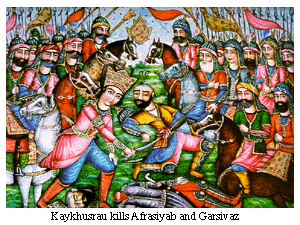 For
the last time, Afrasiyab admitted that he had made a mistake and wished that
his mistake be overlooked. The kings did not agree with him. Instead,
Kaykhusrau drew his sword and severed Afrasiyab's head, putting an end to a
feud that had consumed all the energies of
For
the last time, Afrasiyab admitted that he had made a mistake and wished that
his mistake be overlooked. The kings did not agree with him. Instead,
Kaykhusrau drew his sword and severed Afrasiyab's head, putting an end to a
feud that had consumed all the energies of
Letters were soon dispatched to all confines
of the empire that the dragon-fiend Afrasiyab was dead, Siyavosh's soul
revived, and justice restored. For forty days thereafter people took to the
meadows to celebrate the new day inaugurated by the new king. At the end of the
celebrations, the kings left
In Pars, thankful to have had as a grandson
the wise Kaykhusrau who had revenged Siyavosh and restored justice among the
kings and nobles of all lands, Kayka'us died at the age of one hundred and
fifty. And Kaykhusrau retired into seclusion not to be seen for the next forty
days.
When the wake for Kayka'us was over,
Kaykhusrau sat upon his throne and addressed his people. "I have conquered
all the corners of the known earth," he said, "and have expanded the
kingdom of the Almighty as far as one is able. There is nothing more for me to
do":
The
Shah's great soul became solicitous
About God's dealings and his own high state:
He said: "From Hind and Chin to Rum each place
Is prosperous; withal, from west to east,
Mount, desert, land, and sea have I made void
Of foes; the rule and throne of might are mine;
The world no longer dreadeth enemies.
Full many a day hath passed above my head,
And I have gained from God my full desire,
Besides the vengeance that I had at heart,
Yet let me not grow arrogant of soul,
Corrupt in thought, an Ahriman in faith,
And be an evil-doer like Zahhak,
Jamshid, or such an one as Tur or Salm.
Sprung from Kaus on one side, on the other
Sprung from Turan--all rancour and vainglory--
I, like Kaus and like Afrasiyab,
That warlock froward even in his dreams,
May grow an ingrate unawares to God,
And fray mine own pure soul. His Grace will quit me,
I shall incline to falsehood and unwisdom,
And when I pass within the gloom, and when
My head and diadem shall come to dust,
I shall but leave a bad name in the world,
And make an evil ending in God's sight.
This face of mine, this colour of my cheeks
Will fade, my bones be clad in dust, and all
Accomplishment be lost. Ingratitude
Will come instead, and in the other world
My soul be dark. Another will assume
My crown and throne, and tread my fortune down.
A bad name will be my memorial;
The roses of mine ancient toils will turn
To thorns. Since now I have avenged my sire,
And have adorned the world with goodliness,
Have slain who should be slain, because they were
Perverse and hostile to all holy God,
No place remaineth--settlement or desert--
That hath not read the legend on my sword;
While all the mighty of the world obey me
Albeit they be monarches throned and crowned.
Thanks be to God who gave to me the Grace,
With feet and wings amid the change of fortune.
And now I deem it better to depart
To God in all my glory, and perchance
The Almighty's messenger may, though unseen,
And while I still am flourishing, convey
My spirit to the dwelling of the just,
Because this Kaian crown and throne will pass.
None will excel me in success and fame,
In greatness, welfare, peace, and revelry,
For I have heard and witnessed this world's secrets,
Its good and ill both privy and apert;
But still for husbandman and king alike
There is a common end--the way to death." 183
Having concluded his speech, he ordered the
chamberlain to lock the door and turn away those who sought his audience. For
the next week, Kaykhusrau remained in seclusion, praying to Yazdan, pleading with
Him to keep evil away from him so that he would not follow the way of the
fallen: Zahhak, Jamshid, and Kayka'us.
A week later, amid the consternation of his
champions and nobles, Kaykhusrau returned to the throne room only to announce
that he intended to continue his prayers and seclusion. He asked all present to
do the same and left strict orders not to be disturbed either by the royal
court or by the general public.
A week after that, the Iranian champions,
greatly dismayed, assembled at court to decide on a course of action for the
future of
Rustam and Zal received the messenger
graciously and complied with the order of the assembly. As soon as the
astrologers, the wisemen, and the savants reached Zabul, the entire body set
out for
Having concluded another week in seclusion,
Kaykhusrau appeared before the assembly to discuss his situation. Refusing to
sit in their places as protocol required, the champions addressed the king from
where they stood. They wondered if their actions had triggered the stance that
the king had chosen for dealing with matters of state.
"It is not that I do not need your
help," said the king, "but that at present I cannot involve myself in
matters of state. Our land is secure. Our troops need not be mobilized. My
problem is personal. I have set myself a task that requires my undivided
attention. As soon as I have reached my goal, I shall discuss everything with
you. For the present, however, I wish you well and bid you to return to your
homes."
When the champions were gone, Kaykhusrau
ordered the chamberlain to resume the seclusion procedures and returned to his
chambers to pray. "You have created the universe," he prayed,
"and You have kindled the light of benevolence, justice, and love in this
world. What benefit would I draw from this kingship, if You are not pleased
with me? Assess my good and evil and, if worthy, accept me to paradise."
For the next five weeks, Kaykhusrau remained
in prayer. His body could no longer tolerate lack of sleep. His mental
abilities, however, kept the vigil until he met Surush. Surush's message was
simple. If you wish to reach heaven, you must abandon all involvement with your
terrestrial existence. Appoint a just overseer for your kingdom and depart:
Surush's departure woke the king. He praised God and, soon after, met with his
champions to discuss the future:
I
have attained my wish,
And must dispatch because glad news hath come.
Whenas mine eyes were sleeping yester-morn
Surush, the bless�d, came to me from God,
And said: 'Prepare, for 'tis thy time to go,
Thy watching and distress are overpassed.'
So now mine audiences, care for the host,
For crown and throne and belt, are at an end." 184
Zal praised the king and pledged his
allegiance. "This," Zal said, "is not my pledge alone, but the
pledge of the peoples of kingdoms as far as Qinnauj, Danbar, Murq, and May. We
all feel that throughout history, no king has ruled
Kaykhusrau thanked Zal and others for their
support and concern. "As I told you earlier," said the king, "my
problem was personal. It took me five weeks of constant vigil and supplication
until, last night, Surush finally blessed me with an answer. There is an end to
everything, including kingship. And there is a time when the concerns of a
kingdom become secondary to the greater good. For this reason, I have decided
to step aside and allow a new king to continue the rulership of
The king's decision came upon the Iranians
like a bolt from the sky. Zal questioned the king's wisdom. "The king is
not himself," he said. "Is this the king speaking," he asked,
"or is this Ahriman? Fereydun and Hushang were great kings; they did not
abandon their kingdom and seek seclusion!"
"Great king," said Zal, addressing
Kaykhusrau, "my conviction requires that I relate some history that might
not be pleasant. But so far as the telling of this history might bring about a
change in your decision I feel compelled to tell it. You are a Turanian by
birth and you grew up in Turan. The involvement in magic of your maternal
grandfather, Afrasiyab, is well-known. Your other grandfather, Kayka'us, is not
any different. A kingdom stretching the face of the earth from east to west
could not content him. He had to travel in the sky so he could count the stars.
Ancestry, however, is not the only measure of a man's status. As king, you have
contributed greatly to the well-being of this land. In the war with the
Pechenegs, you showed great chivalry before Khwarazm was reduced. And had
Afrasiyab defeated you,
"You might deem," continued Zal,
"that the problems of
If
thou art bent on such a course, O Shah!
No one will go about to do thy bidding,
And then thou wilt repent thee of thine acts.
Consider! Do not what the divs command.
Moreover if thou seekest thus their way
The Worldlord will withdraw from thee the Grace,
Thou wilt be left in misery and sin,
And men will never hail thee Shah again;
God is our Refuge; therefore turn to God,
Because He is our Guide to what is good.
If thou rejectest this my counselling,
And trustest unto wicked Ahriman,
Thou wilt retain no homage and no fortune,
No royal majesty, no crown, no throne.
May wisdom be the leader of thy soul,
Because the way in front of us is long.
Mayst thou be prudent, may thy counsels prosper,
And may thy brain be steadfast and devout." 185
Kaykhusrau responded with reserve. "I
have listened carefully to the aged Zal," he said, "and I do not wish
to dismay either him or Rustam who has many times saved my life in battle. Yet
I, too, must say what needs to be said. I praise Zal for being forthright in
assessing the situation. His allegation that I have abandoned the Creator,
however, is not correct. My very life flows from the Creator. My decision is
based on my experience and wisdom. I have not, as Zal intimates, turned away
from the path of wisdom. Now, let me put Zal straight in his understanding of
who I am. First, regarding his assertion about my Turanian ancestry and his
claim that no wise men were ever born in Turan. I am the son of Siyavosh, from
the seed of Kayan. My grandfather is Kayka'us, whose wisdom and benevolence is
recognized worldwide. True, my mother is the daughter of Afrasiyab. But we
should not forget that Pashang sired Afrasiyab and that Pashang's grandfather
was Fereydun. I am not at all ashamed to be reminded of my genealogy. A whole
world trembled at the feet of Afrasiyab. Second, Kayka'us' attempt to reach the
stars should be evaluated in the context of kingship. Kings are required to
deal with the extraordinary. I challenged Shideh for exactly the same reason.
Besides, Shideh was not a commoner":
He
said to Zal: "Forbear thine anger, thou
Shouldst speak in measured words. First, for thy saying:--
'None wise and shrewd hath issued from Turan,'
Worldlord and son of Siyawush am I,
A prudent monarch of the Kaian stock,
The grandson of the worldlord Kai Kaus--
The love-inflaming, wise, and fortunate--
And through my mother from Afrasiyab,
Whose wrath deprived us both of food and sleep.
Sprung thus from Faridun and from Pashang,
I shame not at my birth because the sea
Could not have purged the Lions of Iran
Of fears inspired by Afrasiyab.
Next for the carriage which Kaus once made
To raise his head above sovereignty,
Know that no blame attacheth to a king
For lofty aims [.] 186
"Third, when I became king,"
Kaykhusrau went on, "there was only one black spot on my ancestry. I
erased that black spot. And with that, I have expended my raison d'�tre. Remaining as your
king, I feel, will give me cause to
indulge in extravagance and traverse the route that Zahhak and Tur took--the
road to Hell. I have been in prayer for five weeks. The Creator has accepted
me. Where I intend to go, I have no need for an army, a crown or a throne. I
have to travel light." Then addressing Zal, he added, "interpret my
intentions as you wish; nothing changes my course in the direction of the
Creator."
Kaykhusrau's words affected Zal greatly. The
old man blamed himself for his lack of insight and begged the king's
forgiveness. "Perhaps," he said, "it is I who am being misled by
Ahriman. I looked to the past for guidance; no king, to my knowledge, has
chosen the path you are about to walk. I spoke out because I could not bear
parting with my king."
Zal's words pleased Kaykhusrau. He held the
aged warrior by the hand and placed him next to himself on the throne. "I
know," said the king, "that your intentions were good. Now, I would
like all champions to move their armies out of the city and set themselves up
in pavilions in the country. Provide a palace for me as well."
When the camp was in order, the champions
assembled and took their places before the king, according to protocol.
Kaykhusrau addressed the assembly: "Great champions of
"I am an individual like them,"
Kaykhusrau continued. "I devoted my life to my people. Now I have reached
a point where this world no longer sustains my interest. I have been given
access to a domain that is greater than the crown of the Kayanian. I am ready
to leave this kingdom. But before I go, I intend to bestow my lands, weapons,
and treasures to the people of
While some warriors and nobles questioned
the king's sanity, others followed his decree and spent the week as he wished. On
the eighth day, the king ascended his throne in full regalia. The main treasure
of the khusraus, known as the Abad chest, was open and waiting his decree.
Kaykhusrau called Gudarz of the House of
Kishwad. "Gudarz," he said, "there is a time for hoarding and a
time for spending. I want you to travel the length and breadth of
Having divested himself of the world,
Kaykhusrau addressed the people of
The champions were distressed. They did not
know whom to follow in time of war. Zal, the most loyal of the champions, took
the floor. "Your Majesty," he said, "it is appropriate that I
speak frankly about Rustam and his contribution to the well-being of the royal
house. He is the champion who rescued Kayka'us when he was in fetters in
Mazandaran, along with Gudarz and Tus. He killed the White Demon and he
decapitated Sanjah. He sacrificed his son, Suhrab, to revenge Kayka'us and
eliminated Kamus the Kushan. Now that the king has decided to leave the throne,
what reward does he have for the hero?"
"The Creator," said the king,
"more than anyone else will reward Rustam for his good deeds. For my part,
I shall bestow upon Rustam the rulership of the
It was then Gudarz' turn to defend his son,
Giv. "Your Majesty," Gudarz said. "Since the time of Manuchehr
to Kayqubad and from the latter's time until the Auspicious Rule, I have served
this crown and throne. Of my total of seventy-eight sons and grandsons, only
eight live. The rest have been martyred for the king and crown. My son Giv
combed Turan for seven years, eating nothing but zebra's flesh and wearing
deer's hide, until he accomplished his mission and brought the shah back to
The king praised Giv, whom he called his own
double. "You underestimate the contributions of your warrior son,"
said Kaykhusrau. "I bestow on Giv the rulership of
After Gudarz, Tus stood up and addressed the
king. "Your Majesty," he said, "from among the champions
assembled here, I am the only one from the line of Fereydun. I have served the
throne since the time of Kayqubad. I commanded the army that was mandated to
pursue the revenge of Siyavosh in the mountains of Hamavan, I did not abandon
my command in the battle of Lavan, and I had the honor of being fettered with
Kayka'us in Mazandaran. Now that His Majesty intends to leave the kingdom, what
will become of me?"
The king told Tus that he would remain the
commander-in-chief of the armed forces and the ruler of Khurasan. An order to
that effect was written up, signed, and handed to Tus with golden bracelets and
belts.
Although the affairs of the realm were now
in capable hands, Luhrasp had not yet been among those rewarded. The king asked
Bizhan to summon Luhrasp. When Luhrasp arrived, Kaykhusrau stepped down from
the throne, took the crown from his own head and placed it on Luhrasp's head.
"Luhrasp," he said to the consternation of all present, "you are
now the shah!"
Zal contested the ascension of Luhrasp.
"Your Majesty," he said, "we will accept dirt as king, were you
to wish such. But how can a lowly man, who arrived in
The Iranian army, too, echoed the sentiments
of Zal and refused to carry out the mandate of a king whose rule was not
sanctioned by the Creator. But Kaykhusrau continued to support Luhrasp.
"Luhrasp," he said, "is not who you think he is. He is the
grandson of Hushang he is wise and, more importantly, he carries the farr.
Like me, he will fight evil and will inaugurate a just rule. Furthermore,
Luhrasp's son, Gushtasp,
will bring a new day and a new age to the world. Heed my advice and follow his
decrees":
Since
God approveth not of ill from us,
And bad men writhe 'neath time's vicissitudes,
While he whom God createth for high fortune,
Fit to be monarch and adorn the throne,
Endowed with modesty, Faith, birth, and Grace
Will flourish, conquer, and rejoice in justice.
The Maker is my witness when I say
That all these qualities are in Luhrasp.
He is descended from Hushang the worldlord,
A noble of discernment and clean hands,
A scion of Pashin and Kai Kubad,
Well stocked with knowledge, righteous in his thoughts.
He will cut off the sorcerers from the earth,
And manifest the way of holy God,
His counsels will renew the age's youth,
And as he is his stainless son will be.
God said to me: 'Look thou upon Luhrasp,'
And I have acted only as He bade.
Now do ye homage to him as your Shah,
And as ye love me slight not mine advice,
For if a man transgress mine parting counsel
I shall esteem his past exertions as wind [.] 187
Convinced of his mistake once again, Zal
dipped his finger into the dust, passed it across his lips and proclaimed
Luhrasp the shah of
When the time for his departure arrived,
Kaykhusrau spoke to his wives. He asked them to regard him as one who is
already dead. The women did not wish to let him go. They cried as they pulled
their hair, beseeching the king to take them along with him. Kaykhusrau calmed
them. He then addressed Luhrasp: "These are the women of the court of the
Kayanian," he said. "They are the mothers, daughters, and wives of
kings. I trust their well-being to you, and I wish to receive a good report on
the day that you meet Siyavosh and me."
Luhrasp accepted the responsibility.
Kaykhusrau's last advice to Luhrasp was one of humility and acceptance:
"Rule justly and keep the interest of your subjects in mind. As soon as
you feel that kingship no longer interests you, rather than trying to make it
interesting, leave it and save your soul." Luhrasp kissed the ground
before Kaykhusrau.
Zal, Rustam, Gudarz, Giv, Bizhan, Gustaham,
Fariburz, and Tus accompanied Kaykhusrau on the first leg of his journey. The
army followed. At every station, attempts were made to persuade the king to
give up his intention and return to his kingdom. But Kaykhusrau was determined
to leave. He assembled the mu'bads and asked them to work for the final
reunion. "I have a long way before me," he said, "a way which
yields neither water nor grass. Only those endowed with the farr can
walk this road and reach its end. For this reason, I feel it is in your best
interest to return. Let me pass into my other realm alone."
Zal, Rustam, and the aged Gudarz heeded
Kaykhusrau's admonition and returned. Tus, Giv, Bizhan, and Fariburz continued
on the way. They went for a day and a night into the desert, until Kaykhusrau
stopped at a fountain. "We shall stay here for the night," he said,
"and we shall talk about the past. We will not be together much longer. As
soon as the sun rises, Surush will meet me and my journey will come to an
end."
In the evening, the king washed in the
fountain and said goodbye to the champions. "You must return now," he
said, "before the sun rises from behind the mountain. At that time, a wind
will blow the intensity of which would uproot trees, a black cloud will cover
the sky and blanket the ground with deep snow. You will not find your way back
to
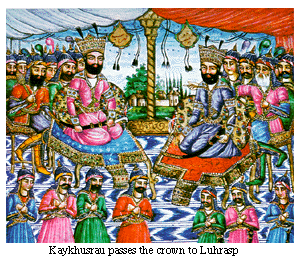
When the sun rose the next morning, the king
disappeared into thin air. The search of the champions for Kaykhusrau took them
deep into the desert, but they could not find a trace of their king anywhere
there. Disappointed, they returned to the fountain. "This is a pleasant
place," Fariburz said. "Why not stay here for the night and take the
news to the army tomorrow? It will, of course, be difficult to convince people
of what we have seen--a living being walking to meet the Creator. On the other
hand, who would doubt that Kaykhusrau was an extraordinary being!"
They hardly had finished their supper when
the wind picked up and snow covered the ground. Soon the snow became intense,
overwhelming the champions. One by one, they perished.
For three days, Rustam, Zal, and Gudarz
waited on the mountain to meet the returning champions. No one came. "If
the king has gone," Gudarz wondered, "what could have happened to the
rest?" Nobody had an answer. The stay was prolonged a week, until Gudarz was
convinced that, once again, members of his house have been sacrificed for the
house of Kayan and that he would never see Giv and Bizhan again.
Succumbing to the rule of the Creator, an
unwilling Gudarz allowed himself to be brought down from the summit. He cried
for the departure of his son, his king, and his companions while, along with
the surviving champions, he pledged to spend the rest of his life at the
threshold of King Luhrasp.
The Wars of Religion
After Kaykhusrau disappears in the White
Light, Luhrasp, grandson of Kaypishin from the seed of Kayqubad, ascends the
throne. His promotion from the governorship of Alanon and as the overseer of
the Ghuzz Fortress to the rulership of a United Iran and Turan creates a great
deal of discord. We can see this both during the last days of Kaykhusrau's rule
and the early stages of his own rule. For instance Zal, and indeed, the whole
House of Nariman that stems from the two royal houses of Jamshid and Zahhak,
are slighted so that Zal, Rustam, and their champions leave the capital and
remain disinterested in the affairs of the kingdom.
On the other hand, after Afrasiyab is killed
by Kaykhusrau, Arjasp ascends the throne of Turan. He not only refuses to pay tribute
to the new rulers in
Luhrasp has two sons: Zarir and Gushtasp. Of the two, Zarir
is obedient and helpful to his father while Gushtasp is valiant but wayward. In
fact, Zarir plays a major role in keeping Luhrasp and Gushtasp together, both
when Gushtasp goes to
Towards the end of his life, Luhrasp passes
the kingship to Gushtasp and becomes a recluse at the Nowbahar Firetemple.
After the appearance of the Prophet Zoroaster, he accepts the good
religion; he is killed during the second invasion of Arjasp.
The ascension of Gushtasp to the throne is
foretold by Kaykhusrau. Kaykhusrau also foresaw that a prophet will come to the
court of Gushtasp and bring a new order. At the time of the advent of the
Prophet Zoroaster, Gushtasp is in a relatively weak position. He pays tribute
to Arjasp to keep the Turanians away from his center of power. Additionally,
while kings in the past had the support of a circle of champions, he has to
rely mostly on his armorclad son, Isfandiyar. The difficulty is
that his son is very much like himself. He seeks to force his father off the
throne so that he himself can rule the realm.
The advent of the Prophet Zoroaster,
especially after he accepts the good religion, changes Gushtasp's attitude
towards Turan, Arjasp in particular. Feeling empowered by the faith, Gushtasp
ceases to pay tribute to Arjasp and persuades Isfandiyar to confront Arjasp and
defeat or kill him. Helped by Jamasp, Gushtasp's court Minister and
the husband of Puruchista, the daughter of Zoroaster, Isfandiyar defeats Arjasp
and expands the domain of the Zoroastrian faith into western Iranian lands. At
the end, however, Isfandiyar does not attain his wish to become the king of
Traditionally, Gushtasp is regarded as the
last king of the Kayanian dynasty. In the wars of religion, however, especially
with regard to the treatment that the house of Nairam receives at the hand of
the Kayanian dynasty, the line of kings that they had literally created,
promoted and sustained, the rulership of Isfandiyar's son, Bahman, becomes important. After
Bahman, his sister-wife Humay Chihrzad rules for 32 years.
Thereafter, especially during the rulership of Darab and Dara, the line between the advent of
the Median dynasty and the post-Bahman era of the Kayanian line becomes
blurred.
See also:
- The Role
of Farr in the Shahname
- The Shahname of
Firdowsi
- Firdowsi's
Shahname in Iranian Society
- Who's Who in
the Shahname The Characters of the Shahname
- Table of
Legendary Kings
In PDF format. You will need Adobe Acrobat Reader installed on your computer to read, save, or print the Table of Legendary Kings.
Click on the logo to download a free copy of Adobe Acrobat Reader,
