A Brief Note
on the Life and Works
of Ali Garmarudi
By
Iraj Bashiri
Copyright, Bashiri 2001
|
|
|
A Brief Note
|
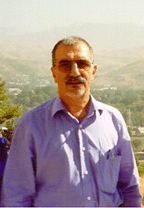
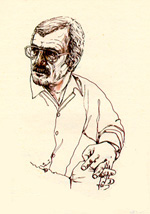
Sayyid Ali Musavi Garmarudi, first of seven children, was born in the 1940's, in the "Chahor Mardan" of Qom to a family of scholars. His father, a teacher of Islamic theology from Alamut, paid special attention to his son's education. His mother is from Tonkobun. Although from Qom, the family is known as Garmarudi, recalling the family's roots in the beautiful village near Alamut on the Shahrud River. Some of the vocabulary in Garmarudi's poetry stem from the early years of his life when his family used to visit Garmarud and spend the summers there.
Garmarudi's formal higher education began in 1967 when he entered the Faculty of Law of Tehran University. His doctorate degree, however, is in Persian language and literature. His dissertation was on the life and works of Adib al-Mamolik-i Farahani. In 1970, he garnered the Yaghma literary prize for modern poetry or "she'r-i now." The poem that launched his career, a fairly long piece inspired by Nima, was entitled "Khastgah-i Nur." Jalal Al-i Ahmad, Simin Daneshvar, Tahereh Sattorzoda, and Ali Shari'ati are among authors and intellectuals to have shaped his thought.
In 1974, Garmarudi was arrested by the SAVAK and spent the next five years in various Iranian prisons, often experiencing torture. His "Sorud-i Ragbar" and the second edition of "Ubur" happened at this time.
Over the past thirty years, Garmarudi has published a considerable amount of materials, mostly poetry, on the literature and culture of Iran. Indeed, in certain circles, he is recognized as a major figure in the intellectual life of the country. The following list is indicative of the extent of Garmarudi's contribution to a better understanding of the social, cultural, and spiritual dynamics of contemporary Iranian society:
- "Ubur," 1978
- "Sorud-i Ragbar," 1979
- "Dar Fasl-i Murdan-i Surkh," 1979
- "Dar Saya-i Sar-i Nakhl-i Vilayat," 1980
- "Khalt-i Khun," 1985
- "Chaman-i Laleh," 1985
- "Baran-i Akhm," 1995
- "Ta-Nakuja," 1986
This latter is a volume consisting of sixty poems of Garmarudi selected by Ricardo Zipoli and published in Italian translation. Another similar selection of Garmarudi's poetry appears under the title of "Guzinai Shi'r-i Garmarudi." The volume with an impressive introduction was presented by Bahauddin Khurramshahi in 1997.
In these collections, Garmarudi, following the examples of Nima Yushij and Ahmad Shamlu, presents a full spectrum of both traditional -- stanzas, quatrains, sonnets, odes -- as well as new poetry (shi'ri now). However, it's neither fair nor correct to deny Garmarudi his own singular view of poetry. He is the poet who usually provides the last word in the sense that when other poets are satisfied with the expression of their views about a theme, Garmarudi joins in with a fresh view of the same. To him movement and lack of it, light and dark, and life and death are inseparable aspects of the same element. Yet, our human capacity to discriminate discerns a fine difference. And it is this fine line which does not escape Garmarud's keen vision of the dynamics of existence. In his poetry, therefore, we observe a reaction to the contradictory aspects of life that is unique. Furthermore, Garmarudi expresses this unique view in a most economic, didactic, and poignant manner. His "Epic of a Tree," translated below, is a telling example of artistic and iconoclastic approach to Persian poetry. In fact, scholars like Ahmad Mahdavi Damghani and poets like Amiri Firuzkuhi, Mahmud Munshi, and Mehrdad Avesta praise Garmarudi's creative genius for this very unique feature.
Garmarudi's language is simple, his style is fluid, and his imagery is realistic and expressive. He chooses his themes from amongst contemporary issues both in terms of disclosing secular values as well as of spiritual direction.
To understand Garmarudi's poetry, we cannot but proceed beyond form and examine the semantic matrixes that control the form. It is the freshness of Garmarudi's collage of meanings that imparts a special sense of concreteness to his verses.
Garmarudi has also published a noteworthy number of prose works. These include:
|
|
The Epic of a Tree by Ali Garmarudi Translated by Iraj Bashiri Copyright 2001 |
|
|
Star, my mother, She provided sufficient light, Do not raise, Respect the narrow lifeline Beautiful is the sound of the tree, Beautiful is the tree's word, Greet the tree When the soldier returned "I know, mother dear," "And actually, I can argue, The bow is now a gun, I greet the tree again, |
|
|
|
You Are My Nowruz... by Ali Garmarudi Translated by Iraj Bashiri Copyright 2001 |
|
|
You are my Nowruz, you are my night and day; |
|
|
|
Hope by Ali Garmarudi Translated by Iraj Bashiri Copyright 2001 |
|
|
Gently the breeze, her locks weaves |
|
|
|
Look by Ali Garmarudi Translated by Iraj Bashiri Copyright 2001 |
|
|
The mirror complained: You look at me and cry, why? I sighed. The mirror's face went dark I passed my hand Over the mirror's face I removed the sigh The mirror smiled.
|
|
|
|
Cloud and Memory by Ali Garmarudi Translated by Iraj Bashiri Copyright 2001 |
|
|
Like a happy scene,
Slumbers in the sky, A cloud piece, pure and white. Visible through this open window
A vague feeling
|
|
|
|
No Time to Lose by Ali Garmarudi Translated by Iraj Bashiri Copyright 2001 |
|
|
There is little time to lose We must pray on the lofty surges of the highest seas We must, in the company of caravaneers, share the desert night; we must drink it. There is little time to lose We must learn flying from the migrating birds --from the red breasts. Using a shout, |
|
|
|
|