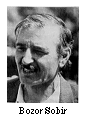
For a complete account of Bozor Sobir's life, see Iraj Bashiri's article in "Encyclopedia of World Literature in the 20th Century."
Also known as Sobirov, poet and social critic Bozor Sobir was born to a rural family of Faizabad, Tajikistan, on 20 November 1938. The loss of his parents at an early age made his life extremely difficult. Nevertheless, he attended Tajikistan University and, in 1962, graduated with a degree in Tajik Language and Literature. His early career involvement was with the media; between 1975 and 1979 he was the editor of three journals: "The Voice of the Orient," "Education and Culture," and "Justice."
Although Sobir began publishing his poetry as early as 1960, his collections do not appear until the early 1970s. They include " Connection" (1972), "Fire in the Leaves" (1974), (The Thorn Flower 1978), "The Eyelids of the Night" (1981), "Aftabnihal" (1982), and "In Taste and Act" (1987). His poetry is generally sentimental and his social themes are developed with extreme care.
Tajikistan's rustic scene forms the backdrop to Sobir's early works. "We Were Children" (1984), "My Childhood Still Weeps (1984), "Where is Childhood?" (1984), and "Village Children" (1984) all hark back to the poet's formative years, while contributions like "Tajik Woman and Cotton" (1989) describe the sentiments of a more mature and sophisticated poet.
Sobir did not praise the Soviet system. In fact, he rose against Communist aggression during the heyday of the Party and survived. He confronted social issues frankly and pursued his goal of reforming society with an unrelenting zeal. For instance, in "The Stage" (1984), he criticized all levels of Soviet society except the working classes. With "After Us," however, he crossed the line and was subjected to vociferous criticism. He refused to conform. Conversely, in 1978, in an assembly at the Writers Union of Tajikistan, he criticized Soviet activities in Afghanistan. This against clear Soviet dicta that poets should praise the achievements of the Soviet military.
Between 1990 and 1992, during Tajikistan's darkest days, Sobir served as the voice of the Opposition. His poetry reflects the Tajiks' struggle as they sought to cast off their Soviet yoke and reestablish their traditional Islamic identity. Here, in addition to Sovietization and Russification, he tackled the delicate issues of Uzbekization and Pan-Turkism as well. In fact, during the demonstrations, he openly incited the public to support the Opposition. His remarks landed him in prison on 26 March, 1993. He remained in custody until June 1994.
Sobir's 1980s contributions concentrate on Soviet activities in the republics of the former Soviet Union, especially Georgia, Uzbekistan, and Tajikistan. Why, he asks for example, instead of walking by the statue of Ahmad Donish should the Tajiks walk daily by the statue of Lenin? Or more poignantly, why should the Tajik youth be exposed constantly to the thoughts of Lenin and Marx rather than to the guidance of their own learned men? But perhaps the most telling piece among his later contributions is his "The Communist Pilgrim" in which he exposes the duplicity of the apparatchiki who, after the establishment of the coalition government in Tajikistan, made the pilgrimage to Mecca.
In his verses, Sobir allows the content to take precedence over the form. His fame. however, is more due to his patriotism and stance against Communist aggression than for either his poetic style or introduction of innovative methods into Tajik literature.
Sobir's rustic background and youthful difficulties as well as his love for his mother and for his homeland form the major foci of his poetry. His lyric deals with romantic themes in the tradition of the Tajiks while his critical pieces carry patriotism and nationalism to the extreme. He passed away 1 May 2018.
|
The Mother
Tongue translated
by |
She handed over all her worldly assets,
She handed over her Balkh and Noble Bukhara,
She handed over sublime traditions and ways,
She handed over her throne of Saman.
Her uneducated foe inherited the works of Sina,
Her uncultured enemy inherited the poetry of Rumi,
Her art-mongering enemy pillaged the art of Behzod,
And her vagabond foe settled in the House of Tajik.
She lost the club of Rustam and Suhrob,
She made mighty her feeble foe,
She neglected her own identity,
She forgot the tomb of Rudaki,
She made her own murderers widely known.
The short-statured Manghit grew
tall,
Agaisnt pillars built of Khurasani
heads;
Low Qipchaq lands grew in height
Against the towering heights of Badakhshan.
O Tajiks, Tajiks!
People of grief,
Tear in eyes like orphans,
Anger on lips like captives.
She surrendered all her assets:
Even her home and her shroud,
To land-grabbers and grave-robbers,
Her impoverished enemies rolled in wealth,
While she herself remained destitute.
She suffered years among the narrow-eyed,
Was burned in water and fire,
Along with the tall minarets of Sughdiana
And the destroyed doors and walls of Afrasiyab.
But, in spite of all that,
Like her mother's very name,
She safeguarded her mother tongue,
Every word entered her being with mother's milk,
Stayed with her and formed her bones.
Like an outcast in the corner of her homeland
She lamented separation and desolation.
Her tears ran the waterfall, to the wind and rain,
She taught the language of the Kuhistan;
To the river she taught Rudaki,
To the wind she taught Anwari.
She built up her language,
When her kingdom was in ruin,
She created order among lawlessness;
Order out of weighty words,
Order out of colorful verse;
Poetry each couplet of which,
Is a brook of the blood of her soldiers,
A ray of light from her Zoroastrian fire.
Although bad luck had forced her
To live, in her own house, among Muslims and
Zoroastrians,
And share prophets and Gods with them,
In language, she stayed apart;
She retained the purity of her language.
Like a wounded deer,
She repeatedly licked her wounds,
Until she healed them
With the miracle of her tongue.
They climbed a hundred pulpits
So that her language can prosper;
On a hundred gallows appeared her poets
So that the worth of her tongue is upheld.
When we come to determine borders,
Only Tajiki delimits the Tajiks,
As long as she has a tongue she has a homeland,
With her language intact, she remains worthy.