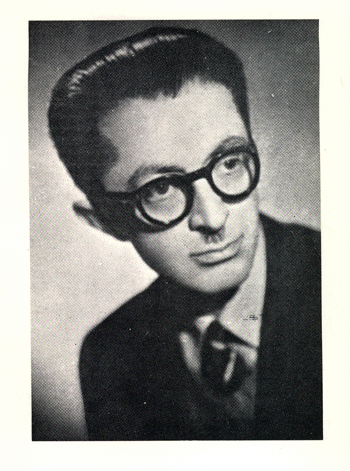
| Sadeq Hedayat's Life by
copyright 1984, 1999 |
|
| Sadeq Hedayat's Life by
copyright 1984, 1999 |
1 For background information on Hedayat's formative years and his life and family, the reader is referred to Kamahad's Modern Persian Prose Literature (Cambridge: Cambridge University Press, 1966), pp. 131-141. See also Abdul Ali Dastgheyb's Naqd-i Asar-i Sadeq-i Hedayat (A Critical Study of the Works of Sadeq Hedayat) (Tehran: Sephr Press, 1977), pp. 12-21.1
2 Dastgheyb, p. 13.2
3 Cf. Siavosh Danesh, Sadeq's Omnibus: A Collection of Short Stories (Tehran: Mehr-i Danesh Publications, 1971), p. 11.3
4 Mahmud Katira'i, Ketab-i Sadeq-i Hedayat (Sadeq Hedayat's Book) (Tehran: Ashrafi & Farzin Press, 1971), pp. 182-183.4
5 Cf. Dastgheyb, p. 18.5
6 Translated from Qa'emian's translation of Komissarov and Rozenfeld's "Selections from the Works of Sadeq Hedayat,' in Nazariyat, (1965), pp. 272-273.6
7 For a discussion of the language in this and other stories, see Chapter seven.7
8 D.S. Komissarov, "Sadeq-i Hedayat" ("Sadeq Hedayat"), trans. H. Qa-'emian, Sukhan, vol. 9, no. 1, (1959), p. 843.8
9 Jan Rypka, "Yadbudha," ("Memories"), Sukhan, vol. 11, no. 5, (1966), p. 461.9
10 Pasteur Vallery Radot, "Yek Nevisande-i Nowmid: Sadeq-i Hedayat," ("Sadeq Hedayat: A Disappointed Author"), Sukhan, vol. 5, no. 5, (1955), p. 351.10
11 Rypka, pp. 463-464.11
12 Rypka, p. 464.12
13 Katira'i, P. 132.13
14 Kamshad, p. 183.14
15 See Khalil Malaki, "Hedayat va Hezb-i Tudeh" ("Hedayat and the Tudeh Party") Tehranshahr, no. 41, March 1952; rep. in 'Aqayed va Asar, (Tehran, 1954), pp. 17-23; see also Ervand Abrahamian, Iran Between Two Revolutions (Princeton, N.J.: Princeton University Press, 1982), p. 334.15
16 Vincent Monteil, "Dar Bare-i Sadeq-i Hedayat" ("About Sadeq Hedayat"), in Nevisandegan, trans. H. Qa'emian, (1967), p. 23. See also Dastgheyb, op. cit., p. 17. 16
17 For a discussion of Hedayat's paintings see Qa'emian and Hedayat's Dar Bare-i Zohur (1963).17
18 Much has been written about the reasons for Hedayat's remaining a bachelor to the end. Among them are his desire to break away from Karma, desire to remain free, and homosexuality. Cf. Siavosh Danesh, pp. 23-24; see also Monteil, in Nevisandegan, p. 37.18
19 For instance, most of the new articles in Hillmann's Hedayat's 'The Blind Owl' Forty Years After revolve around the assertions in Hedayat's Ivory Tower.19
20 Mahmood Nikooyeh, "Buf-i Kur: Per Lashez" ("The Blind Owl: Pere Lachaise"), Rudaki, no. 18 (1973), pp. 3-6.20
21 Cf. Kamshad, p. 201; see also Qa'emian and Hedayat, Dar Bare-i Zohur, P. 11.21
22 See, for instance, Mohammad Moqaddasi's attacks on Hedayat in Afkar va 'Aqayed-i Buf-i Kuri (Blind Owlish Thoughts and Ideas), and Nasl-i Javan-i Iran va Buf-i Kur (Iran's Youth and the Blind Owl). (See Bibliography.]22
23 See Hedayat's letters in "Nameha-i Sadeq-i Hedayat" ('The Letters of Sadeq Hedayat"), Sukhan, vol. 6, no. 3 (1953), pp. 199-209. See also Seyyed Mohammad Ali Jamalzadeh, 'Dargozasht-i Hedayat" ("Hedayat's Death"), Sukhan, vol. 25, no. 10 (1976), pp. 1016-1023. A list of Hedayat's letters appears at the end of the present volume.23