| First Iranian Songs M. R. Shafi'i-Kadkani translated by
copyright 1995 |
|
| First Iranian Songs M. R. Shafi'i-Kadkani translated by
copyright 1995 |
Finding the beginning of Persian poetry, as is the case for finding the first poem in any language, is an ongoing concern. Can we really conceptualize mankind apart from his poetry? After all, poetry is the essence of his thoughts. It is his way of relating to nature. Poetry is akin to his being. How can we separate him from his spirituality?
In fact, the story of poetry falls outside the purview of history per se, making any attempt at determining the first poem for any language futile. Poetry begins with the movement of the first caravan-it is, as it were, the sound of the bell on the leading camel. That is why the title of the first poem and the identity of the first poet will have to remain unknown. The story of Adam's composition of an elegy after the death of his son (killed by his other son) is a legend. The fact that it is reported by Islamic historians does not make it any more credible.1 Like many other legends, we are dealing with what might be termed a poetic notion.
There are, however, certain things that can be asserted with certainty. For instance, based on ancient sources, we can assert that Persian poetry is rooted in the hymns of Zoroaster, the Gathas, the religious songs of the Iranians, as well as in the rest of the Avesta2 and the songs available in Sassanian and Pahlavi Middle Persian.3 These sources include Darakht-i Asurik, Ayadgar-i Zariran, and Jamasp Namak.4 The discussion of those sources, however, is outside the purview of this brief note. Our focus here is on determining the first Dari poem.
This discussion, too, although widely examined, remains inconclusive. It is claimed that Dari poetry appeared after the Arab invasion and that as long as there is no supporting evidence to the contrary, that remains the case. In support of this claim, the poems of Abu Hafs-i Sughdi, Abu al-Abbas-i Marvazi, and those of the Arab poet, Yazid Ibn-i Mifraq are presented as evidence. Obviously, were we to limit Dari poetry to post-Sassanian times, we would have no option but to choose the first poem from among the works of these poets.
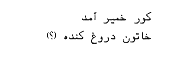
Allamah Qazvini has presented a lengthy discussion of this subject in twenty essays. But his views, too, are focused on these same few specimens.5 The most recent research on Dari in post-Islamic times belongs to Abdul Hussein Zarrinkub where he discusses the songs of the people of Bukhara, especially the amorous verses allegedly exchanged between Sa'd Ibn-i Uthman, the Arab commander, and the Khatun of Bukhara.6 The source of this information, according to Zarrinkub, is Abu Ja'far Muhammad Ibn-i Habib of Baghdad's (d. 245 AH) Asma' al-Miqtalin min al-Ashraf fi al-Jahiliyyah wa al-Islam, published several years ago in Baghdad. Here is a bayt of that poem: 7
|
According to our best information, this is an example of the oldest Dari poem, older even than that of Ibn-i Mifraq, because the story it tells precedes Ibn-i Mifraq in time.
We cannot, therefore, distinguish Dari as a post-Sassanian phenomenon; the ancient quality of its poetry does not allow that. The theories thus far have tried to establish Dari as a continuation of Pahlavi Middle Persian.8But we understand now that the Dari language had been a language spoken alongside Pahlavi Middle Persian at the courts of the eastern Iranian kings. Ibn-i Muqaffa', quoting Ibn-i Nadim and Hamza-i Isfahani in Al-Tanbih Ala Huduth al-Tashif, and Yaqut Humavi in Mu'jam al-Buldan have made references to this fact.9 They speak of Dari as a language, with its own literature, spoken during late Sassanian and early Islamic times.10
In addition to historical facts, the same information can be deduced from a linguistic analysis of the poems and from investigating the history of Persian literature after the Arab invasion. The very eloquence of poets like Rudaki and authors like Bal'ami bespeaks the status of Dari as a language that had been in use for quite some time. How else could it soar to the heights it did within only a couple of centuries?11 Further support can be found in Dari quotations attributed to Sassanian monarchs in such Arabic works as Al-Mahasin wa al-Azdad of Jahiz.12
Can we ignore all this evidence and limit the poetry in the Dari language to the era after the Arab invasion? If the language was in use, it must have had its own poetry. We may not have access to a sample of that poetry, but should this lack of access compel us to deny the existence of the poetry as well?
Islamic historians like Mas'udi13 in Al-Tanbih wa al-Ashraf and Abu Hilal Askari in Al-Tafsil bain al-'Arab wa al-Ajam point to a wealth of poetry during the Sassanian era.14 We do not know, however, how much of this poetry had been in Dari and how much in Pahlavi Middle Persian. The sources are silent on the distinction. We have only Malak al-Shu'ara Bahar's statement made on the basis of the Turfan finds. In his articles entitled "Shi'r dar Iran," in Mihr, he states that the poetry referred to was in Dari because he detected certain differences between the language of that poetry and Pahlavi Middle Persian. Furthermore, that language contained some vocabulary that is absent in Pahlavi Middle Persian.15 Safa, on the other hand, assigns these works to Parthian (northern) and Sassanian (southern) Pahlavi.16 The language of these fragments is still being debated but, most likely, it is Pahlavi. To my knowledge Bahar's is the only reference to Dari poetry during Sassanian times. This, of course, throws doubt on the poetry ascribed to Bahram-i Gur and Huma-i Chihrzad.
The poem ascribed to Bahram had been doctored. If it was not for Ibn-i Khurdadbih's statement in Al-Masalik wa al-Mamalik, we could consider it a figment of the imagination of the historians and story tellers. But we have to give some weight to Ibn-i Khurdadbih's statement that the following had existed:

|
I am the lion of Shanbalah and
I am the mighty tiger.
However, most scholars do not accept the Dari ascription and consider this poem to be in heptameter, i.e., containing seven syllabic feet.18 The Surud-i Karkui, too, in spite of Bahar's ascription of Dari to it,19 and in spite of the poem's originality, cannot be considered Dari as long as the time of its composition is debatable. Conjecture places it after the Arab conquest but, even then and even if we accept it as Dari, it is not the oldest. We must search for even more ancient specimens. As mentioned, Tarikh-i Qum and Mujmal al-Tawarikh record some poems ascribed to Huma-i Chihrzad and Ardashir-i Babakan but, if these were Dari verses, why are there no mentions of them in our literary histories?
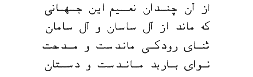
We know that before the Arab invasion, Persian verse, being syllabic, did not conform to the Arabic metric system. Those familiar with the Arabic meters, considered the syllabic verse to be a kind of prose. That is why Awfi, who was familiar with the Arabic metric system, assessed Bahram's syllabic verse as follows: "He [Bahram] was the first to compose poetry in Persian. During the time of Parviz many such compositions existed and were put to music by Borbad.20 But, since these poems are devoid of meter, rhyme, and the other trappings of poetry, we have not dealt with them in any substantial manner."21 This statement indicates that even at the time of Awfi some form of the syllabic verse was still in existence. The frequent references to the songs of Borbad and Nakisa in Persian, during early Islamic times, is indicative of the prevalence of this kind of verse at that time. Furthermore, there are documents indicating that Borbad's verses had been published at that time. The following poem of Mujladi (or Makhlidi) Gurgani, who lived at the end of the 4th or beginning of the 5th century AH, is indicative of that: 22
|
Regarding this Edward Browne states: "There can be no doubt that Sassanian courts were filled with music and with songs and that the trend was, at the least, reflected in post-Sassanian times. No matter how drastically the change to a metric system may have affected the syllabic poetry of ancient Iran, at least superficially, the quatrain and the ode are Iranian in origin."24 Elsewhere Browne says, "Although Persian poetry reached its apogee in the 10th century in Khurasan, ... there is a story that indicates its existence at the Sassanian courts. This story is repeatedly recorded in trusted ancient sources, only the name of the musician takes various forms. The difference is, perhaps, in the rendition of the Pahlavi form. I cannot but say that the subject calls for deeper investigation."25
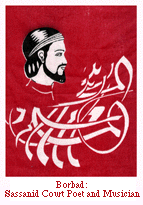
The above statements indicate that the Farsi language had been spoken at the Sassanian court alongside Pahlavi, that it had been a literary language with its own verse form, and that in later (i.e., post-Sassanian) times it had appeared as Dari. One of the examples of poetry of this period frequently discussed by the literary sources, is the songs of Borbad, musician, performer, and theoretician. He lived at the time of Khusrau Parviz and there are many references to his legend in the literature of subsequent centuries.
Christensen says, "Burhan-i Qati' mentions thirty songs that had been composed by Borbad for Khusrau Parviz. The same statement is repeated in Nizami's Khusrau and Shirin with a slight discrepancy. Ascribing the Khusravanis to Borbad, Tha'alibi says that even during his time, musicians performed the khusravanis in the festivities sponsored by the kings and others. In fact, khusravani has not been just one song or melody. Awfi refers to khusravani in the sense of the Seven Royal Dastgahs which Mas'udi calls al-Turuq al-Mulukiyyah..."26 These seven rah's are mentioned by both Mas'udi and Ibn-i Khurdadbih. Mas'udi, however, gives the number to be seven,27 while Ibn-i Khurdadbih gives eight.28
Before producing samples of the khusravaniyyat, i.e., poetry that is syllabic and possibly written in Dari, we shall first proceed to examine the khusravaniyyat genre. Bahar recognizes them as poems written in praise of kings, mu'bads, God, and the temple of fire. They are referred to as surud (songs) or khusravani songs.29 Huma'i recognizes the khusravanis as a type of rhymed verse composed by Borbad in praise of Khusrau Parviz. They were sung with a special melody. Nasir al-Din Tusi, in Asas al-Iqtibas, refers to them as a kind of pseudo-metric verse. He distinguishes them as forms composed of equal syllables resembling metric verse compositions. The Tarikh-i Sistan relates the Persian language to music and the writer of al-Mu'jam speaks about Borbad (from Jahrum) as a master musician composing poetry for Khusrau Parviz's festivities. Even though the entire composition is in praise of Khusrau Parviz, he says, it is recited in prose. And Abu Hilal Askari says the following in his al-Sana'atain about khusravani. It is a melody in present-day Farsi wherein the words are used in a non-verse composition. "They are poems which can be classified as such only due to the lengthening applied to otherwise simple prose forms."30
Lughatnama-i Dehkhuda, Burhan-i Qati', Anandraj, Qiyas al-Lughat, Anjuman Ara, and Mahshi al-Lughat all support the statements presented above.31 Furthermore, Mehdi Akhavan-Sales (M. Omid) presents a comprehensive and well-documented survey in Yaghma of the khusravanis. Unfortunately, he does not produce any samples and rests his case mostly on Bahar's assertions regarding the poetry of the Samanid poet Abu Talib Tayyib Ibn-i Muhammad in Lughat-i Furs-i Asadi. In other words, he guesses. In any event, as long as the form belongs to post-Sassanian times, we should be on the lookout for a more ancient specimen.
There is a stanza in Ibn-i Khurdadbih's Mukhtarat min Kitab al-Lahv wa al-Malahi that, I believe, deserves particular attention. Ibn-i Khurdadbih, of course, is known for his contribution to history, geography, and music during the third century AH. The piece is ancient and is presented by a student of Ishaq Musili, a student well-versed in the history of Persian music.32 Further support for the credentials of Musili is found in Mas'udi's Muravvij al-Zahab. Mas'udi explains how Musili appeared at the court of the Abbasid Caliph al-Mu'tamid and was commissioned to lecture on international music.
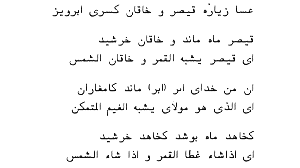
In this book, the original of which is no longer extant, but excerpts of which have survived and have recently been published, we read: "...the greatest Iranian musician at the court of Khusrau Parviz has been Bahlbad (Borbad) from Ray, a skilled lute player who composed songs, played music, and sang songs for Khusrau Parviz. Often he communicated the more distressing items of news, news that others did not dare mention to Khusrau, by incorporating such news in his songs. Altogether, fifty such songs are recognized. The following is an example:
|
Even without the Arabic translation, a present-day Iranian understands this poem. "Abr," (the dot for /b/ is missing) is, of course, "cloud" as attested by "ghaim," "kamgharan" and "kamkaran." The problematic part is, perhaps, the introductory phrase that could mean "At the time of visiting the Caesar, Khaqan, King of Kings Parviz. It is not a part of the poem because, unlike the hemstitches of the poem, it does not have an original form.
Returning to the piece itself, each hemstitch consists of 10-11 syllables. We cannot give an exact number, of course, because we don't know how the poem-with long and short syllables-was read at that time.
The discovery of this poem not only provides us with an ancient poetic form that harks to the time of Khusrau Parviz, but it also throws light on some other issues as well. The first is a recognition of the syllabic nature of the poetry of that time. Literary historians unfamiliar with the metric system mistook it for prose used by Borbad as the base for his compositions. Only Nasir al-Din Tusi, who was familiar with the syllabic system, refers to khusravaniyyat as a type of pseudo-metric form.33
Of course, on the basis of this single verse, we cannot posit that poetry in ancient times was exclusively syllabic. This poem only confirms that the metric verse was introduced into Iran by the Arabs.34 It also rejects Huma'i's view that posits the existence of a metric system for Sassanian times. Although in defense of Huma'i, we should add that he does not state this position firmly, rather, he makes inferences on the basis of music.35 Finally, this poem supports the statement of Ibn-i Muqaffa' and Hamza-i Isfahani, and others that the Dari language was spoken at the court of the Sassanians and that it had its own literature and songs.