| Some Shashmaqam Puzzles
in Tajik Music
by
Faroqat Azizova
translated by
Iraj Bashiri
copyright 1995
|
Shashmaqam is considered to be the basis of traditional Tajik music. The science of music, however, identifies it as a professional or oral tradition1 related to the Eastern systems of music. This feature of the exalted art of music, which was born in Bukhara, appeared in the present form during the middle of the 18th century.2 In essence, the meaning of shashmaqam is difficult to explain. On the one hand, it can be distinguished as the cyclical component of musical theory. On the other hand, it can be defined in practical terms as professional and, thereby, as performance music.
History informs us that the term maqam applies to "the placing of the fingers on the handle of the instrument." There is, therefore, a correspondence between the music category and the instrument. This definition is essential for understanding the shashmaqam, its acquisition, and/or instruction. But in the Tajik music of the 19th and 20th centuries, shashmaqam is mostly understood as a cyclical type of music. This microcycle includes the following maqams: buzruk (buzurg), rast, nava, dugah, sigah, and Iraq. They are governed by specific theoretical and practical rules. The structural make-up (form-structure) of these maqams is the same and each one includes all the internal features. The structure of the maqams is mostly cyclical. In the course of covering the shashmaqam we encounter a number of different cycles which, at various stages, create different forms:
1. shashmaqam
2. maqam
3. mushkilat (a type of instrument); nasr (name of instrument)
4. The microcycle of the shu'bas (first the taranahs; savt [vocal] or muqulcha;
several types of saz; tasnif, tarji', gardun, etc.)
Within these terms, shashmaqam has its own special place. The cycle includes 252 turns. The large body of the shashmaqam makes the incorporation possible. That is why shashmaqam is considered to be a complex instrument used only in the study of theory, and not of much practical use.
Maqamas an instrument has been called mushkilat and as vocal has been called nasr; its independent compositional unit, which resembles a musical asar, is called shu'ba.3 Each shu'ba has a specific function in the general composition of the maqam. And, according to its different functions, the shu'ba is divided into asasi (basic) or ilavagi (additional). Usually the inner structure of the maqam is made up of the asasi, ilavagi, and taranahs.
We shall call asasi those shu'bas which have a place in all maqams. The ilavagi shu'bas then will be working in conjunction with the specifics of a given maqam and will be identified with that particular maqam. In general, the plan for their tonality draws on the same source as the asasi maqam. The taranah, however, is placed only in the first group of the nasri sections. It has a special place and prepares the move from one shu'ba to another. The shu'bas are named below:
The asasi shu'bas of mushkilat:
First Group
• tasnif
• tarji'
• gardun
• mukhammas
• saqil
The nasri type, Group one
• sarakhbar
• talqin
• nasr
• ufar
Second Group
• savt (or muqulcha )
• talqincha
• qashqarcha
• ufar
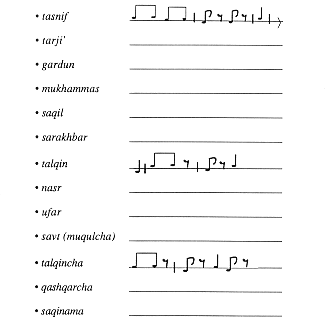
All these shu'bas differ from one another according to their specific asaszarb, which, in shashmaqam terms, is called usul (principles). The asasi shu'bas have the same name as their usuls, i.e., the usuls and the main shu'bas have the same name. Along the shashmaqam, the shu'bas which share the same name but are related to different maqams have the same usuls. Here are those usuls:
It is significant to note that the ilavagi part of the maqam does not have an independent usul and, usually, finds its base either in the nasr, or in the usuls of tasnif and tarji' (in the mushkilat type). Or perhaps it assumes the name of the zarbi system of shashmaqam. As it was mentioned, the name of the zarbi system is usul. Usul, an Arabic word, is the plural of asl, indicating that the shu'bas that have specific usuls are basic forms of the cyclical structure of the maqams. Or, perhaps, it refers to the important role of the zarbi system in the composition of shashmaqam.
Furthermore, the use of usul as the asaszarb of each shu'ba of the maqam cycle corresponds to the rich system of 'aruz that the poet uses in the composition of his ghazals (sonnets). This composition, of course, is not my personal choice, it is based on a scientific principle. Shashmaqam is recognized as a product of the music and the poetic heritage of the Tajiks, because in it we can observe the important facets of poetry and music combined.
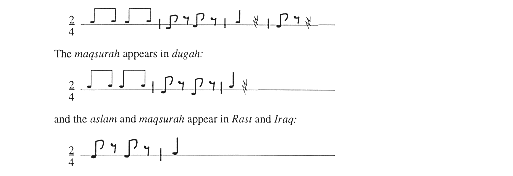
An analysis of shashmaqam indicates that its solid cyclical structure owes a great deal to the poetic system underlying it. The use of some of the rules of 'aruz in shashmaqam is easily observable. These include hazf, afzaish, and tabdil.4 The usuls of tasnif take three different forms in shashmaqam. Its main or full form appears in the buzruk, nava, and sigah:
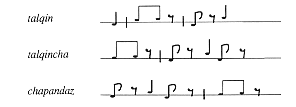
In the usuls of the talqin group (additional forms of this are talqincha and chapandaz) transform the 'aruz into the following:
Our observation of the qualities of 'aruz at the various levels of shashmaqam brings us to the conclusion that the composition of the shu'ba has some of the characteristics of the ghazal genre.5 The compositional part of the shu'ba is never smaller than the usul, the volume of the musical phrases in the shu'ba depends on the volume of the usuls. The basic structural units of the shu'ba in the structure of the bayt are similar.6 In summary, 'aruz plays a major role in the establishment of the cyclical principles of shashmaqam. Furthermore, more investigation is needed in discovering the interrelationship between 'aruz and shashmaqam.
Returning to our discussion of the structure of shashmaqam, below we shall enumerate the various maqams and their related shu'bas:
Buzruk or Nasrullah-i maqam:
Rast, Navruz, Saba, Talqincha of Navruz of Saba
The Nava maqam includes:
Maqam-i Araz (in mushkilat), Araz-i Nava, Hussaini (in nasri form).
The Dugah maqam includes:
Pishrav, Sama of dugah (in
The Sigah maqam includes:
Khafif of Sigah (in mushkilat), Navruz of Khara, Navruz of Ajam (in nasri form).
The Iraq maqam includes:
Chanbar, Farfar (in mushkilat), Mukhayyar of Iraq (in nasri form).
The place of taranah in the maqam drama, i.e., in the middle of the structure, is quite prominent. With its varying size, taranah appears among the basic (asasi) shu'bas and, due to its melody and other characteristics opposes the previous shu'ba. The last taranah, however, affects the next usul and serves as its "overture." The taranahs that precede or follow the ufar are called "the first" and "the last" suparish, respectively and are used in the usuls overture. Such a contribution by the taranah enhances the dramatic nature of the maqam and aids its cyclical composition.
The asasi and ilavagi shu'bas of nasr have the same internal structure. Their components include: sarkhat (overture), miyankhat, dunasr; avj, and faravard. Except for avj,7 each one contains two musical chords and uses only one bayt of a ghazal. The well-known maqam scientist, I. R. Rajabov, describes khat as follows: "... a melody for which one bayt (or two misra's of a ghazal ) is used."8 According to their own compositional function, the first three khats: sarkhat, miyankhat, and dunasr show the main melodic content of the mode in its full form and fortify the position of the tonic value of the maqam. The expanse of the degrees of music and the manner in which it is brought into existence (by the interconnection of the taranahs) is also a function of these first three khats. The amount of the namud, theoretically speaking, is between two and three. The shu'ba is concluded with the final faravard khat. This concluding khat, based on the sarkhat, after various uses, establishes the basic maqam, and using the descending loops, takes the melody to the register of the overture. The structural makeup of the khat, which includes two bands and ahangs, is similar to the bayt. There are two types of combinations of misra's and melody in a maqam. This kind of correspondence creates two types of lines. The first one is related to a special overture's shu'bas; the second relates to all the other shu'bas. The above statement can be illustrated as follows:
As a result, they assist in the varied structure of the composition of the nasri shu'ba. Even if there were to be an inclusion of similar nasri shu'bas in the maqam, the internal structure would not change.
We shall now consider one structure in the makeup of the shu'ba. This structure has two forms: khana and bazgui, and is constructed on the basis of consecutive occurrence. One of the most prevalent moves of melody in mushkilat is called pishrav, which creates the "step by step" composition of the melody. Khana and bazgui play different roles in the shu'ba. Khana embodies the fluctuation quality of th constant. Bazgui, as is evident from its name, is the constant element in the shu'ba. It is a repeatable element in the composition. It is repeated throughout the piece (after several khanas) in a regular fashion. With the increase in the numbers of the khanas (1, 2, 3 ... 12...), both the range of the sound and the volume expand. At this time, the dramatic effect of the piece is created, in the main, by the khana. The dramatic qualities of the bazgui establish the theme and the tonic value of the piece. There are, of course, scientists in the field of music who do not allow bazgui a place in the gardun and saqil.9 But an analysis of shashmaqam indicates that both gardun and saqil are involved in the principle underlying the fluctuating and the repetitive aspects of the composition. For example, in the saqil shu'bas, the unchanging but repetitive band is called farsaqil.10
The well-known maqam specialist, Fazliddin Shahabov, shows that a comparison between farsaqil and bazgui can point to some of their distinguishing features.11 And we believe that this very difference is the cause for their distinct names. Therefore, even if calling this bazgui against the rules of shashmaqam, its compositional function brings the farsaqil within the purview of bazgui.
We must understand that in spite of its name, shashmaqam as a mode system, is not simply composed of six modes. It is a complex of systems of many groups and modes of shu'bas centered on six basic modes.12 These six basic modes then, following theoretical rules, are instrumental in creating countless additional forms. In present-day music, we observe the following modes:
Uzzal, Sarv-i Naz, Iraqi, Bukhara
Rast: Ushshaq, Saba, Panjgah
Nava: Bayat, Araz, Hussaini
Dugah: Chargah, Araz-i dugah, Hussaini dugah
Iraq: Mukhayyar
It is apparent that in the formation of the shashmaqam system, tanbur has played the main function. Therefore, we can identify the tonality involved on the handle of this instrument without encountering any difficulty.13 In the shashmaqam cycle these maqams are varied. Their status can be outlined as follows:
1st level: Buzruk, Rast, Nava, Dugah, Sigah, Iraq-basic themes
2nd level: Uzzal, Ushshaq, Chargah, Muhaiyar-miyanparda themes
3rd level: Saba, Panjgah, Araz, Hussaini-shu'bas.
Another characteristic of the system of modes becomes apparent in the context of the namud. Usually there are nine namuds in shashmaqam. And those are the ones that are in practical use. But, from a theoretical point of view, each maqam, irrespective of its surface value, can possess a namud. Namud is a melody that assumes the specific characteristics of the maqam and, as a result, can be an indicator of its internal structure. That is why, in unusual cases, a melody can be reconstructed without access to its original maqam. I. Rajabov, understanding the main characteristic of the namud, uses the Uzzal as an example and records the final "jumping" at the fourth space. He further identifies this with the etymology of the word "Uzzal."14 This form of the fourth fasila is within the Uzzal namud. We can also observe the special fasilas of each maqam in other namuds as well.15 The namud has developed in shashmaqam according to the rules of the latter. Its use, whether solo or in a group, becomes possible according to the common roots of the maqams. In the construction of the shu'bas of the maqams, we encounter the namuds only in avj. This, too, follows a special rule. We can evaluate the use of the namuds as a part of the theoretical study of music as modulations. We identify this modulation, which is specific to shashmaqam, as a kind of versatile (salis) modulation. The first namud is very close to the first mode. As the number of the namuds increases, "the family" of the namud's theme becomes more and more distant from the main theme. Indeed, the existence of specific rules regarding the use of the namud requires knowledge. Therefore, the transformation of a new namud in a maqam can be accomplished only by skillful and experienced maqam specialists.16
In Tajik music, shashmaqam is a basic theoretical system of music. The past forms of this musical phenomenon are related to the davazdahmaqam of the Middle Ages and the seven pardas of the time of the Sassanians.17 Throughout centuries, the maqams have been at the center of scientific achievements. Today shashmaqam is awaiting an in-depth investigation by the scientists of the exact science of music.
Selected Bibliography
Related topic: From the Hymns of Zarathustra to the Songs of Borbad
Top of the page
Home
| Courses